Understanding the Power of a Teacher Cover Letter
A teacher cover letter is more than just a formality; it is your first opportunity to make a lasting impression on a potential employer. It serves as your personal introduction, allowing you to showcase your passion for teaching, highlight your relevant skills and experiences, and explain why you are the perfect fit for the specific teaching position. A well-crafted cover letter can significantly increase your chances of securing an interview and ultimately landing your dream job. In a competitive job market, where many qualified candidates are vying for the same positions, a compelling cover letter can set you apart from the competition. It allows you to go beyond the basic information presented in your resume and provides a platform to articulate your teaching philosophy, demonstrate your commitment to student success, and convey your unique qualifications in a clear and concise manner. Your cover letter should be tailored to each specific job application, highlighting the skills and experiences that align with the school’s needs and values.
What is a Teacher Cover Letter
A teacher cover letter is a formal document that accompanies your resume when applying for teaching positions. It serves as an introduction and allows you to elaborate on your qualifications, skills, and experiences in a way that a resume alone cannot. Unlike a resume, which provides a summary of your professional history, a cover letter allows you to express your personality, teaching philosophy, and enthusiasm for the role. The purpose of a cover letter is to persuade the hiring committee that you are a strong candidate for the position. It is your chance to showcase your passion for teaching, highlight your relevant skills, and explain why you are the right fit for the specific school or district. A well-written cover letter will capture the reader’s attention, demonstrate your understanding of the school’s needs, and make a compelling case for why you deserve an interview. Think of your cover letter as a sales pitch, where you are selling your skills and experience to potential employers. The goal is to convince them that you are the best candidate for the job, and that hiring you would be a valuable investment for the school.
Key Components of a Winning Cover Letter

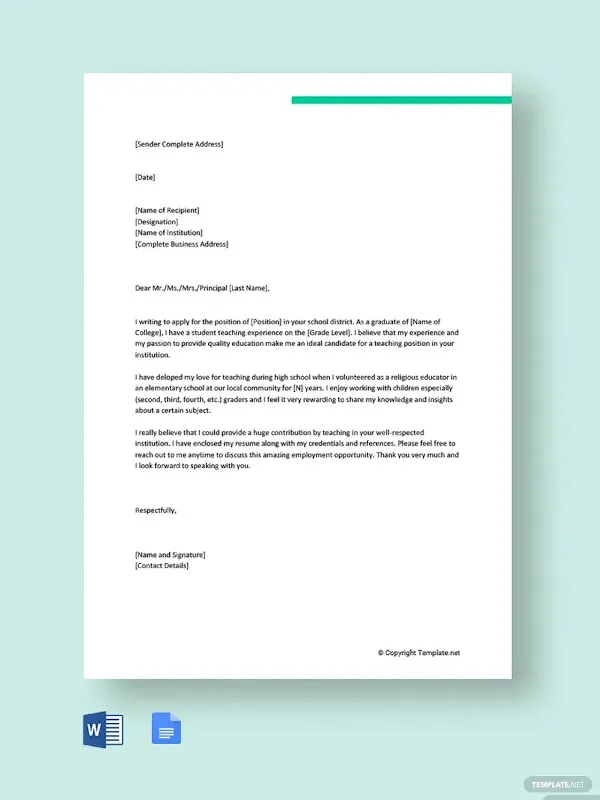
A winning teacher cover letter is composed of several key components that work together to create a persuasive and professional document. These elements include a well-structured header with your contact information, an engaging opening paragraph, compelling body paragraphs that highlight your qualifications and experiences, and a strong closing paragraph with a call to action. Each component of your cover letter should be carefully crafted to showcase your strengths and demonstrate your suitability for the teaching position. Consider the cover letter to be an extension of your resume. It should complement your resume by providing a deeper understanding of who you are and what you can bring to the school. A well-organized cover letter is easy to read and makes it easy for the hiring committee to understand who you are. It is crucial to keep your cover letter concise, focused, and tailored to the specific job and school. You should always proofread carefully for any grammatical errors.
Header & Contact Information
The header of your teacher cover letter is the first thing a potential employer will see, so it’s important to make a professional and organized impression. This section typically includes your name, address, phone number, and email address. It is important to use a professional email address; avoid using nicknames or informal language. This information should be clearly displayed at the top of the document. Ensure that the contact information is accurate and up-to-date so that potential employers can easily reach you. It is a simple way to make a strong first impression and demonstrates your attention to detail. Your header should also include the date and the recipient’s information, such as the name and title of the hiring manager, the school’s name, and the school’s address. Always make sure the person you’re addressing your letter to works at the school you are applying to.
Your Name and Contact Details
Start your header with your full name, centered or left-aligned. Directly below, include your complete mailing address, followed by your phone number and a professional email address. Double-check that all the contact information is correct and easily accessible. This is how the hiring manager will reach out to you, so accuracy is paramount. Consider using a simple, clean font for your contact information to maintain a professional look. Ensure that your email address is appropriate and reflects your professionalism. Avoid using informal nicknames or unprofessional language in your email address.
Date and Recipient’s Details

Following your contact information, include the date you are writing the letter. Then, on the left side of the page, address the letter to the hiring manager. If you know the name, title, and school’s address, include it. If you do not know the hiring manager’s name, try to find it through the school’s website or by calling the school’s office. If you cannot find the name, use a general salutation such as ‘Dear Hiring Committee’. Always tailor the recipient’s details to the specific job application. Research the school’s website or contact the school directly to get the correct information.
The Opening Paragraph Make a Strong First Impression
The opening paragraph of your teacher cover letter is your first opportunity to capture the reader’s attention. Start by clearly stating the position you are applying for and where you saw the job posting. Immediately express your enthusiasm for the opportunity and the school, demonstrating your genuine interest. Briefly mention your key qualifications and experiences that align with the school’s needs and the requirements of the teaching position. This paragraph should be concise, engaging, and set the tone for the rest of the letter. Ensure that the opening paragraph is tailored to the specific job and school. Show the hiring manager that you have put in the effort by researching the school’s values and mission. This helps make the reader feel like they are talking to an individual instead of a mass-produced cover letter.
Expressing Your Enthusiasm
In the opening paragraph, express your enthusiasm for the teaching position and the specific school. Show your genuine interest in the opportunity and state why you are excited about the prospect of teaching at that particular school. Demonstrate that you are not just looking for any teaching job but that you are specifically drawn to this school’s mission, values, or programs. This enthusiasm should be genuine and reflect your passion for teaching and your belief in the school’s educational philosophy. Use words and phrases that convey your excitement and dedication. Avoid generic statements and instead, personalize your message to reflect your specific interests in the school.
Referencing the Job and School

In the opening paragraph, clearly state the position you are applying for and where you found the job posting. This immediately helps the hiring manager understand the purpose of your letter. Mention the school’s name and briefly highlight what attracts you to their institution. You can do this by referencing the school’s mission, values, or any specific programs or initiatives that resonate with your teaching philosophy. This demonstrates your understanding of the school’s needs and requirements and indicates that you have done your research. Tailoring your cover letter to the school and job position is a simple, yet effective, way to show you are the right fit.
Highlighting Your Qualifications and Skills
The body paragraphs of your teacher cover letter are where you showcase your qualifications, skills, and experiences. This is your opportunity to demonstrate why you are the perfect fit for the teaching position. Highlight your relevant experiences, skills, and abilities, providing specific examples to support your claims. Connect your qualifications to the job requirements and the school’s needs. Emphasize your teaching philosophy, your approach to classroom management, and your commitment to student success. Use strong action verbs to describe your accomplishments and responsibilities. Be clear and concise, avoiding jargon and overly technical language. Make sure to tailor the information to each job application.
Showcasing Relevant Experience
Provide specific examples of your teaching experience. Describe your previous teaching roles, internships, or volunteer experiences, highlighting the responsibilities you held, the skills you developed, and the impact you made. Focus on the experiences most relevant to the teaching position you are applying for. Quantify your achievements whenever possible, using numbers to demonstrate your effectiveness. Include details about the grade levels you have taught, the subjects you have taught, and any special programs or initiatives you have been involved in. For each experience, provide a brief overview of your responsibilities and the positive outcomes you achieved.
Demonstrating Skills and Abilities

Highlight the key skills and abilities that make you an effective teacher. This can include classroom management, lesson planning, curriculum development, student assessment, communication, collaboration, and adaptability. Provide specific examples of how you have demonstrated these skills in your previous teaching roles. Describe your approach to creating a positive and engaging learning environment. Explain how you differentiate instruction to meet the needs of diverse learners. Discuss your ability to communicate effectively with students, parents, and colleagues. Show how you collaborate with other teachers and staff members to achieve common goals. Focus on the skills and abilities that are most relevant to the job requirements and the school’s needs.
Quantifying Your Achievements
Whenever possible, quantify your achievements to demonstrate the impact you have made. Instead of saying, ‘I improved student test scores’, state, ‘I improved student test scores by 15%’. Use numbers, statistics, and data to provide concrete evidence of your effectiveness. For example, you can mention the number of students you have taught, the percentage of students who met or exceeded learning objectives, or any awards or recognitions you have received. Quantifying your achievements adds credibility to your claims and helps the hiring manager understand the positive impact you have had on students’ learning outcomes. This is a simple and effective way to show that you can get results.
Tailoring Your Letter to the School
Tailoring your cover letter to the specific school you are applying to is crucial to stand out from the competition. Research the school’s mission, values, programs, and any specific needs or requirements. Demonstrate your understanding of the school’s culture and how your skills and experiences align with their educational philosophy. Address any specific requirements mentioned in the job posting, such as experience with a particular curriculum or technology. Showing that you’ve researched the school and understand their specific needs indicates your genuine interest and increases your chances of getting hired. A tailored cover letter shows the hiring manager that you’ve taken the time to understand their school and that you are not simply sending out a generic application.
Researching the School’s Mission and Values

Before you begin writing your cover letter, research the school’s mission statement, values, and educational philosophy. This information is usually available on the school’s website or through other online resources. Identify what the school prioritizes, such as student achievement, character development, or community involvement. Then, align your skills, experiences, and teaching philosophy with the school’s mission and values. Mention specific programs or initiatives the school offers that align with your interests or expertise. Demonstrating that you understand and share the school’s core values shows that you are a good fit for their community and that you are prepared to contribute to their goals.
Addressing Specific Needs and Requirements
Carefully review the job posting and identify any specific requirements or qualifications the school is looking for. These may include experience with a particular curriculum, technology, or student population. Address these requirements directly in your cover letter. Use specific examples to show how you meet the school’s needs. For example, if the job posting mentions a need for teachers with experience in differentiated instruction, provide examples of how you have successfully differentiated instruction to meet the needs of diverse learners in your previous teaching roles. Show how your skills, experiences, and teaching philosophy align with the specific needs and requirements of the teaching position.
The Closing Paragraph and Call to Action
The closing paragraph of your teacher cover letter should leave a lasting positive impression on the hiring manager. Express your gratitude for their time and consideration and reiterate your enthusiasm for the opportunity. Clearly state your availability for an interview and provide your contact information. End with a strong call to action, encouraging the hiring manager to contact you to discuss your qualifications further. Ensure that the closing paragraph is polite, professional, and leaves the reader with a positive and memorable impression. Do not use generic phrases such as ’thank you for your time’. Instead, personalize your thank you, referencing something you discussed in the letter. This will show that you truly read the job posting.
Expressing Gratitude and Offering Availability

In the closing paragraph, express your gratitude for the hiring manager’s time and consideration. Thank them for taking the time to review your application and for considering you for the position. Reiterate your enthusiasm for the opportunity and your interest in the school. Clearly state your availability for an interview, and provide your contact information again in case it is needed. Be polite and professional in your closing, and leave the reader with a positive impression of your professionalism and your commitment to the teaching profession. Showing gratitude and providing contact information is crucial.
Including a Strong Call to Action
End your cover letter with a strong call to action. This is a statement that encourages the hiring manager to contact you to discuss your qualifications further. Instead of simply stating, ‘I look forward to hearing from you’, try something more specific. For example, you could say, ‘I am eager to discuss how my skills and experiences align with the needs of your students and the goals of your school, and I welcome the opportunity to speak with you further’. Make sure to express your enthusiasm for the opportunity and reiterate your interest in the school. End your cover letter with a professional and engaging tone. This will help the hiring manager remember your cover letter, and will hopefully make you stand out from the competition.
Formatting and Proofreading Your Cover Letter
The formatting and proofreading of your teacher cover letter are critical for making a professional impression. Choose a clean, easy-to-read font and use a standard format. Proofread your letter carefully for any grammatical errors, spelling mistakes, or typos. Ensure that the letter is well-organized, with clear headings and paragraphs. A well-formatted and error-free cover letter shows that you pay attention to detail and are committed to presenting yourself in a professional manner. Consider asking a friend or colleague to proofread your letter before submitting it. Do not rely on the spell checker alone, since it will not catch every mistake. Pay attention to every aspect of your cover letter, from the font you choose to the words you write.
Choosing the Right Format

Choose a professional and easy-to-read format for your teacher cover letter. Use a standard font, such as Times New Roman, Arial, or Calibri, in a font size between 11 and 12 points. Maintain consistent margins throughout the document. Use single spacing within paragraphs and double spacing between paragraphs. Left-align the text, unless the school has requested a different format. Use clear headings and subheadings to organize your content and make it easier to read. Avoid using excessive colors, graphics, or complex formatting, as they can distract from the content of your letter. Stick to a clean and professional layout that allows the reader to focus on your qualifications and experiences.
Proofreading for Errors
Proofread your teacher cover letter carefully for any grammatical errors, spelling mistakes, or typos. Errors can undermine your credibility and make it seem like you lack attention to detail. Read your letter multiple times, and consider reading it out loud to catch any mistakes you might have missed. Use a spell checker, but don’t rely on it entirely, as it may not catch all errors. Ask a friend, colleague, or career advisor to review your letter for any errors or areas for improvement. Ensure that your cover letter is free of errors and presents you in a professional and polished manner. This is a simple step that makes a big difference in your cover letter.