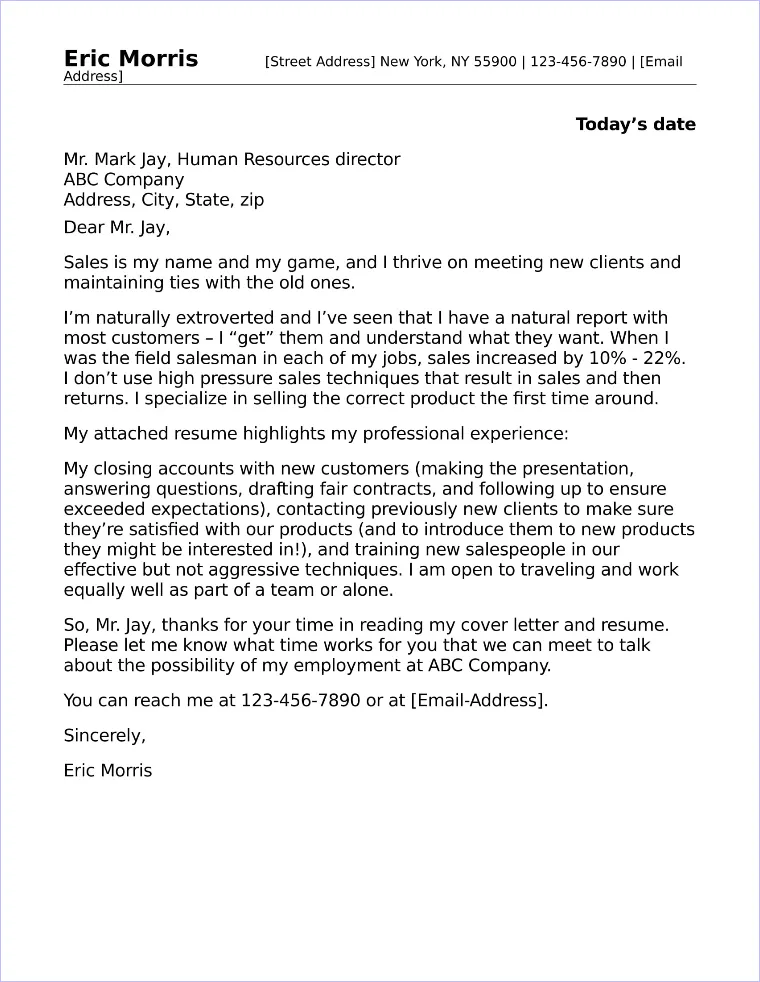
Why a Sales Cover Letter Matters
In the competitive world of sales, a well-crafted cover letter can be the key to unlocking your dream job. While your resume provides a snapshot of your experience and skills, the cover letter offers an opportunity to showcase your personality, enthusiasm, and how you align with the specific role and company. It is your chance to make a strong first impression, highlighting your unique value proposition and demonstrating why you are the ideal candidate. A compelling sales cover letter goes beyond simply restating your resume; it tells a story, demonstrating your ability to connect with potential employers and persuade them to consider you further. A well-written cover letter makes you stand out from other applicants, increasing your chances of getting an interview.
The Purpose of a Sales Cover Letter
The primary purpose of a sales cover letter is to persuade the hiring manager that you are the right fit for the job. It allows you to introduce yourself, explain why you are interested in the position, and provide specific examples of your achievements and skills. Unlike a resume, a cover letter provides context, allowing you to tailor your message to the specific requirements of the role and the company’s values. This is your chance to articulate how your experience, skills, and personality make you a valuable asset to their sales team. Moreover, the cover letter gives you an opportunity to address any potential gaps in your resume or explain any career transitions you may have made. By using this opportunity, you show the hiring manager your professionalism, attention to detail, and communication abilities, all essential qualities for a successful sales professional.
Key Components of a Sales Cover Letter

A successful sales cover letter comprises several key components, each designed to capture the reader’s attention and convince them of your suitability for the role. These elements work together to create a cohesive and compelling narrative. By including each of these key components, your sales cover letter will be informative, engaging, and professional. Following these key elements will help ensure your cover letter is both memorable and impactful.
Header and Contact Information
The header of your cover letter is the first thing the hiring manager will see, so it needs to be professional and easily readable. It sets the tone for the entire letter. Ensure that your contact information is up-to-date and accurate. This includes your full name, phone number, email address, and optionally, your LinkedIn profile URL. This information makes it easy for the hiring manager to reach out to you for an interview. Maintaining professionalism and accuracy in the header shows your attention to detail and commitment to presenting yourself in a positive light.
Formatting the Header
Keep the header clean and organized. Use a font that is easy to read, such as Arial, Calibri, or Times New Roman, and maintain a consistent font size (10-12 points). The header should be aligned to the left or right, depending on your preference, but be consistent throughout the document. Ensure there is enough spacing between each line of contact information for readability. Avoid any unnecessary graphics or designs that might distract from your essential details. The goal is to create a professional, clean look that immediately conveys your contact information.
Professional Salutation

A strong salutation is crucial for making a good first impression. Use a professional greeting that sets the tone for the rest of your letter. Avoid generic greetings like “To Whom It May Concern.” Instead, try to find the name of the hiring manager or the person responsible for sales hiring. If you can’t find a specific name, use a more specific greeting like “Dear Sales Team” or “Dear Hiring Manager”. A personalized greeting shows that you have taken the time to research the company and understand their organizational structure, adding a touch of personalization that is very valuable.
Addressing the Hiring Manager
Researching the hiring manager’s name and using it in your salutation can significantly increase the impact of your cover letter. Look for the hiring manager on the company’s website or LinkedIn. If you can’t find a name, use a general but respectful greeting. Addressing the hiring manager by name demonstrates that you have done your homework and are genuinely interested in the opportunity. It makes your cover letter feel more personal and shows your attention to detail, which are valuable traits in sales.
Opening Paragraph Grabbing Attention
The opening paragraph is your chance to grab the hiring manager’s attention and make them want to read more. Start with a strong statement about why you are excited about the role, mentioning the company by name. Briefly state your relevant experience and how it aligns with the job requirements. You can also use a compelling anecdote or a key achievement to demonstrate your sales abilities. Make sure the opening paragraph is concise, enthusiastic, and focused on the value you can bring to the company. Avoid generic phrases and instead, show a clear connection between your skills and the job’s needs. This paragraph sets the tone for the rest of your letter and encourages the reader to continue.
Highlighting Your Achievements

This section is where you showcase your accomplishments. Focus on sales achievements that are relevant to the job you’re applying for. Use the STAR method (Situation, Task, Action, Result) to describe your accomplishments. This method helps you provide context, explain your role, and quantify the impact of your actions. For example, instead of saying “I increased sales,” state “In my previous role at XYZ Company, I implemented a new sales strategy that resulted in a 20% increase in quarterly revenue.” Highlighting your achievements demonstrates your ability to deliver results, which is crucial in sales. Use specific examples to show your expertise and the value you can bring to the new role.
Quantifying Your Accomplishments
Quantifying your accomplishments is key to making your achievements more impactful. Use numbers, percentages, and specific data to demonstrate your success. For instance, instead of saying “I improved customer satisfaction,” write “I increased customer satisfaction scores by 15% through a new customer service initiative.” Similarly, instead of “I exceeded sales targets,” state “I consistently exceeded sales targets by an average of 10% each quarter.” Using quantifiable results shows the hiring manager the direct impact you’ve made in previous roles, making your claims more credible and persuasive. Highlighting numbers helps differentiate you from other candidates by demonstrating your value and capabilities.
Showcasing Relevant Skills
In this section, highlight the skills that are most relevant to the sales position. Review the job description carefully and identify the skills the employer is looking for. Tailor your cover letter to match these specific requirements. Some essential skills to showcase include communication, negotiation, problem-solving, and customer relationship management (CRM) proficiency. Provide examples of how you’ve used these skills in previous roles and what results you achieved. The more closely your skills align with the job requirements, the more likely you are to capture the hiring manager’s attention. Demonstrate how your skills translate into success, showing the value you bring to the team.
Sales Techniques

Sales professionals need to demonstrate their knowledge of various sales techniques. Mention techniques such as the consultative selling, solution selling, or account-based selling, depending on the requirements of the role. Illustrate how you have successfully used these techniques in the past, providing examples of the strategies you employed and the outcomes achieved. For instance, you might describe how you used a consultative approach to understand a client’s needs, leading to a successful close. Emphasize any training or certifications you have related to sales methodologies. Highlighting specific techniques demonstrates your sales acumen and how you approach different sales challenges.
Communication and Interpersonal Skills
Effective communication and interpersonal skills are vital for sales success. Highlight your ability to build rapport, actively listen, and articulate ideas clearly. Provide examples of how you have built strong relationships with clients and colleagues. Mention your skills in negotiation, conflict resolution, and persuasion. Salespeople must be able to communicate effectively in various formats, including written, verbal, and presentations. Illustrate how you have used these skills to create positive customer experiences and build trust. This section shows the hiring manager how well you can interact with customers and colleagues, and how you build lasting relationships.
Expressing Enthusiasm and Fit
Convey your enthusiasm for the specific role and the company in this section. Explain why you are interested in the company, what attracts you to the role, and how your values align with the company’s mission. Show that you have researched the company and understand their products, services, and target market. Express your confidence in your ability to succeed in the position and contribute to the company’s goals. Demonstrate that you are excited about the opportunity and the potential to make a significant impact. Your enthusiasm will show the hiring manager that you are passionate about the opportunity and are a good fit.
Closing Paragraph

The closing paragraph is your final opportunity to leave a lasting impression. Summarize your key qualifications and reiterate your interest in the position. Thank the hiring manager for their time and consideration. Express your eagerness to discuss your qualifications further and reiterate your availability for an interview. Maintain a professional tone, and ensure that your closing paragraph leaves the hiring manager with a positive impression of your candidacy. End on a strong, confident note to encourage them to contact you.
Call to Action and Next Steps
Include a clear call to action to encourage the hiring manager to take the next step. Request an interview and provide your contact information again. Make it easy for the hiring manager to contact you by reiterating your phone number and email address. Express your anticipation to learn more about the opportunity and discuss how your skills and experience align with the company’s needs. A clear call to action ensures that you end on a proactive note. It shows that you are eager for the opportunity and ready to proceed.
Formatting and Proofreading
Formatting and proofreading are crucial to ensure your cover letter is professional and polished. A well-formatted cover letter is easy to read and shows that you pay attention to detail. Proofreading ensures that your letter is free of errors, which could otherwise undermine your credibility.
Choosing the Right Font and Layout

Select a professional and easy-to-read font. Some common choices include Arial, Calibri, or Times New Roman, with a font size of 10-12 points. Use standard margins (1 inch on all sides) and single-space the body of the letter. Use a clean, organized layout to make the letter easy to read, with clear headings, bullet points, and ample white space. Avoid using overly decorative fonts or excessive formatting, which can distract from the content. Aim for a clean, professional appearance that reflects your attention to detail.
Proofreading and Editing for Errors
Proofread your cover letter carefully for any grammatical errors, spelling mistakes, or typos. Errors can undermine your credibility, so it is very important to double-check all details. Read the letter out loud to catch any awkward phrasing or sentences. Consider having a friend, colleague, or career counselor review the letter. This will provide a fresh perspective and help you identify any errors that you might have missed. Use a grammar checker tool to ensure accuracy. A well-proofread cover letter demonstrates your attention to detail, showing that you are serious about the opportunity.
Adapting the Cover Letter for Specific Jobs
Tailor your cover letter to each specific job you apply for. Review the job description carefully and identify the key requirements and skills that the employer is looking for. Customize your cover letter to highlight your relevant experience and achievements. Mention the company’s name and demonstrate your understanding of their products, services, and target market. The more you tailor your letter to the specific job, the more likely it is to catch the hiring manager’s attention. Demonstrate that you have taken the time to understand the role and how your skills align with the company’s needs. This customization will greatly improve your chances of getting an interview. Adapt your letter by highlighting relevant experiences, achievements, and skills. Showing how you’ve solved problems and achieved success in similar roles increases your chances of being invited for an interview.