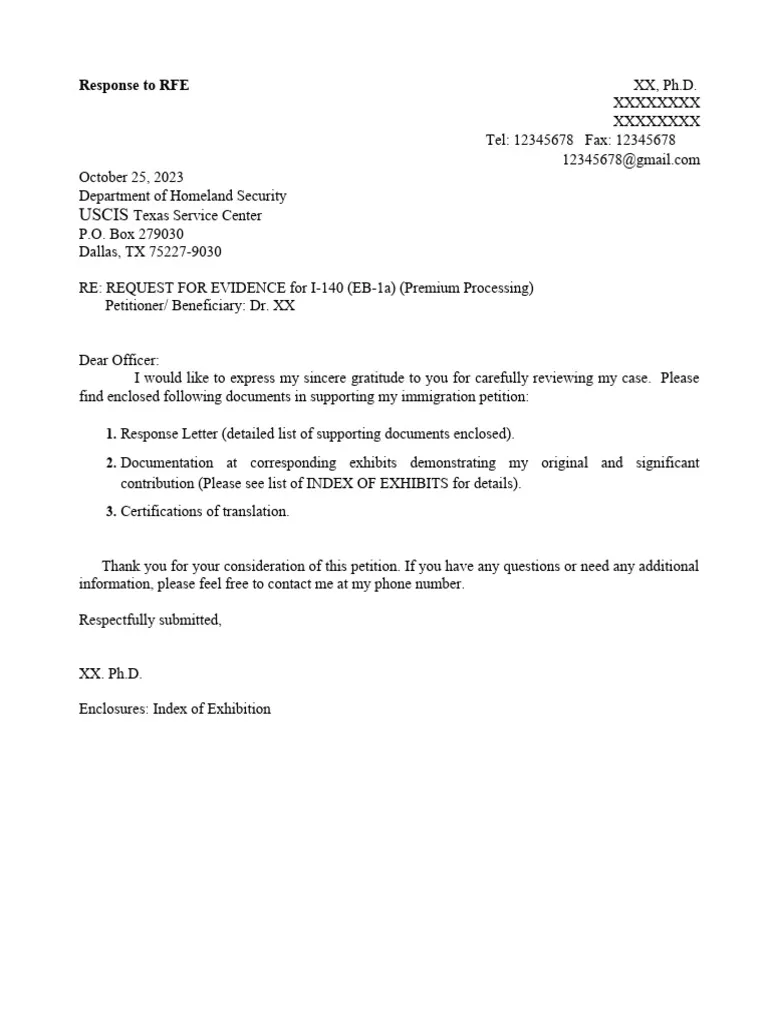
Understanding the RFE Response Cover Letter
An RFE response cover letter is a critical document in the immigration process, serving as a formal introduction and explanation of the evidence submitted in response to a Request for Evidence (RFE) issued by the United States Citizenship and Immigration Services (USCIS). This letter acts as a roadmap, guiding the USCIS officer through your submission and ensuring they understand the context and relevance of the documents provided. The quality and clarity of your cover letter can significantly impact the outcome of your case. A well-crafted cover letter not only organizes the information but also persuasively argues your case, making it easier for the officer to make a favorable decision. This is a crucial step, and neglecting it or submitting a poorly written letter can lead to delays or even denials.
What is an RFE and Why Is It Important?
A Request for Evidence (RFE) is a formal communication from USCIS asking for additional information or documentation to support an immigration application or petition. RFEs are issued when the initial submission lacks sufficient evidence to make a decision. The RFE specifies the missing information, the type of evidence required, and a deadline for submission. Responding to an RFE is crucial because failure to do so, or failing to respond adequately, can result in the denial of your application. The importance of an RFE response lies in its ability to clarify doubts, provide missing details, and strengthen your case. A well-prepared response demonstrates your commitment to the process and increases your chances of a positive outcome. It provides you with an opportunity to address any concerns the USCIS has, offering a chance to correct oversights or provide additional context.
Key Components of an RFE Response Cover Letter

A comprehensive RFE response cover letter includes several essential components, each serving a specific purpose. These elements work together to present a clear, organized, and persuasive case. Omitting any of these key parts can weaken your response, so it’s crucial to address each aspect carefully. The goal is to make the USCIS officer’s job easier by providing all the necessary information in a clear and accessible format. This structured approach demonstrates professionalism and attention to detail, further supporting your application. Preparing these elements in advance can save time and reduce the stress associated with responding to an RFE.
Personal Information and Contact Details
Begin by providing your full name, address, and contact information. This allows the USCIS to easily identify and contact you. Ensure that the address provided is current and the same as the one on your application. Include your email address and phone number to facilitate communication. Double-check the accuracy of this information to prevent any miscommunication or delays in receiving important updates about your case. This section is the foundation for all future communication with USCIS, so accuracy is critical.
USCIS Receipt Number
Include the USCIS receipt number at the top of your cover letter. This number is a unique identifier for your case, allowing the USCIS to quickly locate your file. The receipt number is usually found on the notice you received from USCIS acknowledging the filing of your application. By including it prominently, you help the officer associate your response with the correct application. This minimizes the risk of your response being misplaced or processed incorrectly, which could lead to significant delays. Always double-check the accuracy of this number.
Date of the Letter

Always include the date on which you are writing the letter. This helps USCIS track when your response was submitted, which is essential when the RFE has a deadline. The date also helps in referencing the document later. The date should be in the standard format to avoid any confusion. Place this date at the top, alongside other identifying information, to improve clarity and ensure that the processing officer can quickly assess the timeline of your response. The date provides a clear record of when your response was created and sent.
Formal Salutation
Address the USCIS officer formally. Use “Dear USCIS Officer,” or “To Whom It May Concern” if you do not know the officer’s name. Using a formal salutation shows respect and professionalism. Avoid informal greetings or slang, as this is a legal document. A well-chosen salutation sets the tone for your entire response, conveying your seriousness and attention to detail. Always maintain a respectful tone throughout the letter to build a positive impression. A professional salutation creates a sense of trust and respect.
Addressing the RFE’s Specifics
Clearly identify the specific RFE that you are responding to, mentioning the date of the RFE and the USCIS office that issued it. Briefly state the purpose of your letter to provide a clear context for the officer. A concise introduction helps the officer immediately understand the context of your response. Make it easy for the officer to connect the response with the original RFE. Avoid being ambiguous and clearly state that you are responding to a specific RFE, ensuring the officer understands immediately the letter’s purpose. This ensures that the processing officer knows what is being addressed in the submission.
Highlighting the RFE’s Specifics

Briefly mention the nature of the RFE. Was it about missing documents, clarification of information, or something else? Give the USCIS officer a quick summary of the core issues that need to be addressed. Keep this section brief and focused on the main points of the RFE. Summarizing helps the officer recall the original RFE and focus on the key aspects requiring attention. This demonstrates that you understand the nature of the request and are prepared to respond to it comprehensively.
Reiterating the RFE’s Questions
Before diving into your answers, it’s helpful to reiterate the questions or requests made by the USCIS. This ensures that you are addressing each point in the RFE. Number each question or request to help the officer follow along. This also confirms that you have carefully read and understood the requirements. It helps the officer see the direct links between the RFE and your response, making their job more efficient. By restating the questions, you confirm your understanding of the request.
Presenting the Supporting Evidence
Clearly state the specific documents and evidence that you are providing in response to each question from the RFE. List each piece of evidence and explain how it relates to the question. Make it easy for the officer to find the information. Refer to the documents by their titles or brief descriptions. Ensure that the order of the evidence matches the order of the questions. This demonstrates that you have carefully reviewed each point in the RFE and are responding to it. The evidence must support your claims and answer all questions from USCIS.
Organizing Documents Effectively

Organize your documents logically. This is usually done by section, matching each document with the question it addresses. Consider using tabs or dividers to separate different sections. A well-organized submission is easier to review and increases the likelihood of a favorable decision. It shows that you are organized and diligent, improving your application’s credibility. Ensure that all documents are clear, legible, and in the appropriate format. Make the review process simple for the USCIS officer. Effective organization helps the officer navigate the documents efficiently.
Evidence for [Specific RFE Request]
This section provides details of the specific evidence provided for each request made by USCIS. The information should directly address the points raised. Explain the relevance of each document. This demonstrates your understanding of the RFE and strengthens your case. Organize the evidence by the specific requests. Explain what the document is. Be clear, thorough, and organized in this section. Provide sufficient detail to enable the officer to easily understand how the provided evidence addresses the specific request.
Evidence for [Another Specific RFE Request]
Continue the same process for all requests outlined in the RFE. Repeat the above steps. Ensure you provide all of the evidence needed for each specific request from USCIS. The most important part of the RFE response is the information presented in this section. Ensure all requests are addressed completely.
Crafting the Body of the Cover Letter
The body of your cover letter is the core of your response. It should be well-structured, providing clear and concise answers to each question or request in the RFE. The language you use, the way you format your letter, and the overall logic of your arguments can have a significant impact on the outcome of your case. The goal is to make it as easy as possible for the USCIS officer to understand your response and see that you meet the requirements. This section requires careful attention and precision to present your case effectively.
Providing Clear and Concise Answers
Answer all questions from the RFE clearly and concisely. Avoid vague or ambiguous statements. Ensure that your answers are straightforward and directly address the requests made by the USCIS. Get to the point quickly and provide all necessary details. Avoid unnecessary information that does not support your case. Be specific and provide details and context. Your answers should leave no room for doubt. Clear answers minimize the risk of further inquiries and demonstrate your commitment to providing accurate information. Remember to keep your answers brief and to the point.
Using Proper Formatting and Language
Use proper grammar, spelling, and punctuation. This enhances the credibility of your submission. Avoid using informal language or slang. Use a professional tone throughout the letter. Maintain a respectful and courteous approach. Proper formatting makes your letter easier to read and understand. Consider using a clear, readable font like Times New Roman or Arial. Ensure that the spacing and margins are consistent throughout the document. Using correct formatting demonstrates attention to detail.
Structuring the Letter Logically

Structure the letter logically, following the order of the RFE. Each point in the RFE should be clearly addressed. Use numbered or bulleted lists to organize your answers and evidence. This makes it easier for the USCIS officer to follow your response. Include headings and subheadings to break up large blocks of text. Clear organization makes the officer’s job easier. Provide a clear roadmap for the officer, allowing them to quickly find the information they need. A well-structured letter ensures all critical points are addressed in a logical manner.
Proofreading and Editing
Proofreading and editing are crucial steps in preparing your cover letter. These steps ensure that the final document is accurate, well-written, and presents your case in the best possible light. Errors can undermine your credibility and lead to delays. It’s vital to allocate sufficient time for these critical steps. Reviewing your letter multiple times, seeking feedback, and checking for consistency will improve your response. Proofreading and editing help you avoid mistakes that might lead to rejection.
Ensuring Accuracy and Completeness
Make sure your letter is accurate. All the information you provide should be correct and verifiable. Cross-reference your statements with the supporting documentation. Verify that all requested documents are included. Ensure that you have addressed all the points raised in the RFE. Check that all names, dates, and other details match the supporting documentation. The completeness and accuracy of the information are crucial in the success of your application. Accuracy and completeness minimize the risk of the USCIS requesting additional information.
Proofreading for Grammar and Spelling

Carefully proofread the entire letter for grammar, spelling, and punctuation errors. Errors can undermine your credibility and give the impression of carelessness. Read the letter multiple times, paying attention to each sentence. Use spell-check and grammar-check tools, but don’t rely on them entirely. Have someone else review the letter for any errors. Proofreading ensures that your cover letter conveys a professional image. Checking for and correcting grammatical errors can significantly improve the overall quality of your document. Correct grammar and spelling improve the overall credibility of the submission.
Formatting for Professionalism
Ensure your letter is professionally formatted, including appropriate margins, font size, and font style. Use a clear and easy-to-read font like Times New Roman or Arial, with a font size between 11 and 12 points. Use consistent formatting throughout the document. Use headings, subheadings, and bullet points to make the letter easier to read. Proper formatting contributes to the overall readability of the letter. Professional formatting gives a positive impression of your submission. Properly formatted documents demonstrate attention to detail.
Finalizing and Submitting the Letter
Finalizing and submitting your cover letter involves several steps to ensure that your response reaches the USCIS correctly and on time. Paying attention to these final details can save you from unnecessary delays or complications. Taking these steps seriously improves the chances of a successful outcome for your application. These final steps must be completed accurately and meticulously. A slight error in submission can have a negative impact on your application.
Including Necessary Attachments
Make sure to include all required attachments and supporting documents. Clearly label each document. Cross-reference each document with the specific question it answers. Organize the attachments in a logical order that aligns with the structure of your cover letter. Double-check that all documents are legible. Avoid including irrelevant documents. Always include what the RFE requests to ensure the correct processing of your response. Clearly identifying all attachments helps the officer assess the information provided.
Choosing the Right Delivery Method
Follow the instructions provided in the RFE regarding the method of submission. The USCIS may specify that you must submit your response by mail or through an online portal. If mailing the response, use a trackable delivery method like certified mail with return receipt requested. Keep a copy of your cover letter and all attachments for your records. Be sure to meet the deadline. Selecting the correct delivery method ensures that your response reaches the USCIS in a timely manner. Using the correct method increases the probability that your response will be processed correctly. Carefully read the RFE to determine how the submission should be handled.
Common Mistakes to Avoid
Avoiding common mistakes is essential for a successful RFE response. Failing to address these can cause delays or result in the denial of your application. Familiarize yourself with these potential pitfalls to ensure your response is accurate and effective. Being aware of these mistakes can help in the efficient completion of the process. The goal is to create a comprehensive response. Identifying and correcting potential issues is very important for success. Addressing these issues demonstrates to the USCIS that you are taking the process seriously.
Missing Key Information
Ensure you don’t miss any important information. Thoroughly review the RFE and address every point raised. Omission can lead to delays or a denial of your application. Double-check all sections of your cover letter to ensure you provide all requested information. Never assume the USCIS knows something. Provide all details needed to support your claim. Comprehensive responses improve your chances of approval. Ensure all requested information is included.
Submitting Incorrect Documents
Make sure you submit the correct documents as requested by the RFE. Submitting the wrong documents can lead to delays and may result in the denial of your application. Carefully read the RFE and double-check the documents to ensure you’re submitting the correct ones. Ensure that the documents are relevant to the questions being asked. Check your documents against the RFE requirements. Submitting the correct documents is essential to address the requests.
Failing to Address All RFE Points
Carefully review the RFE, and ensure you address all points. Failing to address even a single point can result in delays. Methodically review the RFE to ensure that every request is met. Your response must comprehensively address all questions and requests. Always check all the requested documents. The goal is to completely answer the RFE requirements. Comprehensive responses leave no room for doubt.
Conclusion Final Thoughts
Responding to an RFE can be a complex process. Success depends on thorough preparation, clear communication, and attention to detail. Following the guidelines provided here will increase your chances of a positive outcome. Your cover letter is a crucial document. A well-written cover letter makes the USCIS officer’s job easier. Take the time to craft a comprehensive and well-organized response. When responding, always be accurate, clear, and complete. Your hard work and effort will ultimately benefit your application. Ensure that you are organized and ready to submit a comprehensive RFE response.