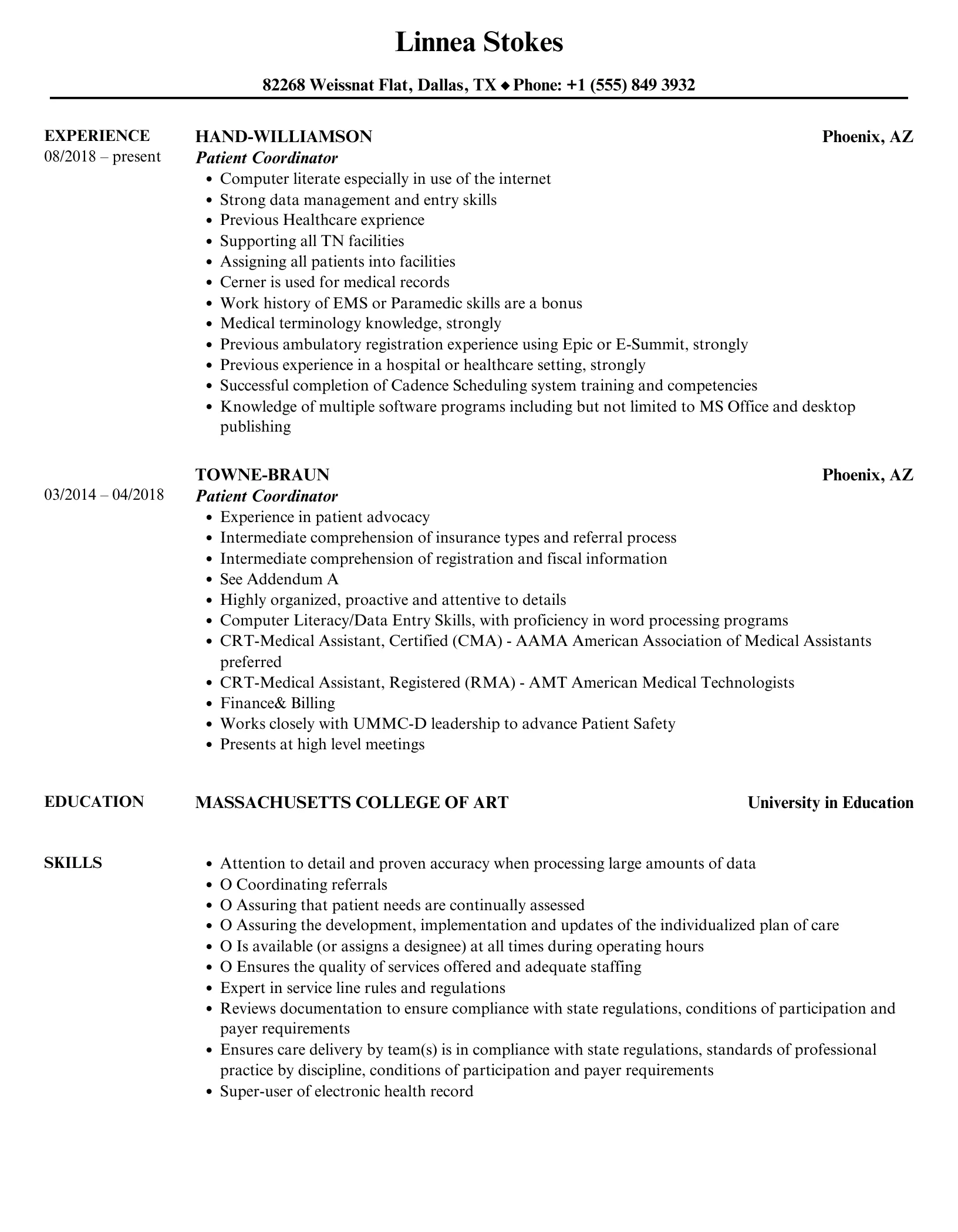
Crafting a Patient Coordinator Resume
A well-crafted resume is your first impression when applying for a Patient Coordinator position. It’s essential to showcase your skills, experience, and qualifications in a clear, concise, and compelling manner. This involves careful attention to detail, strategic formatting, and a focus on highlighting the aspects of your background that are most relevant to the job description. Think of your resume as a marketing document; it’s designed to sell your abilities and convince the hiring manager that you’re the ideal candidate. Ensure that your resume is free of errors and easy to read, as this will significantly increase your chances of getting noticed. Your goal is to make it easy for the reader to see why you are a great fit for the position.
Highlighting Relevant Skills and Experience
The most effective resumes emphasize skills and experience that directly relate to the Patient Coordinator role. Begin by carefully reviewing the job description and identifying the key requirements. These might include experience with patient scheduling, insurance verification, medical record management, and excellent communication skills. When describing your experience, use action verbs and quantify your accomplishments whenever possible. For instance, instead of saying you ‘managed patient appointments’, you could write ‘Managed patient appointments for an average of 50 patients daily, reducing wait times by 15%’. This provides concrete evidence of your capabilities and makes your resume more impactful. Focus on experiences that demonstrate your ability to handle the responsibilities of a Patient Coordinator.
Soft Skills for Patient Coordinators

Patient Coordinator roles demand a unique blend of soft skills. These include the ability to communicate effectively with patients, medical staff, and insurance providers. You must demonstrate empathy, patience, and a genuine desire to assist others. Strong organizational skills are also critical, as you’ll be managing schedules, records, and patient information. Problem-solving skills are essential for addressing patient concerns and resolving administrative issues efficiently. Teamwork is paramount, as you’ll often collaborate with other healthcare professionals. Highlight instances where you’ve used these soft skills to resolve issues, improve patient satisfaction, or streamline processes. Emphasize your ability to remain calm and professional in stressful situations, demonstrating your commitment to providing excellent patient care.
Communication and Interpersonal Skills
Communication is a cornerstone of a Patient Coordinator’s role. You’ll be the primary point of contact for many patients, so your ability to communicate clearly, concisely, and empathetically is critical. Highlight your experience in verbal and written communication. Mention any training you’ve received in medical terminology or patient communication techniques. Demonstrate your ability to listen actively, understand patient concerns, and provide helpful information. Interpersonal skills, such as empathy and the ability to build rapport, are equally important. Show examples of how you’ve built trust with patients, handled difficult conversations, or de-escalated tense situations. Being able to connect with people on a personal level can make a big difference in the patient experience and the overall success of the healthcare team.
Organization and Time Management
The role of a Patient Coordinator requires exceptional organizational and time management skills. You’ll need to juggle multiple tasks, manage patient schedules, maintain records, and handle administrative duties efficiently. Show how you prioritize tasks, manage deadlines, and stay organized in a fast-paced environment. Provide examples of how you’ve used tools like scheduling software, electronic health records, or project management systems to streamline workflows. Highlight your ability to anticipate potential problems, such as scheduling conflicts, and proactively find solutions. If you’ve implemented any organizational improvements that led to increased efficiency or reduced errors, be sure to include those details on your resume.
Technical Skills and Software Proficiency

Patient Coordinators frequently use various software and technical tools to perform their duties. Specify your proficiency in relevant software, such as electronic health record (EHR) systems (e.g., Epic, Cerner), scheduling software, and Microsoft Office Suite. If you have experience with insurance verification portals or billing systems, include those details as well. Highlight any technical skills that make you a more efficient and effective candidate. For instance, mentioning your ability to troubleshoot basic computer issues or your experience with data entry can be advantageous. Be specific about the software you’ve used and your level of proficiency, such as ‘Proficient in Epic EHR system, scheduling appointments and managing patient records’. This provides hiring managers with a clear understanding of your technical capabilities.
Formatting Your Patient Coordinator Resume
The format of your resume should be clean, easy to read, and professional. Use a clear, readable font like Arial or Times New Roman, and maintain consistent formatting throughout the document. Use bullet points to highlight your key skills and accomplishments, making it easy for recruiters to scan your resume quickly. Keep your resume concise, ideally no more than one or two pages, depending on your experience. Use headings and subheadings to organize your information logically, and ensure there is sufficient white space to prevent the document from appearing cluttered. Proofread your resume carefully for any typos or grammatical errors. A well-formatted resume shows attention to detail and professionalism.
Choosing the Right Resume Format
There are several resume formats to consider, each with its strengths and weaknesses. The most common formats are chronological, functional, and combination. A chronological resume lists your work experience in reverse-chronological order, emphasizing your career progression. This format is suitable if you have a consistent work history and want to showcase your career growth. A functional resume focuses on your skills and abilities, rather than your work history. This format is useful if you have gaps in your employment history or are changing careers. A combination resume blends elements of both chronological and functional formats, highlighting both your skills and work experience. Choose the format that best showcases your strengths and aligns with your career goals. Tailor your format to highlight your relevant experiences.
Creating a Professional Summary or Objective

A professional summary is a brief overview of your skills, experience, and career goals. It’s positioned at the top of your resume and serves as an introduction to your qualifications. A well-written summary should capture the hiring manager’s attention and encourage them to read further. Highlight your key skills and experience that align with the job requirements. For example, you could write: ‘Highly organized and compassionate Patient Coordinator with 5+ years of experience in a fast-paced medical environment. Proven ability to manage patient schedules, handle insurance verification, and provide excellent customer service.’ An objective statement, which is less common, states your career goals. Use a summary if you have experience, and an objective if you’re new to the field. Make sure your objective aligns with the job.
Writing a Compelling Work Experience Section
The work experience section is the heart of your resume. For each position you’ve held, include the job title, employer, dates of employment, and a list of responsibilities and accomplishments. Use action verbs to describe your duties, and quantify your achievements whenever possible. Focus on responsibilities and accomplishments that are relevant to the Patient Coordinator role. For instance, instead of saying you ‘answered phones’, you could write ‘Managed a high volume of incoming calls, providing information and directing patients to the appropriate medical staff.’ Highlight any instances where you’ve improved patient satisfaction, streamlined processes, or reduced administrative errors. Use bullet points to make the information easy to scan. Demonstrate your value by illustrating your contributions to the organizations you worked for.
Keywords to Include in Your Resume
Keywords are critical for Applicant Tracking Systems (ATS), which many companies use to screen resumes. Carefully review the job description and identify the key terms and phrases used to describe the required skills, experience, and qualifications. Incorporate these keywords naturally throughout your resume, especially in your professional summary, skills section, and work experience descriptions. Common keywords for Patient Coordinator resumes include ‘patient scheduling,’ ‘insurance verification,’ ‘medical records,’ ‘customer service,’ ‘communication,’ ’electronic health records (EHR),’ and specific software names (e.g., Epic, Cerner). However, avoid keyword stuffing, which can make your resume sound unnatural. The goal is to provide an accurate and compelling portrayal of your qualifications while optimizing for ATS.
Optimizing Your Resume for Applicant Tracking Systems (ATS)

ATS scan resumes for keywords and other criteria to determine their relevance to a job. To optimize your resume for ATS, use a simple, clean format. Avoid using graphics, tables, or unusual fonts, as these can confuse the system. Use standard headings, such as ‘Summary,’ ‘Skills,’ and ‘Experience.’ Ensure your resume is in a format the ATS can read, such as a .doc or .docx file. When possible, tailor your resume to each specific job application, including the keywords mentioned in the job description. Be sure to proofread your resume carefully and ensure it contains no errors. By optimizing your resume for ATS, you increase the chances of your application getting noticed by the hiring manager. Make sure the contact information is clearly visible on the resume.
Writing a Patient Coordinator Cover Letter
A cover letter is your opportunity to introduce yourself, highlight your qualifications, and express your interest in the Patient Coordinator position. It should complement your resume by providing additional context and demonstrating your personality and enthusiasm. Tailor your cover letter to each job application, showing that you’ve researched the company and understand their needs. Address the cover letter to the hiring manager by name whenever possible. The cover letter should be concise, well-written, and free of errors. It should also showcase your ability to communicate effectively and demonstrate your passion for the role and the healthcare field.
Personalizing Your Cover Letter
Personalization is key to a successful cover letter. Avoid using a generic template; instead, take the time to tailor each cover letter to the specific job and company. Research the company and its values, and address the hiring manager by name whenever possible. Highlight the skills and experiences mentioned in the job description, and explain how your qualifications align with their needs. Show genuine enthusiasm for the role and the company. Share a specific example of how your skills have benefited a previous employer or improved patient outcomes. Demonstrating a genuine interest can set you apart from other candidates. Ensure your personalized cover letter reflects your personality and professionalism, showcasing your communication skills and attention to detail.
Showcasing Your Enthusiasm and Fit for the Role

Your cover letter is the perfect place to express your enthusiasm for the Patient Coordinator role and demonstrate why you’re a good fit for the company. Explain what attracts you to the role and what you hope to achieve. Highlight your passion for patient care and your commitment to providing exceptional service. Share a specific experience that demonstrates your understanding of the role. Connect your skills and experiences to the job’s requirements. Describe how your values align with the company’s culture and mission. Express your interest in learning more about the position and the company. A cover letter that shows both your enthusiasm and how you fit the role can make a strong impression on the hiring manager. End with a call to action, indicating your availability for an interview.
Proofreading and Editing Your Resume and Cover Letter
Before submitting your resume and cover letter, carefully proofread and edit both documents. Errors can undermine your credibility and make it difficult for the hiring manager to take your application seriously. Check for any typos, grammatical errors, and inconsistencies in formatting. Ask a friend or family member to review your documents, as a fresh pair of eyes can catch errors you might have missed. Ensure your contact information is accurate and up to date. Verify that your resume and cover letter align with the job description. A polished, error-free application demonstrates your attention to detail and commitment to professionalism. Remember to save your resume and cover letter using a professional file name before submitting.
By following these tips, you can craft a Patient Coordinator resume and cover letter that will help you stand out from the competition and land your dream job.