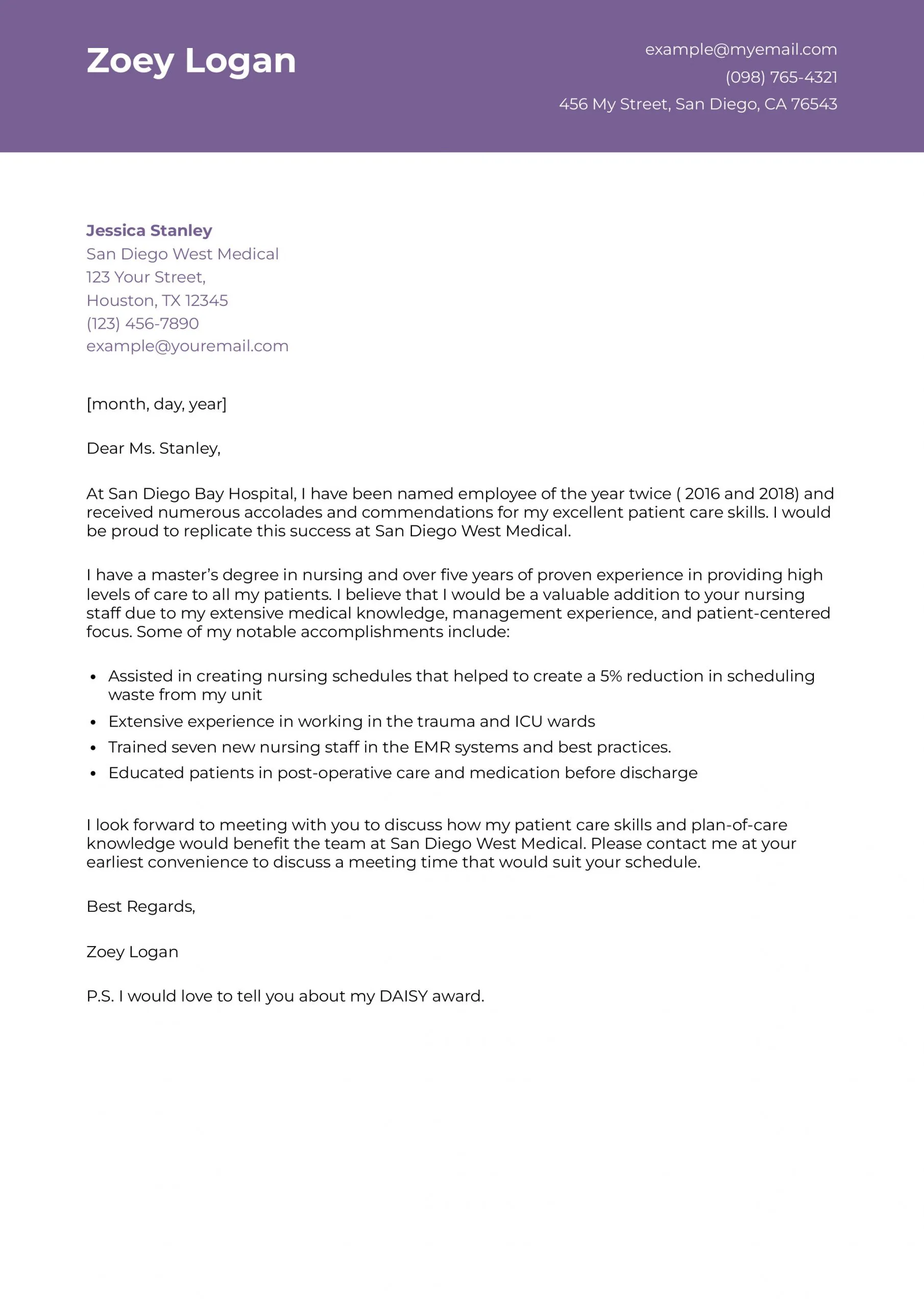
What is a Nursing Cover Letter
A nursing cover letter is a crucial document that accompanies your resume when applying for a nursing job. It serves as your introduction to the hiring manager and provides an opportunity to highlight your qualifications, skills, and experience in a way that a resume alone cannot. Think of it as your chance to make a strong first impression and convince the employer that you are the ideal candidate for the position. A well-crafted cover letter can significantly increase your chances of landing an interview and ultimately, getting hired. This document provides a platform to showcase your personality, enthusiasm for nursing, and specific reasons why you are a great fit for the role and the healthcare facility.
Key Components of a Strong Nursing Cover Letter
A compelling nursing cover letter comprises several key components. Each part plays a vital role in conveying your suitability for the job and demonstrating your professionalism. Attention to detail in these sections ensures a cohesive and persuasive narrative, increasing your chances of capturing the employer’s attention. A clear and concise structure, along with specific examples, helps make your case effectively and leaves a lasting positive impression.
Contact Information Section

The contact information section is essential for both you and the hiring manager. Accurate details are critical for ease of communication and professional presentation. Providing this information ensures that the employer can readily reach you to schedule an interview or provide further updates regarding your application. This section includes your details and, critically, the details of the hiring manager to whom you are writing.
Applicant’s Contact Details
At the top of your cover letter, you must include your contact information. This should include your full name, phone number, professional email address, and optionally, your LinkedIn profile URL or a link to your online portfolio (if applicable). Ensure that your email address is professional-sounding. Avoid using nicknames or casual email addresses. This section ensures that the recruiter or hiring manager can easily reach you.
Hiring Manager’s Contact Information
If possible, address your cover letter to a specific person, such as the hiring manager or the nurse recruiter. Researching the hiring manager’s name and title demonstrates your initiative and attention to detail. If you cannot find a specific name, you can use a general greeting such as “Dear Hiring Manager.” If you can get a specific name, this shows you have taken the time to research and that you care. Include the hiring manager’s title, the name of the healthcare facility, and their address.
Greeting Section

The greeting sets the tone for your cover letter. Use a professional and respectful greeting, such as “Dear Mr./Ms./Dr. [Last Name],” if you know the hiring manager’s name. If you are unsure of the hiring manager’s name, a general greeting like “Dear Hiring Manager” or “To Whom It May Concern” is acceptable. Avoid informal greetings like “Hello” or “Hi.” A well-crafted greeting creates a positive first impression and shows your respect for the recipient and the position.
Body Paragraphs
The body paragraphs are the core of your cover letter, where you highlight your qualifications, skills, and experience. Use these paragraphs to tell your story and show why you are a perfect fit for the nursing position. The content should be well-structured, with clear and concise language. The body paragraphs should include the skills and experience relevant to the job description. Tailor your content to the specific requirements of the role and demonstrate your value to the organization.
Expressing Interest and Value
Start the first body paragraph by clearly stating the position you are applying for and where you saw the job posting. Then, express your genuine interest in the role and the healthcare facility. Highlight what specifically attracts you to the position and the organization. This could be the hospital’s reputation, its values, or the opportunities it offers. Briefly explain why you are a good fit for the role, and convey your enthusiasm for the nursing profession. State the value you can bring to the facility.
Highlighting Relevant Skills and Experience

The most crucial part of your cover letter is highlighting your skills and experience. Provide specific examples that demonstrate your abilities and achievements. Match your skills to the job requirements. Focus on the skills most relevant to the position, such as patient care, clinical skills, communication, and teamwork. Use the STAR method (Situation, Task, Action, Result) to provide detailed examples of how you have successfully handled nursing tasks and challenges. This demonstrates your competence and reinforces your value to the prospective employer. For example, detail experience with Electronic Health Records (EHRs), specific medical equipment, or any specialties like critical care or oncology.
Quantifying Achievements with Data
Whenever possible, quantify your achievements with data and metrics. Use numbers to demonstrate your impact and effectiveness in previous roles. For example, you might mention the number of patients you cared for, the reduction in patient falls, or the improved patient satisfaction scores under your care. Provide data that supports your claims and validates your accomplishments. Using data allows you to make your claims measurable and verifiable, which makes them more credible and impactful. Use numbers to show your contribution and how you have improved outcomes.
Demonstrating Passion for Nursing
In addition to showcasing your skills and experience, convey your passion for nursing. Explain why you are drawn to the profession and what motivates you to provide excellent patient care. Share any relevant personal experiences or reasons why you are committed to nursing. Your passion can differentiate you from other candidates. By demonstrating your enthusiasm and commitment, you can form a deeper connection with the hiring manager. Share any specific interests within nursing or any special skills or training you have that make you unique. This level of connection will help your application stand out.
Closing Section

The closing section should reinforce your interest in the position, summarize your key qualifications, and express gratitude. End your letter with a strong call to action to encourage the hiring manager to take the next step.
Call to Action
Conclude your cover letter with a clear call to action. Express your eagerness to discuss your qualifications further and state your availability for an interview. Thank the hiring manager for their time and consideration. Use a professional closing, such as “Sincerely,” “Best regards,” or “Thank you for your time.” Reiterate your interest in the position and the organization, and restate your contact information for easy access. Make it easy for the hiring manager to reach out to you.
Formatting and Style Guidelines for Nursing Cover Letters
Formatting and style are essential components of your cover letter. A well-formatted letter is easy to read and leaves a professional impression. Adhering to style guidelines ensures your application is polished and reflects your attention to detail.
Font Selection and Readability

Choose a professional and easy-to-read font, such as Times New Roman, Arial, or Calibri. Use a font size between 10 and 12 points. Ensure your cover letter is well-spaced, with consistent margins and line spacing. Avoid using unusual or overly decorative fonts. The goal is to make your cover letter accessible and easy to read at a glance.
Length and Structure
Keep your cover letter concise and to the point. Ideally, a cover letter should be no longer than one page. Use a clear and logical structure, with distinct sections for your contact information, greeting, body paragraphs, and closing. Use headings and bullet points to break up large blocks of text and make your cover letter more visually appealing. Prioritize the most important information. Make sure the structure flows smoothly to guide the reader through your qualifications and experience.
Proofreading and Editing
Always proofread your cover letter carefully before submitting it. Check for any grammatical errors, spelling mistakes, and typos. Have a friend or colleague review your cover letter for clarity and accuracy. A flawless cover letter demonstrates your attention to detail and professionalism. Use a spell-checker and grammar-checker, but do not rely on them solely. Double-check your contact information and the hiring manager’s details for accuracy. Ensure that your tone is professional and appropriate for the nursing profession.
Cover Letter Do’s and Don’ts

When writing your cover letter, it’s crucial to adhere to a set of best practices. Following these guidelines ensures your cover letter is professional, effective, and tailored to the specific job application.
Do’s
- Customize your cover letter for each job application.
- Highlight your most relevant skills and experience.
- Quantify your achievements whenever possible.
- Use a professional and respectful tone.
- Proofread your cover letter carefully.
- Research the healthcare facility and the position.
Don’ts
- Use generic or mass-produced cover letters.
- Include irrelevant information or personal details.
- Exceed one page in length.
- Use slang or unprofessional language.
- Make spelling or grammatical errors.
- Write about salary requirements in your cover letter
Cover Letter Examples
Reviewing examples of nursing cover letters can provide valuable insights. Seeing how others have structured their cover letters and what they include helps you develop your own effective and impactful cover letter.
Nursing Cover Letter Example 1
Here is an example of a basic cover letter template you can adjust to fit your needs. (Insert a simplified example here, addressing a specific job opening and including details about experience and skills).
Nursing Cover Letter Example 2
Here is another cover letter template. (Insert another example here, this time focusing on a different nursing specialty or experience level.)
Tips for Tailoring Your Cover Letter
Tailoring your cover letter to each job application is essential. This involves making specific adjustments to highlight the most relevant skills and experience for the position. Tailoring your cover letter demonstrates to the hiring manager that you have read the job description and understand the role. It is the best way to show that you are interested in the specific role and facility.