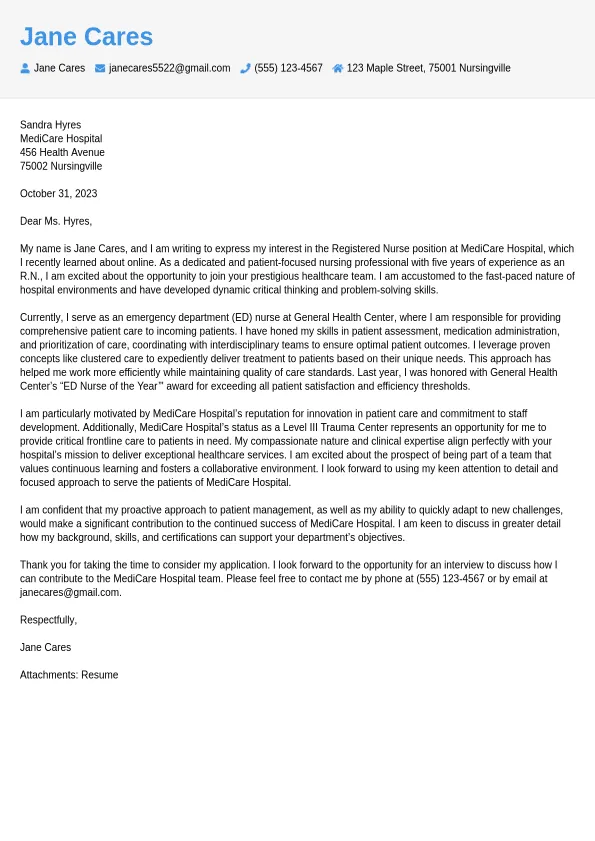
The Importance of a Nursing Cover Letter
A nursing cover letter is a critical component of your job application package. It’s your first introduction to a potential employer, offering a unique opportunity to make a strong first impression. Unlike your resume, which provides a factual overview of your skills and experience, the cover letter allows you to inject personality, express your passion for nursing, and articulate why you are the perfect fit for the specific role and the healthcare organization. A well-crafted cover letter can significantly increase your chances of securing an interview, demonstrating your communication skills, and showing your genuine interest in the position. Therefore, investing time in creating a compelling cover letter is essential for any nurse seeking employment.
Understanding the Purpose of a Cover Letter
The primary purpose of a cover letter is to introduce yourself and highlight your qualifications in a way that complements your resume. It’s a chance to explain why you’re interested in the specific job and what you can bring to the healthcare team. The cover letter allows you to provide context to your resume, elaborating on your skills, experiences, and accomplishments. It is also where you can showcase your personality and communication style, offering insights into how you might fit into the organizational culture. Furthermore, a cover letter lets you address any potential gaps or concerns in your resume and express your genuine enthusiasm for the role and the organization’s mission.
Highlighting Your Key Skills & Experience

When crafting a nursing cover letter, focusing on your key skills and experiences is vital. Review the job description carefully and identify the core competencies and qualifications the employer seeks. Then, use your cover letter to showcase how your skills and experiences align with those requirements. Provide specific examples from your previous roles that demonstrate your abilities. Quantify your achievements whenever possible, using metrics to illustrate the impact you’ve had on patient care or team performance. Highlight your clinical skills, such as patient assessment, medication administration, and care planning, as well as your soft skills, like communication, teamwork, and problem-solving. By tailoring your letter to the job’s specific needs, you show the employer you’re a well-suited candidate.
Key Elements of a Strong Nursing Cover Letter
A strong nursing cover letter should include several key elements to be effective. Start with your contact information, the date, and the employer’s contact information. Then, use a professional salutation addressing the hiring manager or the relevant person by name if possible. The body of your letter should clearly state the position you’re applying for, followed by a brief introduction of yourself. In the main body, highlight your most relevant skills and experiences, providing specific examples of your accomplishments. Express your enthusiasm for the role and the organization, explaining why you’re interested in working there. Close with a call to action, such as requesting an interview, and a professional closing, such as “Sincerely” or “Respectfully.” Remember to proofread the entire letter carefully for any errors in grammar or spelling.
Contact Information & Introduction
Begin your cover letter with your contact information, including your name, address, phone number, and email address. Include the date and the employer’s contact information. Start with a professional salutation, addressing the hiring manager by name if possible. This shows you’ve done your research and pay attention to detail. In the introduction, clearly state the position you’re applying for and where you saw the job posting. Briefly introduce yourself, mentioning your years of experience and your area of expertise. This sets the stage for the rest of the letter and immediately informs the reader of your intent.
Highlighting Relevant Skills

In the main body of your cover letter, dedicate a section to highlight your most relevant skills. Identify the key skills the employer seeks in the job description and align your skills with those. Provide specific examples of how you’ve used these skills in previous roles. These examples should showcase your abilities in areas such as patient care, critical thinking, communication, and teamwork. For example, describe a time you successfully managed a critical patient situation or collaborated with a team to improve patient outcomes. By providing concrete examples, you demonstrate that you possess the required skills.
Showcasing Your Experience
Your cover letter should also showcase your relevant nursing experience. Focus on the experiences most pertinent to the job you are applying for. Describe your previous roles, the settings you’ve worked in, and the types of patients you’ve cared for. Highlight any specialized experience or certifications that are relevant to the position. Quantify your achievements whenever possible using data to demonstrate your impact. For instance, you could mention that you improved patient satisfaction scores by a certain percentage or reduced medication errors. This demonstrates your ability to deliver results and adds credibility to your application. Be specific about your achievements, using concrete examples that illustrate your success.
Expressing Enthusiasm & Passion
Demonstrate your enthusiasm and passion for the role and the organization. Express your genuine interest in the position and explain why you’re excited about the opportunity. Mention anything specific that attracts you to the hospital or clinic or aligns with your career goals. This could be their mission, their reputation for patient care, or their commitment to innovation. Show that you have researched the organization and understand its values. This demonstrates your proactive nature and your commitment to the organization and the profession.
5 Top Nursing Cover Letter Sample Templates

Here are some cover letter sample templates tailored to different nursing roles. They are starting points; customize each one to fit your unique experiences and the specific job posting. Consider these examples as models to structure your own letter, ensuring it highlights your most relevant skills and experiences.
Template 1 Registered Nurse (RN)
This template focuses on RNs and is ideal for those applying to general medical-surgical units, intensive care units, or other hospital settings. It should emphasize your clinical skills, such as patient assessment, medication administration, and care planning. Highlight your experience with electronic health records and any certifications like BLS or ACLS. The template should begin with a strong introduction and then address your achievements in a specific role with quantifiable results. Focus on patient outcomes and team collaboration. This letter needs to clearly show your ability to handle the demands of a high-pressure clinical environment.
Template 2 Licensed Practical Nurse (LPN)
This template is tailored for LPNs and should focus on the practical skills you’ve developed. Highlight your experience in patient care, assisting with medical procedures, and administering medications. The letter should showcase your ability to work under the supervision of RNs or physicians and your commitment to providing compassionate care. Mention any experience with specialized care, such as wound care or geriatric nursing. Tailor this letter for the specific role you are targeting. This version is ideal for jobs in nursing homes, clinics, or assisted living facilities. It emphasizes your hands-on patient care skills and your understanding of nursing protocols.
Template 3 Nurse Practitioner (NP)

The NP cover letter template must emphasize your advanced practice skills and experience in diagnosing and treating patients. Highlight your ability to perform physical exams, order and interpret diagnostic tests, and develop treatment plans. Include any experience in a specific area of practice, such as family medicine, cardiology, or pediatrics. Focus on your experience managing patient caseloads and collaborating with other healthcare professionals. The template should showcase your leadership abilities and your commitment to patient-centered care. This template is ideal for NP positions in clinics, hospitals, or private practices.
Template 4 Nurse Manager
This template is designed for nurses applying for management or leadership roles. Highlight your experience in supervising and mentoring staff, managing budgets, and improving patient care outcomes. The letter should emphasize your leadership skills, such as decision-making, conflict resolution, and team building. Provide examples of how you’ve improved processes or efficiencies in previous roles. The template should demonstrate your ability to create a positive work environment and your commitment to the organization’s mission and values. Mention any relevant certifications or experience, like charge nurse experience.
Template 5 New Graduate Nurse
This template is geared towards new graduate nurses. Highlight your clinical rotations, any volunteer experiences, and your education. Emphasize any skills gained during your clinical rotations and your passion for nursing. Include any awards or honors received during nursing school and your BLS or ACLS certifications. Express your eagerness to learn and grow within the organization and your commitment to patient care. Be sure to showcase any skills or experiences that are relevant to the job posting. This template is a starting point that lets new grads craft their first cover letter.
Customizing Your Cover Letter

The key to a successful nursing cover letter is customization. Never send a generic cover letter. Tailor each letter to the specific job and the organization to which you are applying. This demonstrates that you are genuinely interested in the position and have taken the time to understand the requirements. Research the organization and tailor your letter to align with their mission and values. Highlight the skills and experiences most relevant to the job description. This demonstrates that you have reviewed the job description and carefully considered how your skills and experience align with what the employer is seeking. Be sure to make the letter specific and meaningful for the organization to which you are applying.
Tailoring to the Specific Job
Carefully read the job description and identify the key requirements and qualifications. Make a list of these requirements and then highlight the skills and experiences from your background that meet those requirements. Use the same keywords and phrases from the job description in your cover letter where appropriate. This helps the hiring manager quickly see how your skills match the job needs. Mention specific projects or accomplishments that are directly related to the job. When you show how your skills align with the job description, it will show the hiring manager that you are genuinely interested in the role and qualified for it.
Proofreading and Formatting
Before submitting your cover letter, thoroughly proofread it for any errors in grammar, spelling, or punctuation. Errors can make a poor impression and undermine your credibility. Use a clear and professional format. Choose a readable font, such as Times New Roman or Arial, and use a font size between 10 and 12 points. Keep your letter concise, ideally no longer than one page. Use clear headings and bullet points to make your letter easy to read. Check your formatting to make sure it aligns with the organization’s standards, and that it is easy to read. Having a second pair of eyes review your letter can also help catch any errors that you might have missed.
Common Mistakes to Avoid

Avoid common mistakes that can hurt your chances of getting an interview. Don’t use generic cover letters. Always tailor your letter to the specific job and organization. Do not simply repeat your resume. Your cover letter should provide additional context, highlighting skills, and offering details not included in your resume. Avoid using jargon or overly technical language. Use clear, concise language that is easy to understand. Avoid negative language or talking negatively about previous employers. Never lie or exaggerate your qualifications. Be truthful and accurate in your descriptions. Also, avoid sending your cover letter without proper proofreading.
Grammar and Spelling Errors
Grammar and spelling errors can damage your credibility. Proofread your cover letter carefully before submitting it. Use a spell checker and grammar checker, but don’t rely on them completely. Read your letter aloud to catch any awkward phrasing or typos. Ask a friend or colleague to review your letter for you. Double-check all names, dates, and contact information for accuracy. Ensure the formatting of the letter is easy to read and professional, making sure that you are ready for the job.
Generic Cover Letters
Sending a generic cover letter is one of the most significant mistakes you can make. Hiring managers can easily spot a generic cover letter, and it signals that you are not truly interested in the position. Make sure to address the hiring manager by name if possible, which demonstrates you’ve done your research. Highlight your skills and experience that are relevant to the specific job description. Show that you are knowledgeable about the organization and its mission. Always customize your cover letter to stand out and show you are committed to the role.
Finalizing & Submitting Your Cover Letter

Once you have written and edited your cover letter, it’s time to finalize and submit it. Save your cover letter in a professional format, such as a PDF file. This ensures your formatting remains intact. Customize the filename to include your name and the job title. Double-check all contact information to ensure its accuracy and accessibility. Be sure to review the job posting’s submission instructions for any specific formatting or file type requirements. Send your application materials on time and follow up accordingly.
Tips for Sending Your Cover Letter
Always adhere to the employer’s submission guidelines. Most applications are submitted online, so follow the instructions on how to upload your cover letter and resume. Ensure that your cover letter and resume are in the required file format and that they are properly named. If the job posting provides an email address to send your application, use it. Include a clear subject line that mentions the job title and your name. In the email body, include a brief, professional message re-emphasizing your interest in the position, and then include a signature with your contact information.
Following Up After Submission
After submitting your cover letter and resume, consider following up with the hiring manager. Send a brief email or make a phone call within a week or two of submitting your application. Reiterate your interest in the position and ask about the status of your application. Be polite and professional, and express your enthusiasm for the opportunity. This can help you show initiative and keep your application top of mind. This action demonstrates your interest and proactive nature. However, it is also important to respect the hiring manager’s time and not become overly persistent.