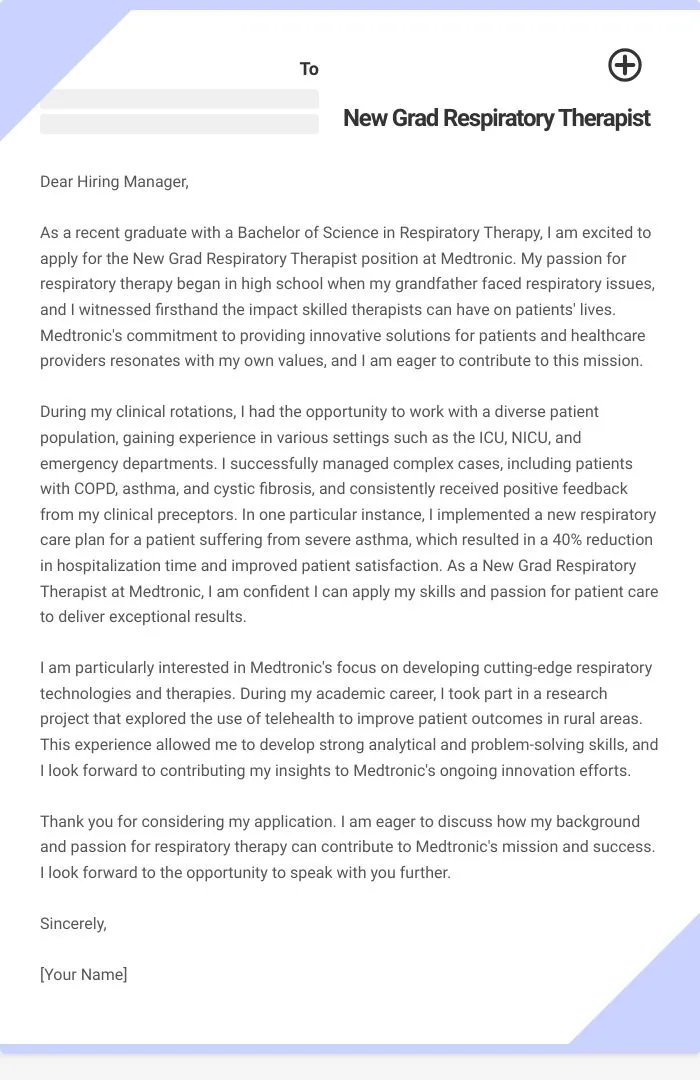
Crafting Your Respiratory Therapist Cover Letter
As a new graduate respiratory therapist, your cover letter is your first chance to make a positive impression on potential employers. Unlike experienced professionals who can lean heavily on years of experience, new grads must showcase their potential and enthusiasm. A well-crafted cover letter can highlight your skills, education, and passion for respiratory care, setting you apart from other applicants. It’s your opportunity to introduce yourself and demonstrate why you’re the ideal candidate for the position. Remember, this is your introduction – make it count. A strong cover letter, when paired with a targeted resume, can significantly increase your chances of landing an interview and ultimately, your first respiratory therapist job.
Understanding the Importance of a Cover Letter
Why is a cover letter so important, especially for new grad respiratory therapists? It’s simple – it provides context. Your resume offers a snapshot of your skills and education, but a cover letter allows you to elaborate on those points. It’s where you can explain your career goals, express your interest in the specific position and the hospital or clinic, and highlight what makes you unique. Think of it as your personal marketing document. It allows you to tell a story, demonstrating your personality and passion for respiratory care. In the highly competitive healthcare job market, a compelling cover letter can be the deciding factor in whether you get an interview or not.
Highlighting Your Skills and Education

Your cover letter should be a showcase of your skills and education, even if you lack extensive professional experience. While you may not have years of practical experience, emphasize the skills you’ve acquired during your respiratory therapy program. This includes skills like patient assessment, administering respiratory treatments, mechanical ventilation management, and patient education. Mention any specialized training or coursework you completed. Also, highlight your academic achievements, such as your GPA, any honors received, and relevant projects. Be specific. Instead of just saying you’re proficient in a skill, provide examples from your clinical rotations or simulations where you successfully applied that skill. Remember to connect these skills to the job requirements.
Key Components of a New Grad Cover Letter
Contact Information and Date
Start with your contact information, including your full name, phone number, email address, and (optionally) your LinkedIn profile URL. Always use a professional email address. Include the date the cover letter is written. Below the date, include the hiring manager’s name, title, and the hospital or clinic’s address. If you can’t find the hiring manager’s name, use a general greeting such as “Dear Hiring Manager” or “Dear [Department Name] Hiring Committee.”
Opening Paragraph

Your opening paragraph should immediately grab the reader’s attention. State the position you’re applying for and where you saw the job posting. Briefly express your enthusiasm for the role and the organization. This is your chance to make a great first impression. Consider mentioning a specific aspect of the role or the hospital that excites you. For example, if you are passionate about working with a specific patient population or using a particular technology, mention it here. The goal is to signal your interest and demonstrate that you’ve done your research.
Body Paragraphs Demonstrating Skills
The body of your cover letter is where you demonstrate your skills and qualifications. Use specific examples from your clinical rotations, simulations, or coursework to showcase your abilities. Refer back to the job description and highlight the skills and experiences that align with the employer’s needs. Quantify your accomplishments whenever possible. For example, instead of saying “I assisted in managing patients on ventilators,” you could say “Successfully managed ventilation settings for up to 5 patients simultaneously during clinical rotations, improving patient outcomes.” This demonstrates your understanding of the role and the importance of providing quality patient care.
Emphasizing Clinical Experience
Your clinical experience is the core of your resume and should be a central focus of your cover letter. Provide detailed descriptions of your rotations, including the types of patients you worked with (e.g., neonates, adults, critical care), the procedures you performed, and the equipment you used. Highlight any unique experiences or accomplishments during your clinical rotations. Explain how you handled challenging situations, resolved conflicts, or improved patient care. If possible, quantify your achievements, for example, “Administered aerosol treatments to over 20 patients daily, leading to a reduction in patient respiratory distress scores.”
Showcasing Relevant Certifications

In addition to your educational background, make sure you mention all relevant certifications, such as your Registered Respiratory Therapist (RRT) credential, Basic Life Support (BLS), Advanced Cardiac Life Support (ACLS), and any other certifications relevant to the specific job. Always mention your RRT status prominently. List your certifications with the issuing organization and the date you obtained them. If you have additional certifications, like the Certified Pulmonary Function Technician (CPFT), it will further strengthen your candidacy. Note that having the correct certifications demonstrates your commitment to meeting professional requirements.
Closing Paragraph and Call to Action
Your closing paragraph should reiterate your interest in the position and thank the hiring manager for their time and consideration. Express your eagerness to learn more about the opportunity. Include a call to action, such as stating that you are available for an interview and can be reached at your contact information. Ensure you reiterate your availability to the potential employer. A well-crafted call to action motivates the hiring manager to contact you. Conclude with a professional closing, such as “Sincerely” or “Respectfully,” followed by your full name.
Tailoring Your Cover Letter to Each Job
Avoid using a generic cover letter. Customize your cover letter for each job you apply for. This shows that you have carefully considered the specific requirements of the position and are genuinely interested in the organization. Tailoring also increases your chances of getting hired by demonstrating attention to detail and interest. Tailoring your cover letter shows you care enough to do the work to stand out. Always tailor your cover letter by highlighting the skills and experiences most relevant to the job description. This shows you’ve reviewed the job description carefully and are ready to contribute.
Researching the Hospital or Clinic

Before writing your cover letter, research the hospital or clinic. Learn about its mission, values, and the services it provides. Find out if they have any specialties or focus areas and mention those in your cover letter to show you’re a good fit. Research the healthcare environment in which the facility is located. Check their website and social media for information. This will show your genuine interest and give you something to write about in your cover letter. Research helps you to personalize the cover letter and demonstrate that you have given thought to why you want to work for that specific organization.
Using Keywords from the Job Description
Carefully review the job description and identify the keywords and phrases used to describe the required skills and qualifications. Integrate these keywords into your cover letter to demonstrate your relevance to the role. For instance, if the job description mentions “mechanical ventilation,” “arterial blood gas analysis,” and “patient assessment,” make sure to include these terms in your cover letter. Remember, not just the use of the keywords matters, but also how effectively you demonstrate those skills. Also, include relevant keywords and phrases in your resume as well. This can help ensure that both your resume and cover letter are reviewed by the hiring manager.
Formatting and Proofreading
Choosing the Right Font and Layout

Choose a professional and readable font, such as Times New Roman, Arial, or Calibri. Use a font size between 10 and 12 points. Keep your layout clean and easy to read. Use standard one-inch margins. Use bullet points to highlight key skills or achievements, but use paragraphs for the main body of the letter. Ensure there’s enough white space to avoid overwhelming the reader. A well-formatted cover letter is a reflection of professionalism and attention to detail. Poor formatting detracts from your message. This allows the hiring manager to quickly find the information they are seeking.
Proofreading for Errors
Proofread your cover letter multiple times. Check for spelling errors, grammatical errors, and punctuation errors. Have a friend or family member proofread your cover letter. Errors can create a negative impression and suggest a lack of attention to detail. Make sure all your contact information is correct. Use a grammar checker like Grammarly. Ensure that your tone is professional and enthusiastic. Double-check that you have tailored the cover letter to the specific job and organization. Correct any inconsistencies or typos. Thorough proofreading can make the difference between getting the interview or not.
Final Review Before Submission
Before submitting your cover letter, do a final review. Make sure your cover letter aligns with your resume. Confirm that you have addressed all the key points and requirements of the job description. Double-check that your cover letter contains a compelling introduction, strong body paragraphs, and a professional closing. Make sure you are showing passion and enthusiasm, so it is clear that you are truly interested in the position. If possible, get feedback from a career counselor or a trusted professional. After you submit the cover letter, save a copy for your records. Remember to customize each letter you send.
Common Mistakes to Avoid

Lack of Personalization
Avoid using a generic cover letter that could be sent to any employer. Tailor your cover letter to each specific job and organization. Research the employer and address the letter to a specific person, if possible. Demonstrating that you have taken the time to understand the company’s needs and mission will make you stand out. Personalizing your cover letter shows that you care enough to put in the extra effort, which can significantly increase your chances of getting an interview. Personalization shows that you are focused on getting this job and not any job.
Ignoring the Job Description
Failing to address the requirements of the job description is a major mistake. The job description is your roadmap to success. Carefully review the job description and highlight the skills and experiences that match what the employer is seeking. Customize your cover letter and emphasize how your qualifications align with their needs. Keywords from the job description are helpful here. The closer you match the job description, the more likely you are to get an interview. Ignoring it demonstrates a lack of attention to detail, and can lead to your application being disregarded.