
Understanding the Importance of a Cover Letter
In the competitive world of manufacturing, a well-crafted cover letter can be the key to unlocking your dream job. It’s more than just a formality; it’s your first opportunity to make a strong impression and demonstrate why you are the perfect candidate. Understanding the significance of a cover letter is the first step toward crafting one that stands out. A cover letter allows you to expand on your resume, providing context and personality that a list of skills and experiences cannot convey. It’s your chance to connect with the hiring manager on a personal level and show your genuine interest in the role and the company. Without a compelling cover letter, your application might get lost in the stack, overlooked by recruiters seeking candidates who take the time to present themselves thoughtfully and professionally. This critical document sets the tone for your application, potentially making the difference between an interview invitation and a rejection letter.
Why a Cover Letter Matters in Manufacturing
The manufacturing sector places a premium on precision, attention to detail, and a strong work ethic. A cover letter allows you to showcase these qualities in action. Unlike general job sectors, manufacturing roles often require specific skills and experience that must be directly applicable. Your cover letter becomes the bridge, connecting your qualifications to the exact requirements of the job. It’s an opportunity to highlight your understanding of manufacturing processes, your experience with machinery and tools, and your commitment to safety protocols. Moreover, in manufacturing, companies often seek candidates who are team players and can demonstrate a problem-solving mindset. Your cover letter provides the perfect platform to communicate these soft skills, demonstrating your ability to contribute to a collaborative and productive work environment. A well-written cover letter shows that you’ve taken the time to understand the company’s needs and are genuinely enthusiastic about the opportunity to contribute to its success.
The Role of a Cover Letter in Job Applications

In the realm of job applications, a cover letter serves several essential roles. Firstly, it acts as an introduction, giving the hiring manager a snapshot of who you are, what you can offer, and why you are the ideal candidate for the role. Secondly, a cover letter provides context to your resume. It allows you to expand on your experience and skills, providing more detail and depth than a resume alone can. This is crucial because it gives you a chance to tell your story, highlighting how your past experiences align with the job requirements and the company’s values. Moreover, a cover letter demonstrates your communication skills. The ability to write clearly, concisely, and persuasively is highly valued in the workplace. A well-written cover letter shows that you can articulate your thoughts effectively and can communicate professionally. By providing a customized narrative, a cover letter significantly increases your chances of securing an interview.
Key Components of a Manufacturing Cover Letter
A successful manufacturing cover letter comprises several key components, each playing a vital role in conveying your qualifications and enthusiasm. The header should include your contact information, making it easy for the hiring manager to reach you. Next, the opening paragraph is your chance to grab their attention. State the position you are applying for and briefly mention why you are interested and what you bring to the table. The body of the letter should highlight your relevant skills and experience, providing specific examples of your achievements. Quantify your accomplishments whenever possible to demonstrate your impact, for example, mention how you improved efficiency or reduced downtime. Furthermore, it is essential to tailor the letter to the specific job description, emphasizing the skills and experiences that align with the job’s requirements. A strong closing paragraph should reiterate your interest in the role and company, and include a clear call to action. Lastly, ensure your cover letter is free of errors through rigorous proofreading and editing.
Header Essentials Contact Information
The header of your cover letter might seem like a minor detail, but it plays a crucial role in ensuring that the hiring manager can easily contact you. Your header should include your full name, professional title if applicable, phone number, email address, and optionally, your LinkedIn profile URL. The inclusion of a LinkedIn profile allows the hiring manager to quickly access your professional background and further validate your qualifications. Ensure that your email address is professional; avoid using nicknames or informal addresses. The header should be clean, well-formatted, and consistent with your resume. Place the header at the top of the page, either left-aligned or centered, and use a simple, easy-to-read font. By providing all the necessary contact information, you facilitate a smooth and efficient application process, which demonstrates your professionalism and attention to detail.
Professional Formatting and Tone

Professional formatting and tone are essential to create a positive impression in your cover letter. Use a clean and legible font such as Arial, Calibri, or Times New Roman in a size between 10 and 12 points. Maintain consistent formatting throughout the document, including consistent spacing, margins, and bullet points if used. The tone of your letter should be formal and professional, yet engaging. Avoid slang, jargon, or overly casual language. Address the hiring manager by name whenever possible; this personalized touch shows that you have taken the time to research the company and the specific job opening. Use active voice and action verbs to describe your skills and experiences; this makes your writing more dynamic and impactful. Proofread your letter carefully to catch any grammatical errors or typos, which can undermine your credibility.
Opening Paragraph Crafting a Strong First Impression
Your opening paragraph is your first opportunity to capture the hiring manager’s attention, so make it count. Start by stating the specific position you are applying for and where you found the job posting. Then, briefly introduce yourself and express your enthusiasm for the role. Instead of simply restating your resume, use this opportunity to highlight a key achievement or skill that aligns with the job requirements. Show your understanding of the company’s needs. For example, if the job emphasizes problem-solving skills, start by mentioning a time you successfully resolved a complex issue in a previous role. The goal is to hook the reader and make them want to continue reading. A well-crafted opening paragraph immediately shows that you are the right fit and have a genuine interest in the opportunity.
Highlighting Relevant Skills and Experience
In the body of your cover letter, focus on highlighting the skills and experiences most relevant to the manufacturing job you are applying for. Carefully review the job description and identify the key requirements. Then, use your cover letter to demonstrate how your skills and experience align with these requirements. Provide specific examples of your accomplishments, using the STAR method (Situation, Task, Action, Result) to illustrate your impact. For example, describe a situation where you identified a production bottleneck, the task you were assigned to solve it, the actions you took, and the positive results you achieved, such as increased efficiency or reduced waste. Use action verbs to describe your skills and responsibilities, such as ‘managed,’ ‘implemented,’ ‘analyzed,’ and ‘improved.’ Quantify your achievements whenever possible to provide concrete evidence of your contributions.
Quantifying Achievements and Results
Quantifying your achievements is a powerful way to demonstrate your value to a potential employer. Whenever possible, use numbers and data to back up your claims and provide concrete evidence of your impact. For instance, instead of saying you ‘improved efficiency,’ state that you ‘increased production efficiency by 15% through the implementation of a new process.’ If you’ve reduced costs, specify the amount you saved. If you’ve improved safety, state the reduction in accidents. By quantifying your achievements, you show the hiring manager that you are results-oriented and that your contributions have a tangible impact on the company’s bottom line. This level of detail sets you apart from other applicants and gives the hiring manager a clear understanding of what you can bring to the role. Always include metrics, percentages, or dollar amounts to quantify your achievements.
Showcasing Technical Skills and Expertise
Manufacturing jobs often require specific technical skills and expertise. Your cover letter is the ideal place to showcase your proficiency with these skills. Be sure to list any relevant certifications, licenses, or training you possess, such as certifications in Lean Manufacturing, Six Sigma, or specific machine operation. Highlight your experience with machinery, equipment, and tools, mentioning the specific models and types you’re familiar with. If the job description mentions specific software or systems used in the manufacturing process, be sure to include that as well. Provide details about projects where you have utilized these skills, and quantify your achievements wherever possible. Tailor this section to the specific requirements of the job, emphasizing the skills and experience that align with the position’s demands. Demonstrate your technical expertise and make it clear that you have the necessary qualifications.
Tailoring Your Cover Letter to the Job Description
One of the most critical steps in writing a compelling cover letter is tailoring it to the specific job description. Never use a generic cover letter; each application should be customized to the role. Carefully read the job description and identify the key requirements, skills, and qualifications that the employer is seeking. Then, use your cover letter to address these requirements directly. Highlight the experiences and skills that match those listed in the job description, providing specific examples and quantifying your achievements whenever possible. Show how your qualifications align with the company’s needs and demonstrate your understanding of the role. Tailoring your cover letter demonstrates that you have taken the time to understand the job and are genuinely interested in the opportunity, making you a more attractive candidate.
Researching the Company and Its Values

Before you write your cover letter, take the time to research the company and its values. This research will enable you to tailor your letter to the specific organization, demonstrating your genuine interest and understanding of their mission and culture. Visit the company’s website, read their ‘About Us’ page, and explore their social media presence. Look for information on their products or services, their target market, and their company values. Identify any recent achievements, awards, or news articles about the company. Incorporate this information into your cover letter to show that you are familiar with the company and are interested in contributing to their success. Mentioning specific company initiatives, projects, or values shows that you have taken the initiative to learn about the organization and that your goals align with theirs.
Matching Skills to Job Requirements
Effectively matching your skills to the job requirements is vital for a compelling cover letter. Review the job description carefully, identify the key skills and qualifications the employer is seeking, and then align your experiences with these needs. Provide specific examples of how you have used those skills in past roles. Quantify your achievements to demonstrate your impact, such as metrics related to efficiency improvements, cost reductions, or safety enhancements. Use the same keywords and phrases found in the job description. This helps your application get past Applicant Tracking Systems (ATS) and ensures that your qualifications are immediately recognizable to the hiring manager. Focus on the most relevant skills and experiences, and avoid listing anything that does not directly relate to the job requirements. Always ensure the alignment of your qualifications with the specific needs of the position.
Formatting for Applicant Tracking Systems ATS
Many companies use Applicant Tracking Systems (ATS) to scan and filter resumes and cover letters. To ensure your cover letter makes it through the ATS and into the hands of a hiring manager, you need to format it correctly. Use a simple and clear font such as Arial, Calibri, or Times New Roman. Avoid using graphics, tables, or images, as these can confuse the ATS. Use standard headings and formatting, such as left-aligned text and appropriate spacing. Use keywords from the job description throughout your cover letter. Focus on the relevant skills and qualifications mentioned by the employer. The primary goal is to make your cover letter easily readable by both humans and the ATS. By following these guidelines, you increase the chances that your application will be reviewed by a human and considered for the position.
Structuring Your Cover Letter for Success

A well-structured cover letter is easier to read and more impactful. Start with a professional header that includes your contact information and the date. Address the hiring manager by name whenever possible. In the opening paragraph, state the position you are applying for and briefly explain your interest and qualifications. In the body paragraphs, highlight your relevant skills and experience, providing specific examples and quantifying your achievements. Tailor the content to match the job description and showcase your technical skills. In the closing paragraph, reiterate your interest in the role, include a clear call to action (e.g., requesting an interview), and express your gratitude for the hiring manager’s time and consideration. Proofread carefully for any errors in grammar and spelling to ensure a polished and professional appearance. A logical structure improves readability and helps you deliver a compelling message.
The Body Paragraphs Detailing Your Value
The body paragraphs of your cover letter are where you truly demonstrate your value. This is your chance to showcase your skills, experiences, and accomplishments in detail. Begin by identifying the key requirements from the job description and dedicating each paragraph to a specific skill or experience. Use the STAR method (Situation, Task, Action, Result) to provide concrete examples of your achievements. Describe the situation, the task you were assigned, the actions you took, and the positive results. Quantify your results whenever possible. Did you increase productivity by a certain percentage? Did you reduce costs, improve safety, or streamline a process? By providing specific examples and quantifiable results, you show the hiring manager exactly what you bring to the table. Your goal is to make a strong case for why you are the best candidate.
The Art of the Bullet Point Highlighting Key Skills
Use bullet points strategically to highlight your key skills and qualifications. Bullet points are an effective way to present information concisely and make your cover letter easier to read. When using bullet points, focus on the most relevant skills and experiences. Start each bullet point with a strong action verb to describe what you did or what you achieved. Quantify your achievements whenever possible. For example, instead of saying ‘Managed a team,’ say ‘Managed a team of 15 employees, resulting in a 10% increase in productivity.’ Keep the bullet points short and to the point, and use consistent formatting. Ensure that the skills and experiences you highlight with bullet points directly align with the job requirements. This helps draw the hiring manager’s attention to your most relevant qualifications.
Demonstrating Problem-Solving Abilities

Manufacturing jobs often require strong problem-solving skills. Your cover letter is the perfect place to demonstrate your ability to tackle challenges and find solutions. Provide specific examples of how you have identified and resolved problems in past roles. Describe the situation, the problem you faced, the steps you took to find a solution, and the outcome. Focus on how you applied critical thinking, analytical skills, and creativity to overcome obstacles. Highlight any tools or techniques you used, such as root cause analysis, process improvement methodologies, or data analysis. Quantify the positive results of your problem-solving efforts. For example, if you resolved an issue that led to downtime, state the reduction in downtime. Show the hiring manager that you are a proactive, resourceful, and results-oriented problem solver.
Emphasizing Teamwork and Collaboration
Teamwork and collaboration are critical in the manufacturing sector. Highlight your ability to work effectively with others. Describe your experience working as part of a team, including your role and responsibilities. Provide examples of successful collaborations. Mention how you have contributed to a positive and productive work environment. Explain how you effectively communicate with colleagues, supervisors, and other stakeholders. If you’ve led or participated in team projects, describe your contributions and the positive outcomes achieved. Focus on how you have fostered a collaborative spirit, shared knowledge, and helped your team achieve its goals. Hiring managers value candidates who can work effectively with others.
Closing the Cover Letter with a Call to Action
Your closing paragraph should reiterate your interest in the role, express your gratitude for the hiring manager’s time and consideration, and include a clear call to action. Briefly restate why you are a good fit for the position and what you can bring to the company. Thank the hiring manager for their time and consideration. State your availability for an interview and provide contact information. You might say, ‘I am eager to learn more about this opportunity and discuss how my skills and experience can benefit your team. I am available for an interview at your earliest convenience and can be reached at [phone number] or [email address].’ By ending with a clear call to action, you make it easy for the hiring manager to take the next step.
Expressing Enthusiasm and Interest

Throughout your cover letter, make sure to express your genuine enthusiasm and interest in the job and the company. Show that you have researched the organization and are excited about the opportunity to contribute to its success. Use phrases like ‘I am particularly drawn to,’ ‘I am excited about the prospect of,’ or ‘I am confident that I can make a significant contribution to your team.’ Highlight any specific aspects of the role or the company that appeal to you. By expressing your genuine interest, you show the hiring manager that you are not just looking for any job, but that you are genuinely interested in this particular opportunity. This will make you stand out from other candidates.
Providing Contact Information for Follow-Up
Ensure that your cover letter includes all necessary contact information to make it easy for the hiring manager to reach you. At the top of your cover letter, include your full name, phone number, email address, and optionally, your LinkedIn profile URL. In your closing paragraph, reiterate your contact information, as well as your availability for an interview. Make sure your email address is professional and that you regularly check your email for any messages. Also, provide your phone number, and ensure your voicemail is set up and ready to receive messages. Providing complete and accurate contact information will help the hiring manager to reach you quickly and efficiently, showing that you’re attentive to details and serious about the job.
Proofreading and Editing for Perfection
Proofreading and editing are crucial steps in ensuring your cover letter is polished and professional. Typos, grammatical errors, and inconsistencies can undermine your credibility and leave a negative impression on the hiring manager. After you finish writing your cover letter, take the time to proofread it carefully. Check for spelling errors, grammatical mistakes, punctuation errors, and inconsistencies in formatting. Use a spell checker and grammar checker, but don’t rely on them entirely; always read your cover letter closely. Consider having a friend, family member, or career advisor review your cover letter for feedback. Multiple sets of eyes can catch errors you might miss. A well-proofread cover letter reflects your attention to detail and your commitment to presenting yourself professionally.
Common Mistakes to Avoid
Avoid certain common mistakes to ensure your cover letter makes a positive impression. One of the most common mistakes is using a generic cover letter. Never submit a cover letter that is not tailored to the specific job you are applying for. Another mistake is ignoring the job description; always reference the job requirements in your cover letter. Typos and grammatical errors are another major issue. Proofread your letter carefully. Also, avoid being overly lengthy. Keep your cover letter concise and to the point, focusing on your most relevant skills and experiences. Finally, avoid using jargon or overly complex language.
Using a Generic Cover Letter
Using a generic, one-size-fits-all cover letter is a significant mistake that can severely limit your chances of getting an interview. A generic cover letter lacks the personalization and relevance that hiring managers look for. It does not demonstrate that you have taken the time to understand the specific needs of the job or the company. Generic letters often feel impersonal and do not showcase why you are the perfect fit for the role. To avoid this mistake, always tailor your cover letter to each specific job application. Research the company, study the job description, and highlight the skills and experiences that align with the position’s requirements. A customized cover letter will make a much stronger impression and significantly increase your chances of securing an interview.
Ignoring the Job Description
Ignoring the job description is another critical mistake. The job description is your roadmap to crafting a successful cover letter. It outlines the key requirements, skills, and qualifications the employer is seeking. When you ignore the job description, you risk missing key information and failing to address the employer’s needs. Always carefully read and analyze the job description before you begin writing your cover letter. Highlight the keywords and phrases used in the job description. Tailor your cover letter to match the job requirements, emphasizing your relevant skills and experiences. Providing specific examples of how you have met the criteria mentioned in the job description will greatly increase your chances of success.
Typos and Grammatical Errors
Typos and grammatical errors can undermine your credibility and make a negative impression on hiring managers. Errors in your cover letter suggest a lack of attention to detail and professionalism. To avoid this, proofread your cover letter carefully. Use a spell checker and grammar checker, but also read your letter closely. Ensure the content is clear, concise, and free of errors. Read your cover letter aloud; this can help you catch mistakes you might have missed when reading it silently. Consider having a friend, family member, or career advisor review your cover letter. A fresh pair of eyes can catch errors. Proofreading is a critical step in the cover letter writing process; it is a demonstration of your attention to detail.
Example Cover Letter for a Manufacturing Job
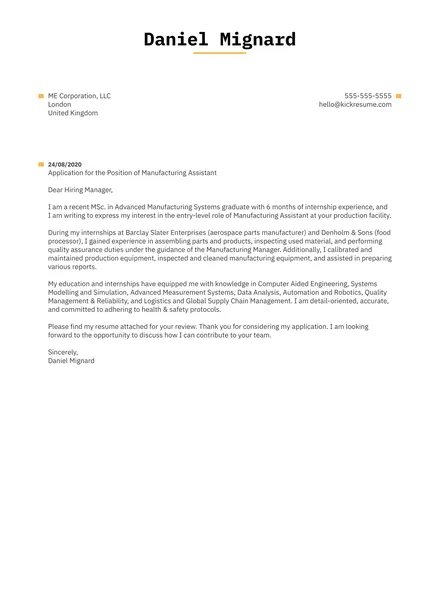
An example cover letter serves as a valuable guide for crafting your own. Study successful examples to understand how to structure your letter, highlight your skills, and demonstrate your enthusiasm. A good example will follow a standard business letter format. It will include your contact information, the date, and the hiring manager’s information. It will open with a strong opening paragraph that grabs attention and states your interest in the position. The body paragraphs will highlight your relevant skills and experiences, using the STAR method and quantifying your achievements. The closing paragraph will reiterate your interest and include a clear call to action. While using an example, ensure that you adapt it to your specific situation and qualifications. Avoid simply copying and pasting; personalize it to showcase your unique value.
Template and Structure
Using a template can simplify the process of writing your cover letter. A template provides a pre-formatted structure that you can customize. However, do not rely on the template completely. Templates typically include sections for your contact information, the date, the hiring manager’s information, an opening paragraph, body paragraphs to highlight your skills and experiences, and a closing paragraph with a call to action. When using a template, make sure it is well-designed and professional. Pay attention to formatting, fonts, and spacing. Tailor the template to your specific needs and ensure the content is customized to the job. Be sure to personalize the letter to showcase your unique value and demonstrate why you are a great candidate.
Customizing the Template
Customizing the template is the most important aspect of using a cover letter template. Templates provide a framework, but you must customize it to stand out. Start by replacing the generic information with your own details. Adapt the content to align with your experiences. Highlight the skills and qualifications outlined in the job description. Use the STAR method to illustrate your achievements and quantify your results. Modify the language to match your voice. Make sure your cover letter is a true reflection of you and your expertise. By customizing the template, you create a personalized and compelling cover letter that showcases your unique qualifications and makes a strong impression on the hiring manager. Remember, the goal is to make your letter stand out from the crowd.