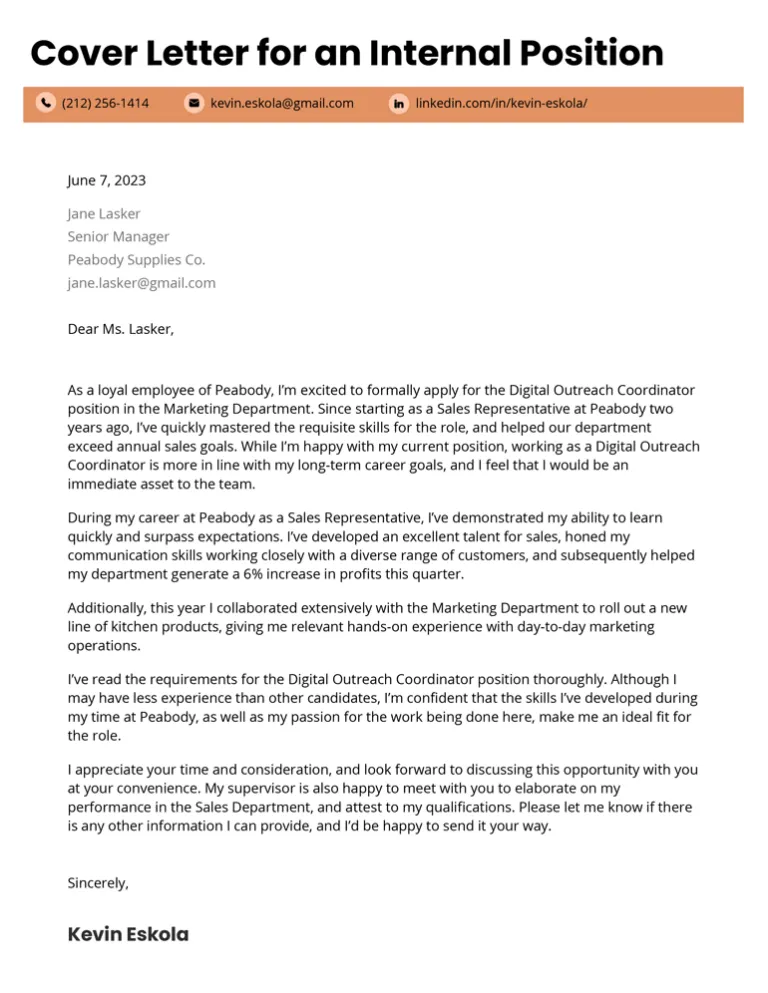
Understand the Job Promotion Cover Letter
A job promotion cover letter is a crucial document that showcases your qualifications, experience, and suitability for a higher-level position within your current company. It’s your opportunity to express your interest in the promotion, highlight your accomplishments, and demonstrate how you align with the new role’s requirements. Unlike a standard job application, this letter targets internal stakeholders who are already familiar with your work ethic and contributions to the company. This gives you a slight advantage to create a stronger connection with the person or team in charge. A well-crafted cover letter can significantly increase your chances of securing the promotion, so taking the time to personalize it and highlight relevant achievements is essential. It’s not simply a reiteration of your resume; it’s a narrative that connects your past performance with your future potential within the organization.
Research the Promotion and Company
Before you start writing, thoroughly research the promotion and the company’s current priorities. Understand the responsibilities, expectations, and the specific skills required for the new role. Review the job description carefully. If possible, speak with people who currently hold the position or have a solid understanding of the role. Research the company’s recent projects, goals, and any recent company communications that provide insights into its future direction. Demonstrating that you understand the company’s needs and how you can contribute to its success is a powerful way to convince decision-makers that you are a good fit for the role and that you are well-prepared for the step up. This also shows initiative and a proactive approach to understanding the job.
Review the Job Description

Carefully analyze the job description to identify the key skills, experiences, and qualifications the company is seeking. Make a list of the requirements and align your accomplishments and skills with these specific points. Identify the keywords used in the job description and incorporate them into your cover letter naturally. Be specific about how your experiences and qualifications meet the job requirements and provide concrete examples to support your claims. This is critical; the goal is to demonstrate how your skills and experiences make you the best candidate for the job. Showing the direct relationship between your past achievements and the job requirements shows that you can do the job.
Highlight Your Accomplishments
Focus on showcasing your most relevant accomplishments and contributions to the company. Instead of listing your job duties, describe specific achievements that demonstrate your value and impact. Use the STAR method (Situation, Task, Action, Result) to describe your accomplishments. This approach will help you provide context, explain the challenge, describe the steps you took, and highlight the positive results. For example, instead of saying “Managed projects,” you could say “Led a project that resulted in a 15% increase in efficiency, contributing to the company’s success.” Quantifiable accomplishments are extremely valuable, so use numbers to prove the value you bring. This helps the reader to understand your contributions and your value.
Quantify Your Achievements
Use quantifiable metrics to demonstrate the impact of your accomplishments. Numbers provide concrete evidence of your achievements and make your claims more credible. For example, instead of saying “Improved customer satisfaction,” say “Improved customer satisfaction scores by 20% through implementing a new customer service protocol.” Use numbers to illustrate the scale of your impact; these numbers show you are more than just a person doing the job but a person making a difference. When listing achievements, quantify them wherever possible. This includes metrics such as percentage improvements, cost savings, revenue generated, or deadlines met. These metrics should relate to the job description and the new role. Using this will help you stand out from the competition.
Use Action Verbs

Start your sentences with strong action verbs to make your cover letter more dynamic and engaging. Action verbs describe what you did, how you did it, and the outcomes of your work. Avoid generic phrases and instead use verbs that showcase your skills and accomplishments. Examples of effective action verbs include: led, managed, developed, implemented, achieved, increased, reduced, and improved. By using vivid action verbs, you can make your cover letter more compelling and showcase your proactive approach to work. This also shows how your abilities fit into the job description and how you can use them in the new role. Use these verbs to connect your experience to the job requirements.
Showcase Your Skills and Qualities
Identify and highlight the skills and qualities that are relevant to the new role. These may include technical skills, leadership abilities, communication skills, problem-solving capabilities, and teamwork skills. Provide specific examples of how you have demonstrated these skills in your previous roles. For example, if the job requires leadership skills, describe a situation where you successfully led a team to achieve a specific goal. If communication is a key requirement, give an example of how you effectively communicated with colleagues, clients, or stakeholders. Make sure to directly address all the required skills as described in the job description. This ensures that the person in charge knows that you have the skills to excel in the role.
Align Your Skills with the New Role
Connect your existing skills and experiences to the requirements of the new role. Explain how your past accomplishments have prepared you for the responsibilities of the promotion. Demonstrate how your skills will translate to success in the new position. Provide examples of how you have previously demonstrated the required skills, such as project management, team leadership, or strategic planning. Tailor your cover letter to emphasize the skills and experiences that are most relevant to the new role. This customization will demonstrate your understanding of the position and your suitability for it. Focus on the skills and experience you have that directly align with the job description, making it clear how you can contribute to the company’s goals in the new role.
Demonstrate Leadership and Initiative

If the promotion involves a leadership role, showcase your leadership skills and initiative. Provide examples of how you have led teams, mentored colleagues, or taken initiative to solve problems or improve processes. Highlight any projects where you took the lead, implemented new strategies, or exceeded expectations. These can include initiating projects, mentoring other employees, and proposing new and innovative ideas. Your cover letter should demonstrate a proactive attitude and a willingness to go above and beyond your regular duties. Be sure to clearly showcase your ability to take initiative and drive positive outcomes. The reader should get a sense of what you can do when given the opportunity to lead.
Address Your Career Goals
Briefly mention your career goals and how the promotion aligns with your professional aspirations. Explain why you are interested in the new role and how it will help you grow and develop within the company. Show the reader that this role is a strategic step in your career trajectory and that you are committed to the company’s long-term success. Avoid generic statements; instead, show genuine interest in the position and how it will help you grow within the company. This shows your goals and what you are working towards. It should be clear how the new role aligns with your long-term goals within the company.
Express Your Enthusiasm
Convey your genuine enthusiasm for the promotion and the opportunity to contribute to the company in a new capacity. Use positive language and a confident tone. Show your excitement about the prospect of taking on new challenges and responsibilities. Let the reader know that you are highly motivated and eager to take on the new role. Expressing your enthusiasm can leave a positive impression and demonstrate your strong interest in the position. Your enthusiasm can be a powerful factor in convincing decision-makers that you are the right choice for the promotion.
Proofread Your Letter

Proofread your cover letter carefully for any grammatical errors, spelling mistakes, or typos. Errors can undermine your credibility and make you appear less professional. Have someone else review your letter as well, as a fresh pair of eyes can often catch mistakes that you might miss. Ensure that your cover letter is free from errors and that your writing is clear, concise, and professional. Double-check the names of the recipients, the job title, and the company’s name to ensure accuracy. A polished, error-free cover letter demonstrates attention to detail and a commitment to excellence. Take your time to review everything; mistakes can lower your chances of getting the job.
Format Your Cover Letter
Use a professional format for your cover letter. Keep it concise and easy to read. Use a clear and legible font, such as Arial or Times New Roman, and maintain a consistent font size. Use appropriate spacing and margins. Break up large blocks of text into shorter paragraphs. Use bullet points to highlight key accomplishments and skills. Structure your letter logically, with a clear introduction, body, and conclusion. The format should be easy to read, so the person in charge of the role will be able to quickly read through it. Using a good format makes a good impression. A well-formatted cover letter shows professionalism and attention to detail.
Use a Professional Tone
Maintain a professional and respectful tone throughout your cover letter. Use formal language and avoid slang or jargon. Address the hiring manager or the person in charge by name, if possible. Avoid overly casual or informal language. Express your interest in a professional, respectful way that reflects your understanding of workplace communication norms. Be polite and respectful of the company and its culture. A professional tone shows that you are serious about the promotion and committed to maintaining a professional standard in the workplace.
Keep it Concise

Keep your cover letter concise and to the point. Aim for one page, and make every word count. Avoid unnecessary details and focus on the most relevant information. Use strong action verbs and clear language to express your qualifications and accomplishments efficiently. Respect the reader’s time by presenting your information in a streamlined and focused manner. Brevity demonstrates that you respect the reader’s time. Make sure your cover letter gets your point across while not wasting the reader’s time.
Follow Up After Submission
After submitting your cover letter and application, follow up with the hiring manager or the person in charge to reiterate your interest in the promotion. Send a brief email or make a phone call to express your continued interest and ask about the status of your application. This follow-up demonstrates your enthusiasm and initiative. Ask about the interview process and timeline, showing your investment in securing the new role. Express your gratitude for the opportunity and restate your qualifications and interest in the position. Following up is a simple but effective way to show that you are serious about the promotion.