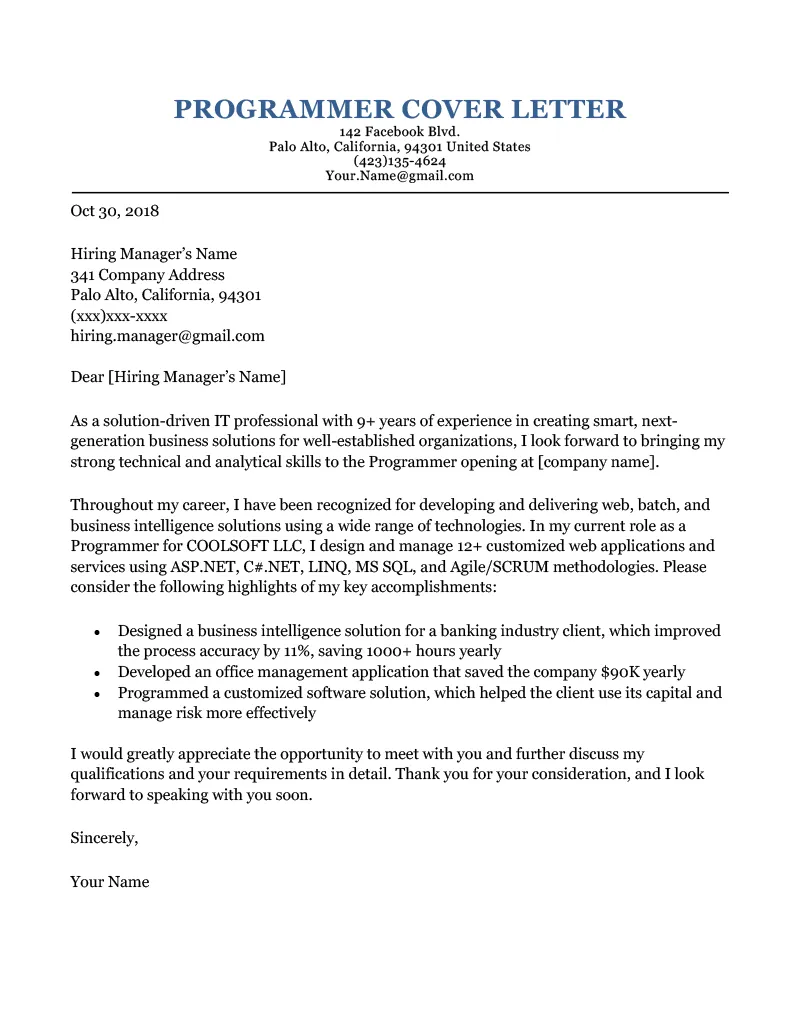
What is an IT Cover Letter
An IT cover letter is a crucial document that accompanies your resume when applying for IT-related positions. It serves as an introduction to your qualifications, skills, and experiences, providing the hiring manager with a snapshot of your suitability for the role. Unlike a resume, which is a factual overview of your work history, a cover letter allows you to express your personality, demonstrate your passion for the field, and explain why you are the ideal candidate. It’s your chance to make a strong first impression and set yourself apart from other applicants. This letter should be tailored to each specific job, highlighting the skills and experiences that align with the job description, emphasizing your understanding of the company’s needs and your eagerness to contribute to their success. A well-crafted IT cover letter can significantly increase your chances of getting an interview.
Why You Need an IT Cover Letter
In the competitive IT job market, a cover letter is more than just a formality; it’s a strategic tool. It provides context to your resume, elaborating on your accomplishments and demonstrating your suitability for a specific position. Many hiring managers consider the cover letter as important as the resume itself, as it reveals your communication skills, attention to detail, and genuine interest in the role and the company. A well-written cover letter showcases your personality and enthusiasm, which can be difficult to convey through a resume alone. It is an opportunity to address any potential gaps in your resume, such as career changes or periods of unemployment, proactively explaining the circumstances and highlighting the skills you gained during those times. Ultimately, a cover letter helps you make a personal connection with the hiring manager, making you more than just a list of qualifications and experience.
Key Components of an IT Cover Letter

A successful IT cover letter comprises several key components that work together to create a compelling narrative. Each element serves a specific purpose and contributes to your overall impact. Starting with a professional header and contact information, the letter should then move into a personalized greeting, ideally addressing the hiring manager by name. The opening paragraph should capture the reader’s attention and clearly state the position you’re applying for, and then the main body of the letter should focus on your relevant skills and experience, using specific examples and quantifying your achievements whenever possible. The closing paragraph should reiterate your interest in the role, express gratitude, and include a clear call to action, such as requesting an interview. Finally, proofreading and formatting are crucial to ensure your letter is free of errors and presents a polished image.
Contact Information and Header
The header of your IT cover letter should include your full name, address, phone number, and professional email address. Ensure this information is accurate and easy to read. The header should be positioned at the top of the document. The date should also be included beneath your contact information. The header sets the tone for your application, so it should look clean and organized. The contact information provides the hiring manager with all necessary details to reach you quickly. Using a professional email address is also vital, avoid any informal or unprofessional email addresses. A well-formatted header immediately demonstrates your attention to detail and professionalism, setting a positive foundation for the rest of your cover letter. Ensure that the header is consistent in formatting with your resume to maintain a professional look.
Professional Greeting
Begin your IT cover letter with a professional greeting. The ideal approach is to address the hiring manager by name. This shows that you’ve taken the time to research the company and the specific role. If you are unable to find the hiring manager’s name, use a general greeting such as ‘Dear Hiring Manager’. Avoid generic greetings such as ‘To Whom It May Concern’, which can make your letter seem impersonal. If you’re applying through an online portal where the hiring manager’s name isn’t provided, a greeting tailored to the role, such as ‘Dear IT Team’, is acceptable. Correctly addressing the recipient is an important detail that shows your respect and attention to detail, setting a positive tone for the entire letter. Always double-check the spelling of the name and title for accuracy.
Opening Paragraph

The opening paragraph of your IT cover letter is your chance to make a strong first impression. It should immediately grab the reader’s attention and clearly state the position you’re applying for. Briefly mention where you saw the job posting (e.g., LinkedIn, company website) and express your enthusiasm for the opportunity. Highlight your most relevant skill or accomplishment to showcase your suitability for the role. The opening should be concise and to the point. It should convey your understanding of the company and the specific requirements of the job. The opening paragraph should provide a hook that makes the hiring manager want to read further. Make it memorable by mentioning something that stands out about the company, or by quickly summarizing your qualifications. This is the first step to setting your cover letter apart from other applicants.
Highlighting Relevant Skills and Experience
The body of your IT cover letter should focus on highlighting the skills and experiences most relevant to the job description. Carefully review the job posting and identify the key requirements, tailoring your letter to demonstrate how your qualifications meet those needs. Provide specific examples of your accomplishments and how you have used your skills in past roles. Use action verbs to describe your responsibilities and achievements (e.g., ‘managed,’ ‘implemented,’ ‘developed’). For each skill or experience you mention, provide context and results. Show how you solved problems, improved processes, or contributed to a team’s success. Customize your cover letter for each application, as a generic approach will not resonate as effectively. This shows that you have taken the time to understand the specific needs of the company and that you are a good fit.
Quantifying Achievements
Whenever possible, quantify your achievements to make your cover letter more impactful. Instead of simply stating ‘improved network performance’, provide specific data like ‘Improved network performance by 20% resulting in faster data transfer speeds.’ Numbers add credibility to your claims and make it easier for the hiring manager to understand the value you can bring to the role. Use metrics to demonstrate your impact. Examples could be the percentage of time saved on project completion, the amount of cost reduction achieved, or the number of users supported. Quantifying your accomplishments shows that you are results-oriented and focused on achieving measurable outcomes. Ensure that the numbers and statistics are accurate and relevant to the job requirements. This is an excellent way to make you stand out from other candidates.
Tailoring Your Cover Letter to the Job

One of the most crucial steps in crafting a successful IT cover letter is tailoring it to the specific job you are applying for. Generic cover letters are easy to spot and often end up in the rejection pile. Start by thoroughly reviewing the job description and identifying the key requirements, skills, and keywords mentioned. Then, customize your cover letter to address these points directly. Highlight the skills and experiences that are most relevant to the role and provide examples of how you have demonstrated these skills in the past. Use the same language and terminology as the job description to demonstrate your understanding of the company’s needs. Customizing your letter shows that you have taken the time to understand the position and that you are genuinely interested in the opportunity. This shows the hiring manager that you have the skills and experience they are looking for.
Body Paragraphs
The body paragraphs of your IT cover letter should delve into your key qualifications, providing detailed examples of your skills and achievements. Use two or three paragraphs to expand on the points highlighted in your opening paragraph. Structure each paragraph around a specific skill or experience, supporting your claims with concrete examples. For instance, if the job description requires experience with cloud computing, describe your projects, the tools you used, and the outcomes you achieved. Quantify your accomplishments whenever possible to demonstrate the impact of your work. Tailor each paragraph to match the job description’s requirements, using the same keywords and terminology. Maintain a professional tone throughout, and keep each paragraph concise and focused. Ensure each paragraph flows logically, building a cohesive narrative that showcases your suitability for the role.
Demonstrating Technical Skills
In your IT cover letter, it’s essential to highlight your technical skills and provide specific examples of how you’ve used them. Mention the programming languages, software, hardware, and technologies you’re proficient in. Instead of just listing your skills, provide context by describing the projects you’ve worked on and the results you achieved. For instance, if you have experience with network security, explain how you implemented security protocols, identified vulnerabilities, and reduced the number of security incidents. When describing your technical skills, tailor your language to match the job description, using the same keywords and phrases. Quantify your accomplishments whenever possible to demonstrate your impact. For instance, you can specify how you improved system efficiency, decreased downtime, or saved costs. Ensure your descriptions are clear, concise, and easy to understand, even for a non-technical reader.
Showcasing Soft Skills

While technical skills are important, don’t forget to showcase your soft skills. Soft skills are essential for success in any IT role. Highlight your abilities in communication, problem-solving, teamwork, and leadership. Provide examples of how you’ve used these skills in past roles. For example, describe a time you collaborated with a team to solve a complex technical issue or how you communicated complex technical information to non-technical stakeholders. Demonstrate your adaptability and willingness to learn new technologies, as the IT field is constantly evolving. Show your ability to manage projects effectively and meet deadlines. Your ability to effectively work with others, manage projects, and communicate clearly will make you a more appealing candidate. Highlighting your soft skills will help you stand out from candidates with only technical skills.
The Closing Paragraph
The closing paragraph of your IT cover letter should reiterate your interest in the role and express your enthusiasm for the opportunity. Briefly summarize why you are a good fit, referencing your key skills and experiences. Keep it concise and to the point. Express your appreciation for the hiring manager’s time and consideration. Your closing should be professional and leave a lasting positive impression. This is your last chance to reinforce your qualifications and make the reader want to learn more about you. Your aim is to reiterate your qualifications, expressing your interest and gratitude. It should clearly signal your eagerness to move forward in the hiring process. Close with a strong, positive statement about your belief in your suitability for the role.
Call to Action
Include a clear call to action in your closing paragraph. This tells the hiring manager what you want them to do next. Request an interview and state your availability. Suggest a specific time frame for contact or express your willingness to discuss the opportunity further at their convenience. This shows initiative and a proactive attitude. Making it easy for the hiring manager to take the next step increases your chances of getting an interview. Be polite and professional. Make sure your call to action is specific, clear, and easy to understand. The call to action is a crucial part of the cover letter, so take the time to craft it well.
Expressing Gratitude

Always express gratitude in your closing paragraph. Thank the hiring manager for their time and consideration. Show your appreciation for the opportunity to be considered for the role. Expressing gratitude demonstrates your professionalism and respect. It leaves a positive impression, showing that you value their time and effort. A sincere thank you can help you stand out from other applicants and can show respect for their time. A simple ‘Thank you for your time and consideration’ is sufficient. Make sure your thank you is genuine and not just a formality, and tailor it to the specific company or role.
Proofreading and Formatting
Before submitting your IT cover letter, thoroughly proofread it for any errors in grammar, spelling, and punctuation. Errors can undermine your credibility and make you seem unprofessional. Read the letter aloud to catch any awkward phrasing or mistakes that you might miss when reading silently. Use a spell checker and grammar checker to catch obvious errors, but don’t rely on them completely. Have a friend or colleague review your cover letter for a fresh perspective. Pay close attention to formatting. Use a professional font, such as Times New Roman, Arial, or Calibri, and ensure consistent spacing and alignment. A well-formatted letter is easier to read and shows that you pay attention to detail. Proofreading shows your dedication to the application process, ensuring you make the best possible impression.
IT Cover Letter Examples
Reviewing IT cover letter examples can provide valuable insights into how to structure your own letter and highlight your skills and experience effectively. Several online resources offer sample cover letters for various IT roles, such as IT support technicians, system administrators, and project managers. These examples can help you understand the language, tone, and format used in successful cover letters. Pay attention to how the examples address the specific requirements of the job descriptions, and how the applicants quantify their accomplishments. While using examples as a guide, remember to customize your cover letter to reflect your unique skills and experiences. Tailoring your letter will demonstrate your understanding of the job requirements. Using these examples will provide a good basis for creating your IT cover letter.
Example 1 Entry Level IT

Dear Hiring Manager,
I am writing to express my keen interest in the Entry-Level IT Support position advertised on [Platform]. As a recent graduate with a degree in Computer Science and a passion for technology, I am eager to apply my skills and knowledge to support your IT infrastructure. During my studies, I gained hands-on experience with troubleshooting hardware and software issues, providing technical support to users, and configuring networks. I am proficient in Windows and macOS operating systems and familiar with various networking protocols. My coursework included building and maintaining computer systems, resulting in successful IT infrastructure operations, which I am excited to bring to your team. I am a quick learner, detail-oriented, and dedicated to providing excellent customer service. I am confident that my skills and enthusiasm make me a great fit for this position.
Thank you for your time and consideration. I look forward to hearing from you soon.
Sincerely, [Your Name]
Example 2 IT Support Technician
Dear [Hiring Manager Name],
I am writing to express my interest in the IT Support Technician position at [Company Name]. With over three years of experience in providing technical support and resolving complex IT issues, I am confident I can contribute immediately to your team’s success. In my previous role at [Previous Company], I was responsible for diagnosing and resolving hardware and software problems, managing user accounts, and maintaining network infrastructure. I consistently exceeded expectations, resolving over 100 support tickets per week while maintaining a 95% customer satisfaction rate. My technical proficiency extends to Windows and Linux systems, network configuration, and cybersecurity protocols. I am also adept at collaborating with cross-functional teams to implement IT solutions. I am eager to leverage my skills and experience to support your IT operations. I am confident that I can contribute to providing excellent IT support.
Thank you for considering my application. I am looking forward to an interview.
Sincerely, [Your Name]
Example 3 IT Project Manager
Dear [Hiring Manager Name],
I am writing to express my interest in the IT Project Manager position. With a track record of successful project delivery and a strong background in IT infrastructure and software development, I am confident I can contribute immediately to your team’s success. During my tenure at [Previous Company], I managed several projects, including the implementation of a new CRM system, the migration of our data center to the cloud, and the deployment of a new cybersecurity system. My experience includes managing budgets, leading cross-functional teams, and ensuring projects are completed on time and within budget. I have consistently delivered projects under budget. I am adept at identifying risks, developing mitigation strategies, and ensuring effective communication. I am proficient in project management methodologies such as Agile and Waterfall and possess certifications such as PMP. I am eager to leverage my skills and experience to lead and support your IT projects. I am confident that I can contribute to excellent project management.
Thank you for considering my application. I welcome the opportunity to discuss my qualifications further.
Sincerely, [Your Name]
Common Mistakes to Avoid

There are several common mistakes to avoid when writing an IT cover letter. These mistakes can significantly reduce your chances of getting an interview. One of the most common mistakes is using a generic cover letter, which doesn’t specifically address the requirements of the job or the needs of the company. Be sure to make it specific to the role. Another mistake is including typos and grammatical errors, which can make your cover letter appear unprofessional. Always proofread and use spell-check and grammar-check tools to ensure accuracy. Failing to customize your cover letter to the job is another mistake. Take the time to research the company, understand the job requirements, and tailor your cover letter accordingly. Not quantifying your achievements or showcasing relevant skills are key aspects which could leave your cover letter unsuccessful.
Generic Cover Letters
Generic cover letters are one of the most significant pitfalls to avoid. These are the cover letters that are not tailored to a specific job or company. They often use the same generic phrases and lack the specific details that show your understanding of the role. Generic cover letters fail to demonstrate that you’ve taken the time to research the company and understand its needs. They do not highlight your skills and experiences. They show a lack of interest in the specific opportunity. Customize each cover letter to the role. By avoiding this, you can make a more compelling case for your suitability.
Typos and Grammatical Errors
Typos and grammatical errors can significantly undermine your credibility. Your cover letter should be error-free. Errors suggest a lack of attention to detail and professionalism. Even a minor typo can make a negative impression on a hiring manager. Use spell check and grammar check tools, but don’t rely on them entirely. Read the letter aloud to catch any awkward phrasing or mistakes that you might miss when reading silently. Have a friend or colleague review your cover letter for a fresh perspective. Double-check the spelling of the hiring manager’s name and the company’s name. A polished and professional cover letter will make a good first impression and will significantly increase your chances of success.
Lack of Customization
A lack of customization is a critical mistake in IT cover letters. Failing to tailor your letter to the specific job and company shows a lack of interest. It indicates a general approach to the application process. Customize your cover letter to each job and company. Thoroughly review the job description and identify the key requirements. Highlight your skills and experiences, and explain how you have demonstrated these skills in the past. Use the same language and terminology as the job description to demonstrate your understanding. Tailoring your letter shows that you have the skills and experience the hiring manager is looking for.
Cover Letter Tools and Resources
Several tools and resources can help you write a compelling IT cover letter. Resume builders can help you structure your cover letter and provide templates. Grammar and spell-check tools can help you ensure your letter is error-free. Career websites offer examples of successful cover letters. Seek advice from career counselors, or friends and colleagues. Many websites and articles will give examples of what you need. Consider the tone of each example, and think of the best way to address the role. Using these tools and resources can help you create a strong cover letter.