What is a Cover Letter?
A cover letter is a crucial document that accompanies your resume when applying for a job. It serves as your first personal introduction to the hiring manager, providing a concise overview of your qualifications, skills, and experiences. Unlike a resume, which is essentially a factual summary of your work history, a cover letter allows you to express your personality, demonstrate your genuine interest in the specific role and company, and highlight why you believe you are the ideal candidate. It’s your opportunity to make a strong first impression, persuading the reader to delve deeper into your application by reviewing your resume. Think of it as a personalized sales pitch, meticulously tailored to both the job and the company’s specific needs and values. This letter is your chance to make a memorable impact.
Why is a Cover Letter Important?
In today’s intensely competitive job market, a well-written cover letter can significantly enhance your chances of securing an interview. It’s an exceptional opportunity to showcase your unique skills and experiences in a manner that a resume alone cannot achieve. The cover letter enables you to directly correlate your qualifications to the specific requirements of the job, demonstrating that you have carefully considered the role and fully understand the company’s needs. By expressing your enthusiasm for both the position and the organization, you can create a positive first impression that immediately captures the hiring manager’s attention. Many employers view cover letters as a mandatory component of the application, and omitting one might signal a lack of attention to detail or a lack of sincere interest in the role. Your cover letter is the perfect place to share your story and convince the hiring manager to read your resume.
Cover Letter Essentials

A strong cover letter should be concise, well-organized, and meticulously tailored to the specific job and company. Begin with a clear and professional header that includes your contact information, followed by the date and the recipient’s details. Structure the body of the letter into three or four well-defined paragraphs, each focusing on a distinct aspect of your qualifications and interest in the role. It’s imperative to highlight your most relevant skills and experiences, providing concrete, quantifiable examples of your accomplishments whenever possible. Always proofread your letter meticulously for any errors in grammar or spelling. Maintain a professional tone, and use language that clearly reflects your enthusiasm. Ensure your letter is no longer than one page, and aim to communicate your value proposition succinctly and effectively. A compelling cover letter artfully combines your key skills with genuine personal interest, thereby aligning with the company’s objectives.
Formatting Your Cover Letter
Effective formatting is essential for maximizing readability and making a strong positive first impression. Use a professional and easy-to-read font, such as Arial or Times New Roman, with a font size between 10 and 12 points. Maintain consistent spacing throughout the document, generally single-spaced with a space between each paragraph to provide visual clarity. Employ standard 1-inch margins on all sides of the page to avoid a cluttered or cramped appearance. Align your text to the left, as this is the most naturally comfortable reading alignment. Be sure to include a clear and easily identifiable header with your essential contact information. Good formatting ensures that your letter is visually appealing and easily scanned by the reader. Proper formatting indicates a high degree of professionalism and meticulous attention to detail. The goal is to make the document appear clean, organized, and professional at all times.
Header Section
The header is the very first element of your cover letter the hiring manager will see, so it must be clear, concise, and easy to read. Include your full name, your professional phone number, your professional email address, and optionally, a link to your LinkedIn profile. Position this information at the top of the page, either left-aligned or centered. Be absolutely certain that the contact information you provide is accurate and up-to-date. Use a professional-sounding email address; avoid using nicknames or casual handles. Keep the header design simple and uncluttered. This section provides the hiring manager with immediate access to your contact details, making it straightforward to reach out to you if they are interested in your profile. Remember, your header is a vital component of your personal branding. Use a clean, professional design to enhance its overall appearance.
Recipient Information

Address your cover letter to the hiring manager or the specific person responsible for the position. Whenever possible, conduct thorough research to identify the name and title of the hiring manager, checking the company website, LinkedIn, or the job posting itself. Use their name in the salutation, e.g., “Dear Mr./Ms. [Last Name]”. If you are unable to determine the name of the hiring manager, use a general greeting such as “Dear Hiring Manager” or “Dear [Company Name] Recruiting Team.” Personalizing the letter in this way demonstrates that you have taken the time to learn about the company, which in turn underscores your genuine interest in the role. Always double-check the correct spelling of their name and title.
Date
Include the date you are sending the cover letter. Place the date directly under the recipient’s information, directly before the salutation. Use the standard date format that is appropriate for the country or region to which you are applying. The date provides context for the letter, clearly indicating when it was written. Ensure the date is accurate, reflecting the day you are submitting your application. The date serves as a confirmation of your current interest in the position. This ensures that the hiring manager knows that you are actively seeking employment opportunities.
Salutation
Your salutation sets the overall tone of your cover letter. Use a professional greeting such as “Dear Mr./Ms. [Last Name],” if you know the hiring manager’s name. If you are uncertain of the hiring manager’s name, opt for a general greeting, such as “Dear Hiring Manager” or “Dear [Department Name] Team.” Avoid overly casual greetings, such as “Hey” or “Hi,” unless you are certain that the company culture supports a more informal approach. The salutation should always align with the rest of your professional presentation. Carefully double-check the spelling of the name used in the salutation. The most important aspect is to maintain a polite and professional tone throughout this section.
Body Paragraphs

The body paragraphs are where you effectively showcase your skills, experience, and overall enthusiasm for the specific role. Your cover letter generally comprises three or four distinct paragraphs. Structure each paragraph to serve a specific, well-defined purpose, beginning with an attention-grabbing opening statement, subsequently highlighting your most relevant qualifications, and ultimately concluding with a compelling closing statement that encourages the reader to consider you further for the position. Meticulously tailor each paragraph to demonstrate how your specific skills and past experiences directly align with the job requirements. Use concise and clear language, focusing primarily on your key achievements and the measurable results you have obtained, rather than merely listing your responsibilities. The core objective is to demonstrate and illustrate what you can bring to the company, rather than simply stating it.
First Paragraph Make an Impact
The first paragraph is your golden opportunity to immediately capture the hiring manager’s attention. Begin by clearly stating the specific position you are applying for and where you initially saw the job posting. Then, craft a compelling opening statement that clearly conveys why you are genuinely interested in the role and what specifically makes you an excellent fit. You might choose to reference a specific accomplishment or skill that is directly aligned with the job requirements. It can also be helpful to highlight your enthusiasm for the company or the industry. The introductory paragraph should be concise, typically no more than three to four sentences. The key is to create an engaging opening that immediately captures the hiring manager’s interest. This introduction sets the stage for the remainder of your letter and provides a vital first impression.
Second Paragraph Highlight Skills
In the second paragraph, concentrate on highlighting your core skills and experiences that are directly relevant to the job’s essential requirements. Thoroughly review the job description to pinpoint the crucial skills and qualifications that the employer is seeking. Provide specific examples of how you have effectively used those skills in previous roles to achieve tangible results. Quantify your accomplishments whenever possible, utilizing specific numbers to illustrate the measurable impact of your work (e.g., “increased efficiency by 15%”). This section presents the prime opportunity to establish a direct connection between your skills and the employer’s specific needs. Be clear, concise, and focused on demonstrating the particular value you can bring to the company. Aim to clearly show that you completely meet the requirements of the job description.
Third Paragraph Show Your Passion

This paragraph should be dedicated to illustrating your genuine interest in both the specific role and the company itself. Explain why you are particularly interested in working for this specific organization and what, precisely, excites you about the opportunity. Describe what resonates with you about their mission, values, or the specific work that they are doing. You might also mention any particular company projects or initiatives that deeply resonate with you. Showing that you have thoroughly researched the company is essential. This paragraph is your chance to connect with the hiring manager on a more personal level, thereby creating a stronger connection. Be certain to highlight both your passion and enthusiasm.
Closing Paragraph
The closing paragraph should reiterate your enthusiastic interest in the position and express your sincere gratitude for the reader’s time and consideration. Reiterate your most important qualifications and once again, your excitement about the opportunity. Clearly state your willingness to further discuss your qualifications and indicate your availability for an interview. Thank the hiring manager for their attention and acknowledge their valuable time. Use a professional closing, such as “Sincerely” or “Best regards,” followed by your typed name. The closing paragraph is the last impression you will make, so focus on leaving a positive and lasting impact. End with a clear call to action, inviting the reader to take the next step.
Complimentary Close
Choose a professional and appropriate complimentary close. Common, well-regarded options include “Sincerely,” “Best regards,” “Yours sincerely,” and “Thank you.” Select a closing that is completely consistent with the overall tone of your cover letter. Always capitalize the first word and conclude with a comma. Ensure that the closing is respectful and accurately reflects the overall message you have communicated. The complimentary close is essential for concluding your cover letter in a polished and professional manner. Avoid overly casual or informal closings; professionalism is always the best strategy.
Signature

Leave a sufficient amount of space for your handwritten signature between the complimentary close and your typed name. If you are submitting a hard copy, print your cover letter and sign it in blue or black ink. If you are submitting an electronic version of your cover letter, you can either insert a scanned image of your signature or simply type your name. Your signature adds a personal touch to the document and visually demonstrates your endorsement of its content. Ensure that your typed name is clear and easily readable in a digital cover letter, as this ensures clarity. Your signature should be clean, crisp, and professional.
Cover Letter Checklist
Before submitting your cover letter, carefully review it against a detailed checklist to ensure its high quality and accuracy. Confirm that you have included all of the essential components, such as your contact information, the date, a proper salutation, and well-structured body paragraphs. Ensure that your letter is skillfully tailored to the specific job and company, highlighting the most relevant skills and experiences. Check for any and all grammatical errors, spelling mistakes, and typos by proofreading the entire document carefully and thoroughly. Verify that the formatting is both consistent and professional and that the overall tone is entirely appropriate for the company culture. Run your letter through a reliable grammar and spell checker tool, but do not rely solely on these tools. Completing this checklist will help to guarantee the overall quality of your cover letter.
Proofread and Edit
Proofreading is a critically important step in the job application process. Carefully review your cover letter to identify any and all grammatical errors, typos, and inconsistencies. Pay close attention to sentence structure, your word choices, and punctuation. Read the letter aloud to help you catch any awkward phrasing or areas that need further clarification. Use a spell checker and a grammar checker tool, but do not rely on these tools exclusively. It is highly recommended to have another person, preferably a friend or family member, review your cover letter as well, as a fresh pair of eyes often catches errors that you might have missed. Correcting any errors is absolutely vital; a polished, error-free cover letter projects professionalism and an intense attention to detail. Careful proofreading helps to prevent any unfavorable first impressions.
Tailor to the Job

Personalization is an absolutely crucial component of an effective cover letter. Always customize your cover letter for each and every job you apply for. Thoroughly review the job description and diligently identify the specific skills, qualifications, and experiences that the employer is actively seeking. Integrate the job description’s keywords and key phrases throughout your letter. Highlight your most relevant skills and experiences, ensuring they align with the job’s requirements. Clearly explain how your qualifications directly meet the employer’s needs. Demonstrate that you fully understand both the role and the specific requirements of the company. This personalized approach immediately shows that you have researched the company and that you have taken the time to tailor your application specifically to their needs and values. Tailoring your cover letter to the job requirements will greatly increase your chances of being noticed and chosen by the hiring manager.
Quantitative Analyst Skills to Showcase
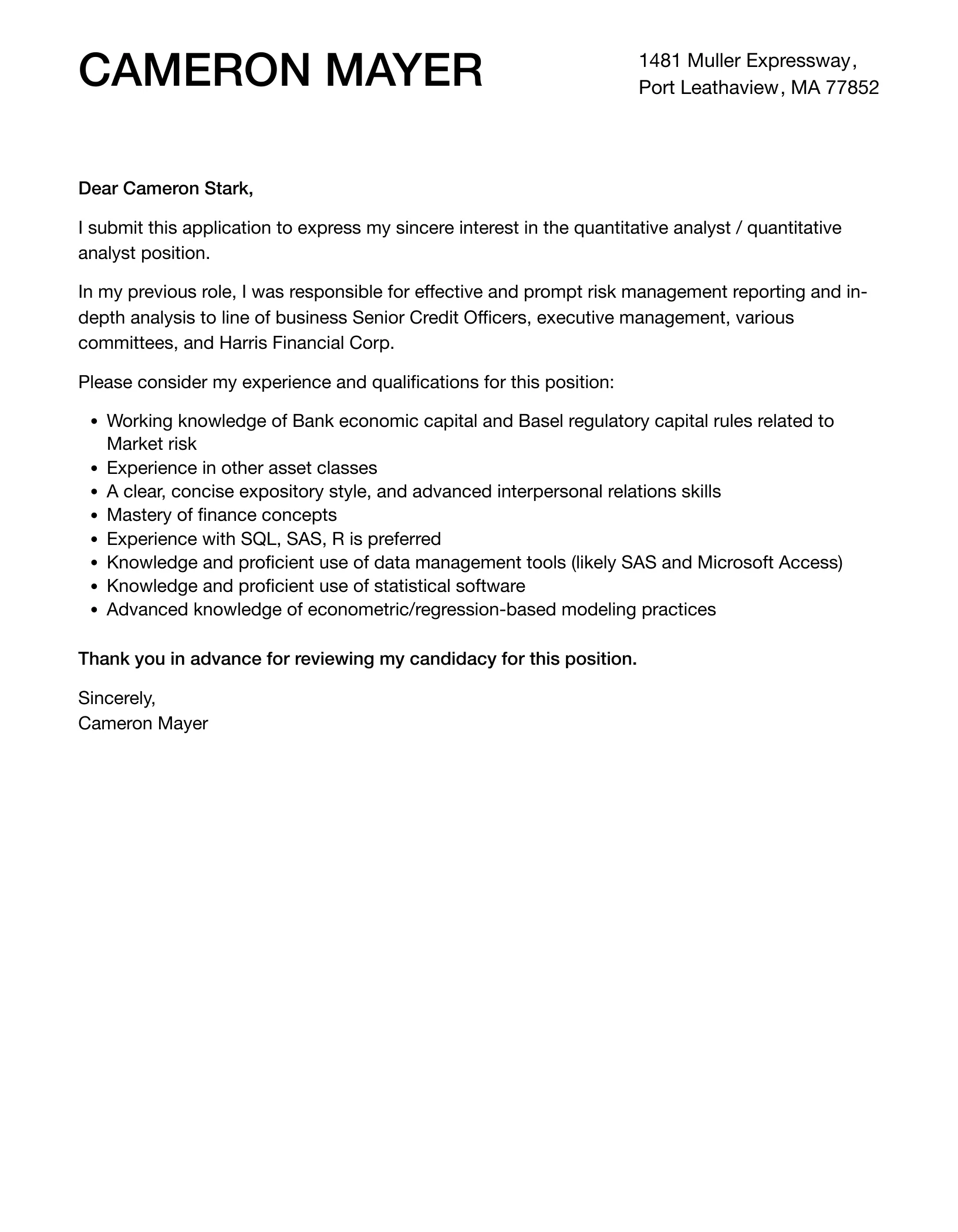
When writing a cover letter for a Quantitative Analyst position, focus your efforts on highlighting the skills and experiences that are most directly relevant to the role’s specific demands. This involves a potent combination of technical, analytical, and strong communication skills. Tailor your cover letter to the specific requirements detailed in the job description, with an emphasis on illustrating how your qualifications meet and exceed their stated criteria. Provide specific examples of your past accomplishments, and whenever possible, quantify your results to demonstrate the tangible value you can bring to the company. Demonstrating these critical skills shows that you thoroughly understand the job’s core requirements. A well-crafted cover letter, showcasing your most relevant and applicable skills, will make a strong and positive impression on all hiring managers.
Technical Skills
Technical skills are fundamentally essential for success in the Quantitative Analyst field. Highlight your demonstrable proficiency in programming languages such as Python, R, or C++. Mention your hands-on experience with statistical software packages like MATLAB, SAS, or SPSS. Showcase your in-depth knowledge of financial modeling, risk management methodologies, and derivatives pricing techniques. Specify any experience you have with databases and data manipulation tools. Provide compelling evidence of your proven ability to analyze and interpret complex datasets. Mention any particular financial models or methods with which you are exceptionally proficient, such as Monte Carlo simulations or regression analysis. Be sure to include your direct experience with all relevant software tools. Your technical skills are a cornerstone of your qualifications.
Analytical Skills

Quantitative Analysts require exceptionally strong analytical abilities. Emphasize your exceptional ability to analyze data, interpret the results of your analyses, and solve highly complex problems. Showcase your demonstrable skills in statistical analysis, rigorous hypothesis testing, and data visualization. Describe specific instances in which you have successfully utilized your analytical skills to identify key trends, make accurate predictions, or solve challenging business problems. Demonstrate your ability to effectively apply both mathematical and statistical concepts to address financial issues. Mention any experience you have with the development and implementation of quantitative models. Provide concrete, specific examples of how you have successfully applied your analytical skills in the past. Quantifiable results will further enhance your position.
Communication Skills
Effective communication is absolutely essential for a Quantitative Analyst. Highlight your proven ability to clearly and concisely communicate complex quantitative findings to both technical and non-technical audiences. Provide specific examples of situations in which you have presented your analyses and their results. Describe your experience in writing comprehensive technical reports or delivering impactful presentations to management. Showcase your ability to collaborate effectively with cross-functional teams. Mention your experience explaining complex financial concepts in a clear and understandable manner. Your capacity to effectively explain your results to those without technical backgrounds is a critical skill. Demonstrate your excellent communication skills throughout your cover letter, and be both clear and concise when describing your proficiencies.
Quant Analyst Cover Letter Examples
Carefully reviewing quantitative analyst cover letter examples can provide extremely valuable insights and inspiration. Seek out examples that are perfectly aligned with the specific roles and industries that you are targeting. Pay close attention to how the candidate effectively highlights their technical, analytical, and communication skills. Take careful note of how these cover letters are skillfully tailored to directly address the specific requirements of the job postings. Analyze how the most successful cover letters are consistently structured and the specific type of language and phrasing that they employ to most effectively engage the reader. Use these diverse examples as a helpful guide when creating your own, unique cover letter. The key is to take inspiration from these examples.
Key Takeaways and Next Steps
Writing a compelling cover letter for a quantitative analyst position requires meticulous attention to detail, the demonstration of strong skills, and an ability to personalize your application. Start by thoroughly understanding the specific requirements of the job. Structure your letter with a clear and professional header, compelling body paragraphs, and a professional closing. Highlight your most relevant technical, analytical, and communication skills, providing specific, concrete examples of your key achievements. Always proofread your cover letter meticulously and tailor it precisely to the specific job and the company’s requirements. For your next steps, comprehensively research the companies to which you are applying and consistently tailor your cover letter accordingly. Ensure that your resume is completely up-to-date and fully reflects your current skills and experiences. Begin applying for jobs diligently and strategically. By carefully following these steps, you will successfully craft a cover letter that effectively captures the hiring manager’s attention and makes a lasting positive impression. Your primary goal is to significantly increase your chances of landing an interview and ultimately securing a job offer. Remember, your cover letter is an investment that can yield substantial returns.