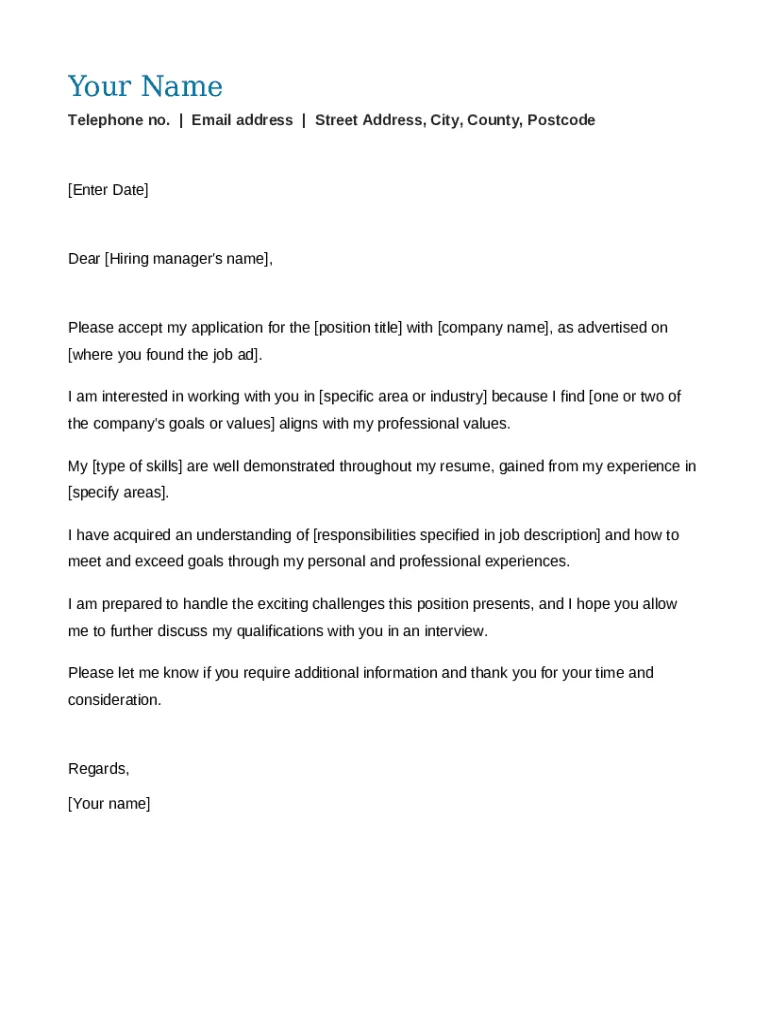
What is a Cover Letter?
A cover letter is a crucial document that accompanies your resume when applying for a job. It serves as an introduction, providing a personalized overview of your qualifications and expressing your interest in the specific position. Unlike a resume, which offers a factual summary of your skills and experience, a cover letter allows you to showcase your personality, writing skills, and enthusiasm for the role and the company. It’s your chance to make a strong first impression and persuade the hiring manager to read your resume and consider you for an interview. Therefore, a well-crafted cover letter is essential for standing out from the competition and increasing your chances of landing your dream job. It provides context to your application and highlights why you are a perfect fit for the role. The cover letter is where you can explain any gaps in your employment history, career changes, or other relevant information that may not be explicitly stated in your resume.
Why Cover Letters Matter
Cover letters are not just optional extras; they are vital components of a successful job application strategy. In today’s competitive job market, where hundreds of applicants compete for the same position, a cover letter gives you an opportunity to distinguish yourself. It allows you to demonstrate your genuine interest in the specific company and role. It gives you space to articulate how your unique skills and experiences align with the job requirements and the company’s values. Recruiters and hiring managers often read cover letters before reviewing resumes to gauge a candidate’s writing ability, attention to detail, and communication skills. A well-written cover letter can significantly increase your chances of getting your resume read and securing an interview. It offers a platform to address specific requirements mentioned in the job description, thus tailoring your application to meet their needs effectively. The cover letter becomes even more crucial if you are changing careers or have employment gaps. In such cases, a cover letter provides the opportunity to offer explanations and context to any potential concerns the hiring manager may have.
5 Top Cover Letter Tips

Writing a compelling cover letter can seem daunting, but with these five essential tips, you can create a document that captures attention and makes a strong case for your candidacy. The following tips will guide you through crafting a cover letter that not only meets but exceeds the expectations of hiring managers. Follow these tips to create a cover letter that effectively markets your skills, experiences, and enthusiasm. Each tip is designed to enhance your chances of making a positive impression and securing an interview. Use these guidelines to stand out from the crowd and showcase your professional persona.
Tip 1 Tailor Your Cover Letter
Generic cover letters are easily identified and often discarded. The key to a successful cover letter is customization. Tailor your letter to each specific job application. This means researching the company and the specific role you’re applying for. Carefully review the job description and identify the key skills, qualifications, and experiences the employer is seeking. Then, in your cover letter, demonstrate how your skills and experiences directly align with these requirements. Mention specific projects, achievements, or experiences that showcase your ability to meet the job’s needs. Personalize the letter by addressing the hiring manager by name (if possible) and expressing your genuine interest in the company’s mission, values, or recent projects. This level of detail proves you’ve done your homework and are genuinely interested in the position, increasing your chances of making a favorable impression and securing an interview. A generic cover letter makes you look disinterested and can cause a candidate to fail the hiring process.
Understanding the Job Description
The job description is the most important document to refer to when writing your cover letter. Carefully analyze the job description to understand the required skills, experience, and qualifications. Note the keywords and phrases used to describe the role and the company’s expectations. Identify the key responsibilities and tasks. Use this information to highlight the specific aspects of your background that align with these requirements. For instance, if the job description emphasizes experience in project management, then your cover letter should clearly and concisely detail your project management experience, including specific projects you’ve managed, the outcomes achieved, and the skills you used. Ensure that your cover letter aligns with each and every detail mentioned in the job description, which will show that you meet the requirements.
Highlighting Relevant Skills

Your cover letter should not be a mere repetition of your resume. Instead, use it to elaborate on the skills most relevant to the job. Identify the core skills the employer is seeking and provide concrete examples of how you’ve used these skills to achieve results. For instance, if the job requires strong communication skills, provide examples of successful presentations, written reports, or collaborations where you effectively communicated ideas and achieved desired outcomes. If the role demands technical skills, mention specific software or tools you’re proficient with and how you’ve applied them in previous roles. Quantify your achievements whenever possible to demonstrate the tangible impact you’ve made. Highlighting the relevant skills in your cover letter will help the hiring manager quickly assess your potential fit for the role. Provide clear and concise examples to show, rather than just tell, that you possess the skills needed to succeed.
Tip 2 Showcase Your Achievements
Instead of simply listing your responsibilities, focus on showcasing your achievements and the results you’ve delivered in previous roles. Use the STAR method (Situation, Task, Action, Result) to structure your examples. Describe the situation you were in, the task you needed to accomplish, the actions you took, and the positive results you achieved. This approach provides concrete evidence of your skills and abilities and demonstrates the value you can bring to the company. For example, rather than stating “Managed social media accounts,” write “Increased social media engagement by 30% in six months by implementing a new content strategy.” This shows not just what you did, but the specific impact of your actions. By highlighting your achievements, you will not only gain the hiring manager’s attention but also display your ability to excel in the role. Be sure to use action verbs to showcase your achievements.
Quantifying Your Accomplishments
Quantifying your accomplishments is one of the most effective ways to make your cover letter stand out. Whenever possible, use numbers, percentages, or specific data to illustrate the impact of your contributions. Instead of saying “Improved customer satisfaction,” quantify it by saying “Increased customer satisfaction scores by 15%.” Use metrics such as revenue growth, cost savings, project completion rates, or any other quantifiable data that demonstrates your effectiveness. Quantifying your achievements not only provides concrete evidence of your skills but also allows the hiring manager to easily assess the value you can bring to the company. This makes your accomplishments more impactful and memorable and makes it easy for the hiring manager to understand your value as a candidate.
Using Action Verbs Effectively

Action verbs are crucial in making your cover letter dynamic and engaging. Start your sentences with strong action verbs to describe your accomplishments and responsibilities. Avoid passive language and instead use verbs that convey action and results. For example, use verbs such as “led,” “managed,” “developed,” “achieved,” “implemented,” “increased,” or “reduced.” This will create a vivid image of your capabilities. For example, instead of writing “Was responsible for project management,” write “Managed multiple projects simultaneously, delivering them on time and under budget.” The effective use of action verbs immediately grabs the reader’s attention. It highlights your initiative and provides a clearer picture of your professional capabilities. Using a variety of action verbs will also show you’re a dynamic and effective communicator.
Tip 3 Format for Success
The format of your cover letter is just as important as its content. A well-formatted letter is easy to read, professional, and reflects your attention to detail. Use a clean, professional font such as Times New Roman, Arial, or Calibri, and maintain a consistent font size (11 or 12 points). Use appropriate spacing between paragraphs and sections to create a visually appealing layout. Keep your letter concise, ideally no more than one page. Break up large blocks of text with bullet points and short paragraphs. Your goal is to present your information in a clear, organized, and easy-to-scan format, making it simple for the hiring manager to quickly grasp the most important information. Ensure your formatting is consistent throughout your letter, from the header to the closing. Proper formatting increases the readability and professionalism of your cover letter.
Choosing the Right Font and Size
Selecting the right font and size is fundamental to the readability and visual appeal of your cover letter. Choose a professional font that is easy to read and widely recognized, like Times New Roman, Arial, or Calibri. Avoid using overly ornate or unconventional fonts. Stick to a font size between 11 and 12 points. This size is large enough to be easily read, but not so large that it appears unprofessional or takes up too much space. Ensure your font choice is consistent throughout the entire document. Maintain a consistent size throughout your letter. Selecting the correct font and size will help make your cover letter more accessible and appealing to the hiring manager, making it a more pleasant experience for the reader.
Structuring Your Letter

The structure of your cover letter should follow a standard format that includes an opening paragraph, body paragraphs, and a closing. In the opening paragraph, state the position you’re applying for and how you learned about it. Briefly highlight your key qualifications and express your enthusiasm for the role. The body paragraphs should elaborate on your relevant skills, experience, and achievements, providing specific examples and quantifiable results. Tailor each body paragraph to the specific requirements outlined in the job description. In the closing paragraph, reiterate your interest in the position, thank the hiring manager for their time and consideration, and include a call to action, such as encouraging them to contact you for an interview. Proofread your letter to avoid grammatical errors and ensure a smooth flow of information.
Tip 4 Proofread Carefully
Proofreading is an essential step in the cover letter writing process. Errors in grammar, spelling, and punctuation can undermine your credibility and detract from your qualifications. Carefully review your cover letter for any mistakes before submitting it. Read the letter slowly and deliberately, paying close attention to each word and sentence. Check for any grammatical errors, such as incorrect verb tenses, subject-verb agreement issues, or misuse of commas. Verify that all words are correctly spelled. A single typo can make a negative impression, indicating a lack of attention to detail. Take your time to proofread your cover letter thoroughly to increase your chances of getting a good impression to the hiring manager.
Checking for Grammar and Spelling
Grammar and spelling errors are the most common mistakes that can appear in cover letters. Ensure you run a thorough grammar and spell check before submitting your cover letter. Use a spell checker to catch any typos or incorrectly spelled words. But don’t rely solely on a spell checker. Proofread your letter manually to catch any errors that the spell checker might miss. Pay close attention to punctuation and capitalization, and ensure that all sentences are grammatically correct and complete. Correct grammar and spelling errors make a great first impression. A cover letter filled with errors can damage your application and reduce your chance of getting the job.
Getting a Second Opinion

It can be challenging to catch all your mistakes when you’re the one writing the cover letter. Getting a second opinion is always a good idea. Ask a friend, family member, career counselor, or trusted colleague to review your cover letter. They can provide an objective perspective and catch any errors or areas for improvement that you might have missed. Ask them to look for clarity, conciseness, and overall effectiveness. Their feedback can help you refine your letter and make sure it is polished and professional. A fresh pair of eyes can offer valuable insights and help you produce a cover letter that showcases you in the best light.
Tip 5 Call to Action
A strong call to action in your cover letter encourages the hiring manager to take the next step and contact you for an interview. Express your enthusiasm for the role and the company. Restate your interest in the position and reiterate how your skills and experiences align with the job requirements. Clearly state your availability for an interview. Also, include your contact information, such as your phone number and email address. Making it easy for the hiring manager to reach you. A strong call to action reinforces your interest and increases the likelihood of the hiring manager taking action. It encourages them to move forward in the hiring process. It shows you are proactive and keen to proceed with the application.
Expressing Enthusiasm
Expressing genuine enthusiasm is a vital part of a cover letter. Show your excitement for the role and the company. Share your excitement for the opportunity. Tell them why you’re excited about the specific responsibilities and what you will bring to the team. Highlight why you’re passionate about the industry or the company’s mission. Use phrases that reflect your eagerness, such as “I am very enthusiastic about the opportunity” or “I am excited about the prospect of.” Enthusiasm makes a positive impression and helps you stand out. It demonstrates that you are not just looking for a job but are genuinely interested in the opportunity and are eager to contribute to the company’s success. Your level of enthusiasm might determine your success in the hiring process.
Providing Contact Information

Make it easy for the hiring manager to reach you by providing your contact information in your cover letter. Include your phone number and email address, making sure that both are up to date. Consider including your LinkedIn profile URL, which offers additional information about your professional background. Place your contact information in a prominent location, such as at the top of the cover letter. A simple layout increases the chances that the hiring manager can quickly contact you. Ensuring your contact information is accurate and accessible. It is crucial to securing an interview opportunity. This final touch ensures that the hiring manager can easily reach you to discuss the next steps in the hiring process. A cover letter without contact information is less likely to be considered.