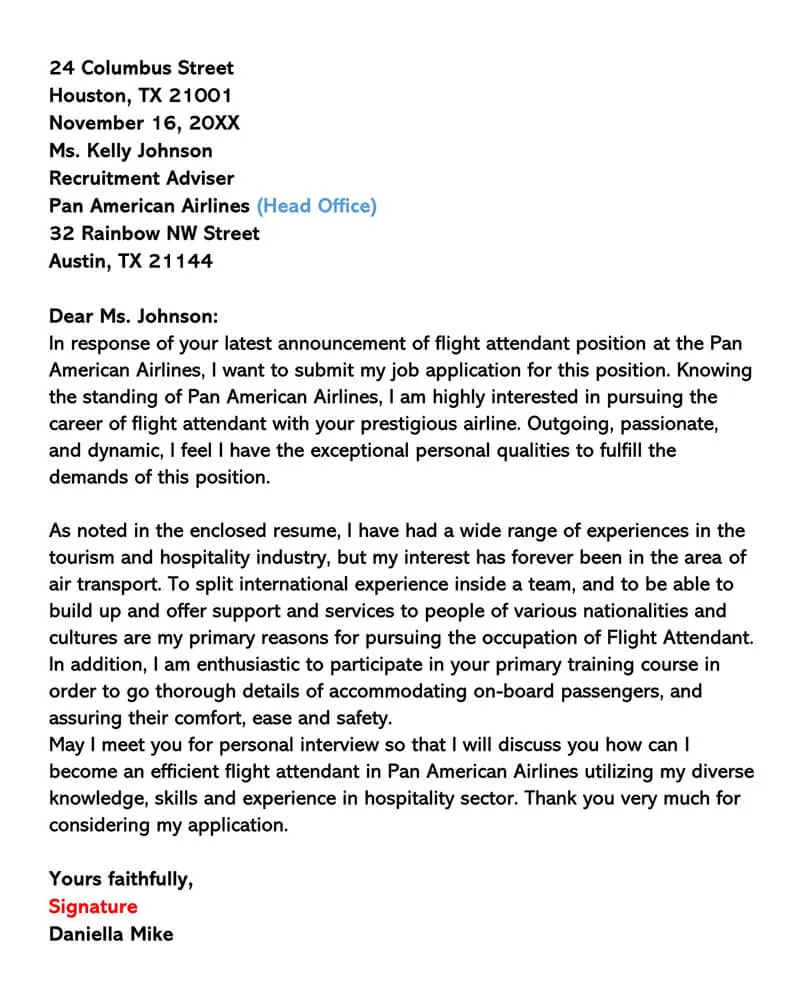
Crafting Your Flight Attendant Cover Letter
A compelling flight attendant cover letter is your first opportunity to make a positive impression on a potential employer. It’s more than just a formality; it’s a crucial marketing tool. The cover letter allows you to showcase your personality, enthusiasm, and relevant skills, setting you apart from other applicants. To get hired, you need to demonstrate a clear understanding of the role, the airline’s values, and how your experience aligns with their needs. A well-crafted cover letter is a strategic advantage in a competitive job market, helping you secure an interview and ultimately, your dream job in the skies. Before starting, always tailor your cover letter to each specific airline you’re applying to, as each company has its own culture and preferences.
Researching the Airline
Before you begin writing, thorough research is essential. Understand the airline’s mission, values, and the specific qualities they seek in flight attendants. Visit their website, explore their social media presence, and read news articles or press releases about the company. This will give you valuable insights into their brand and culture. Tailor your cover letter to reflect your knowledge of the airline and express your genuine interest in their specific operations. For example, if an airline emphasizes safety, highlight your ability to remain calm under pressure and your commitment to safety protocols. If the airline is known for its customer service, showcase your experience in resolving customer issues and providing excellent service. This research demonstrates your proactive approach and your dedication to being a valuable member of their team. Your cover letter will resonate more with the hiring manager when they see you’ve taken the time to understand their company.
Highlighting Relevant Skills

The skills that make a great flight attendant are diverse. Focus on the skills that align with the airline’s expectations. Highlight skills that are directly transferable to the role. Your cover letter should showcase how your skills and experiences meet the airline’s requirements. Instead of merely listing skills, provide concrete examples of how you’ve applied them. Use the STAR method (Situation, Task, Action, Result) to illustrate your abilities. Start by briefly setting the scene, then describe the task or challenge you faced. Next, detail the actions you took and conclude with the positive result. This provides a clear and compelling picture of your capabilities, and your ability to perform the duties. Consider your experience working with other individuals. Flight attendants are not only good at helping their passengers, but they are excellent at teamwork as well.
Showcasing Customer Service Experience
Exceptional customer service is the cornerstone of a flight attendant’s role. Highlight your experience in creating positive interactions and resolving customer issues. Give examples of difficult situations you’ve handled, and how you ensured the customer was satisfied. If you have received positive feedback from customers or supervisors, include a brief quote or reference it in your letter. Be specific about how you handled complaints, addressed passenger needs, or went above and beyond to make a passenger’s experience pleasant. If you’ve worked in the hospitality industry, detail the extent of your experience. Airlines want to see that you genuinely care about the passenger experience.
Demonstrating Communication Prowess
Effective communication is vital for flight attendants. Highlight your ability to communicate clearly, concisely, and empathetically, both verbally and in writing. Demonstrate your ability to adapt your communication style to diverse audiences. Consider your experience in any type of role that requires communicating to others. Provide instances where you explained complex information in a way that was easy to understand, or how you handled difficult conversations with tact and diplomacy. Also, mention your experience in other languages, as this is a valuable asset. Strong communication skills are critical for both ensuring passenger safety and maintaining a positive atmosphere. It’s about active listening, and ensuring that everyone feels welcome and informed.
Emphasizing Adaptability and Problem-Solving

Flight attendants often face unexpected situations. Highlight your ability to think on your feet, remain calm under pressure, and adapt to changing circumstances. Share examples where you successfully handled emergencies, resolved conflicts, or found creative solutions to challenges. Describe incidents in detail, showing how you quickly assessed the situation, made decisions, and executed a plan of action. Airlines value candidates who can handle stressful situations. Highlight your ability to remain flexible and adaptable, especially when unexpected situations arise. Flight attendants must be problem solvers, ready to find solutions quickly.
Formatting Your Cover Letter
The layout and presentation of your cover letter are important. Use a professional format that is easy to read. The formatting reflects your attention to detail and your commitment to professionalism. Use a clean, readable font, such as Arial or Times New Roman. Be consistent with your formatting throughout the document. Ensure there is sufficient spacing between paragraphs and sections. Proofread everything. Use a well-structured layout that is simple and organized. Always tailor the format to the specific instructions. You can find many cover letter templates online to help you. A well-formatted cover letter makes a positive impression.
Header and Contact Information
Begin your cover letter with your contact information. Include your full name, address, phone number, and email address. Also, include the date and the hiring manager’s name and title, if known. Ensure that your contact information is accurate and up-to-date. Use a professional email address. Check that your voicemail is set up correctly. This makes it easy for the recruiter to contact you. Always format your header in a professional style.
Greeting and Salutation

Address your cover letter to a specific person whenever possible. Use a professional greeting, such as “Dear Mr./Ms. [Last Name]” or “Dear Hiring Manager.” If you don’t know the hiring manager’s name, research the company’s website or LinkedIn to find it. Avoid generic greetings, such as “To Whom It May Concern.” A personalized greeting shows that you have taken the time to research the company and are genuinely interested in the role. It shows that you are attentive to detail and proactive in your approach. A personalized greeting will make your cover letter stand out from the others.
Body Paragraph Structure
Structure your body paragraphs to highlight your relevant skills and experience. The first paragraph should state the position you are applying for and where you found the job posting. Then, use the subsequent paragraphs to showcase your skills. Explain how your skills and experiences align with the specific requirements of the role. Use the STAR method to provide concrete examples of your accomplishments. Keep each paragraph focused on a specific skill or experience and make sure each paragraph is clear. Aim for a tone that is both professional and enthusiastic, showing your passion for the role. Tailor the content to showcase your unique value proposition. Remember to keep the body of the letter concise, and easy to read.
Writing a Strong Closing
Your closing paragraph should reiterate your interest in the position and the airline. Express your enthusiasm. Thank the hiring manager for their time and consideration. Include a call to action, such as stating that you are available for an interview. Provide your contact information again. Your closing should leave a lasting, positive impression. A strong closing reinforces your qualifications and your desire to become a flight attendant. Keep it brief and to the point. A professional closing will increase your chances of getting an interview.
Reviewing and Proofreading

Before submitting your cover letter, proofread it carefully to ensure it is error-free. A polished cover letter reflects your attention to detail and your commitment to excellence. Spelling and grammar errors can create a negative impression, potentially costing you the opportunity. Always read it aloud, or use online tools to double-check your writing. Take breaks between writing and reviewing, which will help you see the letter with fresh eyes. Always go through the process to make sure your cover letter accurately reflects your strengths. Proofreading and reviewing are essential for a well-crafted cover letter.
Seeking Feedback
It’s helpful to get feedback from trusted sources before you submit your cover letter. Ask friends, family, or career counselors to review your cover letter. Seek advice from people who have experience in the aviation industry. Be open to suggestions, and use the feedback to improve your cover letter. Another set of eyes can catch errors you might have missed. Feedback can help you improve the structure, content, and clarity of your letter. Getting constructive criticism can help you fine-tune your message and make it more impactful. Consider all advice, and make the changes that you feel are best.
Proofreading for Errors
Pay close attention to spelling, grammar, and punctuation. Check that all words are spelled correctly, and that sentences flow smoothly. Use online tools like Grammarly to check for common errors. Make sure that your formatting is consistent. Review the tone of your letter to ensure it is professional and enthusiastic. Check that the contact information is correct. Proofreading is a crucial step. A cover letter with errors may not be considered. Your ability to catch small errors and be thorough is part of your potential as a flight attendant.