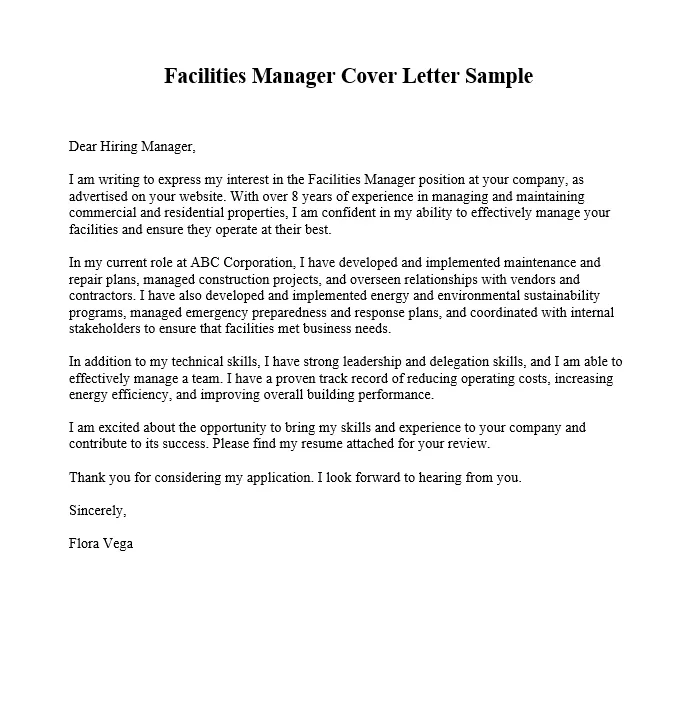
Crafting a Compelling Facilities Manager Cover Letter
A well-crafted facilities manager cover letter is your first opportunity to make a positive impression on a potential employer. It’s not just a formality; it’s a crucial marketing tool that showcases your qualifications, skills, and experience. Your cover letter should be more than just a summary of your resume. It should be a persuasive document that highlights why you are the ideal candidate for the specific facilities manager position. A strong cover letter demonstrates your understanding of the role and the company’s needs. It sets the stage for a more in-depth conversation during an interview, ultimately increasing your chances of landing the job. The goal is to create a compelling narrative that captures the hiring manager’s attention and makes them eager to learn more about you.
Understanding the Purpose of Your Cover Letter
The primary purpose of a facilities manager cover letter is to introduce yourself and your qualifications to a prospective employer. It serves as a personal introduction, allowing you to elaborate on your skills and experience in a way that a resume alone cannot. The cover letter’s secondary purposes include demonstrating your interest in the specific role and company, showcasing your communication skills, and highlighting your unique value proposition. A well-written letter also gives you the opportunity to address any potential gaps in your resume or explain career transitions. Furthermore, it provides a platform to showcase your personality and enthusiasm for the facilities management field. By clearly articulating your goals and how they align with the company’s needs, you set the stage for a successful application and demonstrate that you’ve put thought into the opportunity.
Highlighting Key Skills and Qualifications

Facilities managers require a diverse set of skills, and your cover letter is the perfect place to showcase them. Begin by identifying the key skills mentioned in the job description. These might include project management, budget management, vendor negotiation, maintenance, safety compliance, and leadership. Provide specific examples of how you have utilized these skills in previous roles. For instance, instead of simply stating “managed budgets,” describe your experience in developing and implementing budgets, controlling costs, and achieving financial goals. Also, emphasize your qualifications, such as relevant certifications (e.g., CFM, FMP) or educational background (e.g., a degree in facilities management, engineering, or a related field). Always align your skills and qualifications with the specific requirements of the job, demonstrating that you are a perfect fit.
Emphasizing Relevant Experience
Focus on your experience relevant to the facilities manager position you are applying for. Highlight your experience in areas such as property management, building maintenance, space planning, and energy management. Use the STAR method (Situation, Task, Action, Result) to illustrate your achievements. For example, if you successfully managed a major renovation project, describe the situation (e.g., an aging building with outdated systems), the task (e.g., overseeing the renovation), the action (e.g., coordinating contractors, managing budgets, and ensuring timely completion), and the result (e.g., completing the project on time and under budget, improving energy efficiency). Providing concrete examples of your experience adds credibility and demonstrates your ability to deliver results. Prioritize experiences that align with the job description, emphasizing the impact you made in previous roles.
Quantifying Achievements to Impress
Numbers speak volumes. Whenever possible, quantify your achievements to make a strong impression. Instead of saying “Improved efficiency,” state “Increased operational efficiency by 15% through the implementation of a new maintenance schedule.” Quantify budget management responsibilities by stating, “Managed a facilities budget of $X million annually.” Quantify your success in vendor negotiations by stating something like, “Negotiated contracts with vendors, resulting in a 10% cost reduction.” By using specific metrics, you provide tangible evidence of your accomplishments and demonstrate your value to potential employers. Quantifiable achievements make your cover letter more impactful and help the hiring manager understand the value you brought to previous roles.
Showcasing a Strong Understanding of the Role

Demonstrate your understanding of the facilities manager role by explaining how you would approach the responsibilities outlined in the job description. Briefly discuss your strategy for managing budgets, overseeing maintenance, ensuring safety compliance, and managing a team. Showcase your knowledge of industry best practices and relevant regulations. For example, mention your experience with preventative maintenance programs, emergency response protocols, and sustainability initiatives. Mention your experience with relevant software (e.g., CMMS) or technologies. Demonstrate your commitment to creating a productive and efficient work environment. Tailor your statements to the specific job description, indicating that you understand the company’s priorities and are prepared to meet its needs.
Tailoring Your Letter to the Specific Job
Generic cover letters are easy to spot and rarely make a strong impression. Tailor your cover letter to each specific job you apply for. Carefully review the job description and identify the key requirements and desired qualifications. Customize your letter to address those specific needs, emphasizing the skills and experience that align with the job’s requirements. Demonstrate your genuine interest in the company and the position by referencing specific aspects of the job description. Also, personalize your cover letter by mentioning any relevant connections to the company or industry. By demonstrating that you’ve taken the time to understand the specific needs of the employer, you show your commitment and increase your chances of getting noticed.
Researching the Company and Its Culture
Before writing your cover letter, research the company and its culture. Visit the company website, read news articles, and check out their social media profiles. Understanding the company’s mission, values, and recent achievements will allow you to personalize your letter and demonstrate your genuine interest. Use this information to tailor your letter, highlighting how your skills and experience align with the company’s goals. For example, if the company emphasizes sustainability, mention your experience with energy-efficient practices. Researching the company also helps you identify the hiring manager and tailor your letter to their specific needs, making your application more effective. By showing that you’ve taken the time to learn about the company, you make a positive first impression and increase your chances of getting an interview.
Formatting Your Cover Letter for Success

A well-formatted cover letter is easy to read and professional-looking. Use a clear and concise font, such as Times New Roman, Arial, or Calibri. Maintain consistent formatting throughout the letter, including the font size, spacing, and margins. Start with your contact information and the date, followed by the hiring manager’s name and title (if available). Address the letter to the hiring manager directly, using their name. Divide your letter into clear paragraphs, each addressing a specific point. Keep paragraphs concise and to the point. End with a professional closing, such as “Sincerely” or “Best regards,” followed by your typed name. Use a professional template to create a visually appealing letter that reflects positively on your qualifications and shows attention to detail.
Using Keywords to Optimize Your Letter
Many companies use Applicant Tracking Systems (ATS) to scan resumes and cover letters for relevant keywords. To optimize your letter, incorporate keywords from the job description. Identify the key skills, qualifications, and requirements mentioned in the job posting and strategically include those terms in your cover letter. This will help your letter get noticed by the ATS and increase the likelihood that your application will be reviewed by a human. However, avoid keyword stuffing, which can make your letter sound unnatural and detract from your message. Use keywords naturally within the context of your writing, demonstrating your understanding of the role and your ability to meet the employer’s needs.
Proofreading and Editing for Perfection
Proofreading and editing your cover letter is critical. Errors in grammar, spelling, or punctuation can create a negative impression and undermine your credibility. Before submitting your letter, carefully review it for any mistakes. Read it aloud to catch any awkward phrasing or sentence structure. Ask a friend or colleague to proofread your letter for a second opinion. Ensure that your contact information is accurate and up-to-date. Proofread all the details, including the company name, the hiring manager’s name, and the job title. A well-proofread cover letter demonstrates your attention to detail and commitment to professionalism, significantly increasing your chances of success.
Common Mistakes to Avoid in Your Cover Letter

Several common mistakes can derail your application. Avoid generic, cookie-cutter cover letters, as these demonstrate a lack of interest. Do not simply rehash your resume; use the cover letter to expand on your qualifications and provide context. Refrain from using overly formal or verbose language. Focus on clarity and conciseness. Never use jargon or technical terms that the hiring manager may not understand. Avoid negative language or making complaints about previous employers. Always tailor your letter to the specific job and the company’s needs. Proofread your letter carefully, and ensure there are no grammatical or spelling errors. By avoiding these common pitfalls, you can significantly increase your chances of success.
Closing Your Cover Letter with Confidence
Your closing paragraph is your final opportunity to make a strong impression. Clearly state your interest in the position and reiterate your enthusiasm for the opportunity. Express your confidence that you possess the skills and experience needed to succeed in the role. Include a call to action, such as, “I am eager to discuss my qualifications further in an interview.” Provide your contact information, including your phone number and email address. Thank the hiring manager for their time and consideration. Use a professional closing, such as “Sincerely” or “Best regards,” followed by your typed name. A confident and well-crafted closing paragraph can leave a lasting positive impression and encourage the hiring manager to contact you.
Following Up After Submitting Your Application
After submitting your application, follow up with the hiring manager to express your continued interest. Send a brief email or make a phone call one or two weeks after submitting your cover letter and resume. Reference the specific job you applied for and reiterate your interest in the position. Briefly mention something you discussed in your cover letter to remind the hiring manager of your qualifications. This is a chance to demonstrate your enthusiasm and reinforce your application. Keep your communication brief, professional, and courteous. If you haven’t heard back after a reasonable period, consider following up again. A well-timed follow-up shows initiative and demonstrates your commitment to the role.