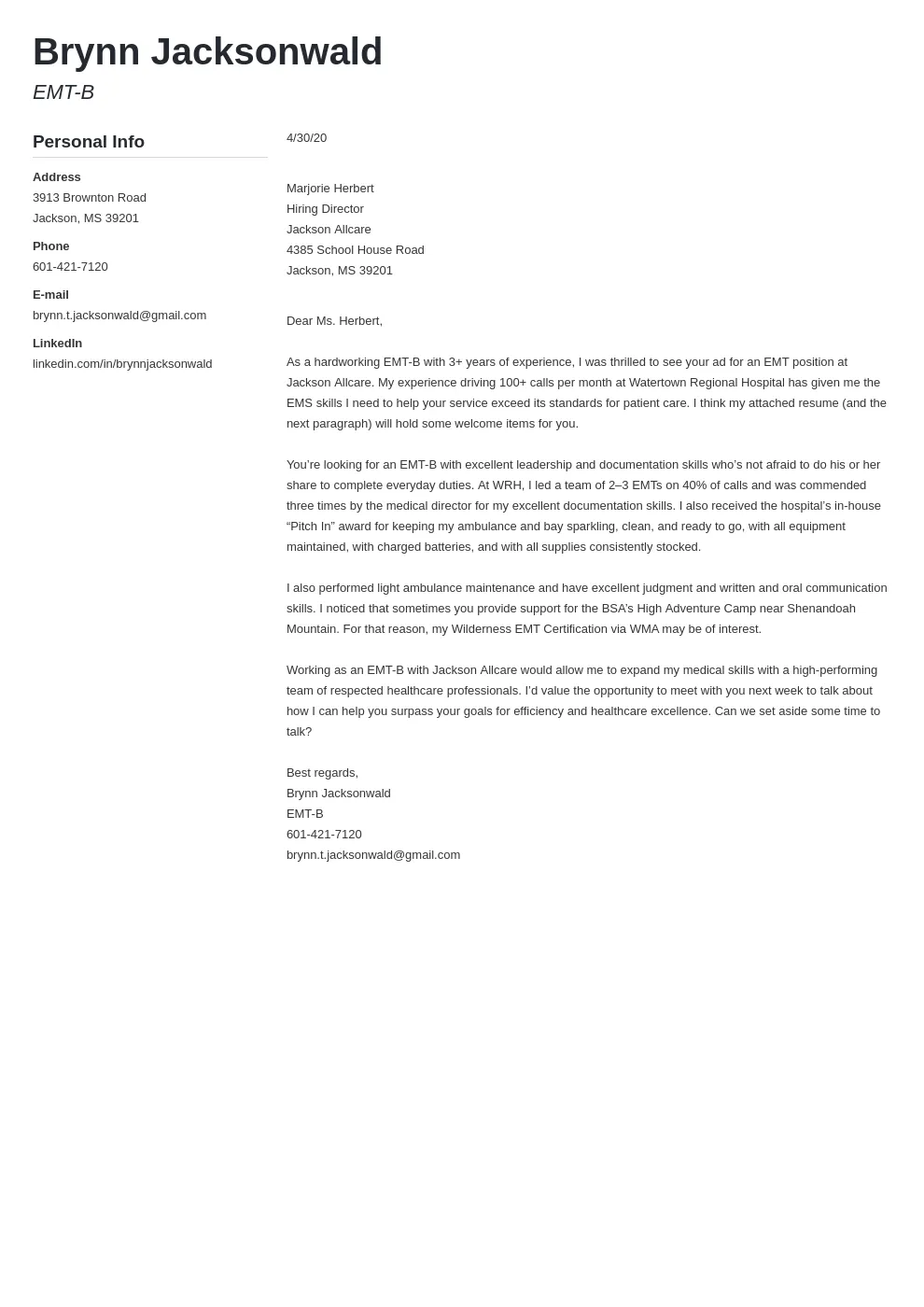
Understanding the Importance of an Emergency Medicine Cover Letter
In the competitive field of emergency medicine, a well-crafted cover letter is your first opportunity to make a strong impression. It’s more than just a formality; it’s your chance to showcase your personality, passion for the profession, and suitability for a specific role. A cover letter complements your resume by providing context, detailing your experiences, and highlighting your key skills in a way that a resume alone cannot. It allows you to express your interest in the position and the organization, demonstrating that you’ve done your research and are genuinely interested in contributing to their team. A compelling cover letter can be the difference between getting an interview and being overlooked.
Why a Cover Letter Matters in Emergency Medicine
Emergency medicine demands quick thinking, decisive action, and the ability to work under pressure. Your cover letter is where you demonstrate these qualities. It’s a chance to highlight your commitment to patient care, your ability to work effectively in a high-stress environment, and your dedication to continuous learning and professional development. Emphasize your understanding of the unique challenges and rewards of emergency medicine, demonstrating your enthusiasm for the specialty. Tailor your letter to each specific job application, reflecting on how your skills and experience align with the specific requirements and values of the hospital or clinic. By personalizing your cover letter, you show that you have taken the time to understand the role and are truly interested in the opportunity.
Highlighting Relevant Skills and Experience

Your cover letter should serve as a bridge between your resume and the job description, highlighting the skills and experiences most relevant to the position. Think about the specific requirements listed in the job posting and identify instances where you have demonstrated those skills. Focus on your experience in emergency medicine, including any specializations, certifications, or areas of expertise. Emphasize skills such as rapid assessment, critical decision-making, teamwork, communication, and adaptability. Use specific examples from your past experiences to illustrate your abilities. For example, describe a time you successfully managed a high-pressure situation, or collaborated effectively with a multidisciplinary team to achieve a positive patient outcome. This provides concrete evidence of your skills and abilities.
Key Components of a Compelling Emergency Medicine Cover Letter
Contact Information and Formal Salutation
Begin with your contact information, including your name, address, phone number, and email address. This should be clearly displayed at the top of the letter. Always address your letter to a specific person if possible. Research the hiring manager’s name and use a formal salutation, such as “Dear Dr. [Last Name]” or “Dear Hiring Manager.” This shows that you’ve taken the time to personalize your application and are serious about the opportunity. Avoid generic greetings like “To Whom It May Concern.”
Opening Paragraph Your Hook

The opening paragraph is your chance to grab the reader’s attention. Start with a strong statement of your interest in the position and the organization. Briefly mention your qualifications and experience, and state why you are a good fit for the role. This should be concise and engaging, highlighting your enthusiasm and setting the tone for the rest of the letter. Consider mentioning something specific that attracted you to the position or the organization, showing that you have done your research and understand their mission or values. For example, you might reference a recent achievement of the hospital or a specific program that aligns with your interests.
Body Paragraphs Showcasing Achievements
The body of your cover letter is where you provide the details of your skills, experiences, and achievements. Use this section to expand on the information in your resume, providing more context and demonstrating how your qualifications match the job requirements. Provide specific examples of your accomplishments, using the STAR method (Situation, Task, Action, Result) to clearly illustrate your abilities. Focus on your achievements and quantify your impact whenever possible. Discuss your clinical experience, your ability to work as part of a team, and your commitment to patient care. Demonstrate how your skills and experiences align with the specific needs of the hospital or clinic.
Quantifying Accomplishments
Whenever possible, quantify your accomplishments. Use numbers and statistics to demonstrate your impact. For example, instead of saying “Improved patient outcomes,” say “Improved patient outcomes by 15% through implementation of a new sepsis protocol.” This provides concrete evidence of your abilities and makes your achievements more impactful. Quantifying your achievements helps the hiring manager understand the scope and significance of your contributions. Other examples include: “Managed an average of 25 patients per shift,” “Trained 10 new residents,” or “Reduced patient wait times by 20%.” By using specific metrics, you make your cover letter more compelling and demonstrate your ability to deliver results.
Tailoring Your Cover Letter to the Job

Avoid using a generic cover letter. Customize your cover letter for each job application. Carefully review the job description and identify the specific skills, experiences, and qualifications that the employer is seeking. Highlight the experiences and skills that align with the job requirements. Research the hospital or clinic and understand their mission, values, and priorities. Demonstrate your understanding of the organization and explain why you are a good fit for their team. Tailoring your cover letter demonstrates that you are genuinely interested in the position and have taken the time to understand the organization’s needs. This significantly increases your chances of getting an interview.
Closing Paragraph and Call to Action
In your closing paragraph, reiterate your interest in the position and thank the hiring manager for their time and consideration. Express your enthusiasm for the opportunity and reiterate your qualifications. Include a call to action, such as inviting the hiring manager to contact you for an interview. Provide your contact information again and express your availability for an interview. Keep the tone professional and enthusiastic, and make sure to proofread your closing paragraph carefully for any errors. End with a professional closing, such as “Sincerely” or “Respectfully.”
Formatting and Presentation of Your Cover Letter
Font Selection and Readability

The appearance of your cover letter is just as important as its content. Choose a professional and easy-to-read font, such as Times New Roman, Arial, or Calibri. Use a font size between 10 and 12 points. Ensure that your letter is well-formatted, with clear headings, bullet points (where appropriate), and sufficient white space. This will make your cover letter easier to read and more visually appealing. Avoid using overly elaborate fonts or formatting that might distract from the content. Keep the layout clean and uncluttered to make a positive impression on the reader.
Proofreading and Editing Your Cover Letter
Before submitting your cover letter, carefully proofread it for any errors in grammar, spelling, and punctuation. Ask a friend, colleague, or mentor to review your cover letter for you. Multiple sets of eyes can catch mistakes that you might have missed. Pay close attention to the details, ensuring that your contact information is correct and that your letter is free of typos. Make sure the tone of the letter is professional and reflects your personality in a positive way. A polished and error-free cover letter demonstrates your attention to detail and professionalism. Errors can give the impression that you lack attention to detail, which is crucial in the field of emergency medicine.
Emergency Medicine Cover Letter Examples
Example 1 Demonstrating Specific Skills

A strong cover letter example would highlight specific skills relevant to emergency medicine. “In my role at [Hospital Name], I consistently demonstrated proficiency in advanced cardiac life support (ACLS), successfully resuscitating multiple patients experiencing cardiac arrest. Furthermore, I have extensive experience in trauma management, including rapid assessment, stabilization, and definitive care of patients with complex injuries. My ability to remain calm and focused under pressure, coupled with my excellent communication skills, enabled me to effectively coordinate with interdisciplinary teams and ensure optimal patient outcomes.”
Example 2 Highlighting Relevant Experience
This example illustrates the importance of detailing relevant experience. “During my residency at [Hospital Name], I gained extensive experience in managing a diverse range of emergency cases, from acute illnesses to complex trauma scenarios. I played a key role in establishing a new protocol for the treatment of sepsis, which resulted in a 15% reduction in mortality rates within the first year. I also actively participated in research projects focusing on improving patient outcomes in the emergency department, and I am confident in my ability to contribute to the success of your team at [Clinic Name].”
Example 3 Showcasing Leadership Abilities
Leadership skills are key in emergency medicine. “As a senior resident at [Hospital Name], I took on a leadership role, mentoring junior residents and medical students. I organized and led simulation exercises to enhance the team’s performance in high-pressure situations. I also served as a liaison between the emergency department and other departments, ensuring smooth communication and collaboration. My commitment to teamwork, my ability to make critical decisions under pressure, and my dedication to teaching make me a strong candidate for this position. These examples highlight the importance of showing, not just telling, about your skills and experience in your cover letter.”
Common Mistakes to Avoid in Your Emergency Medicine Cover Letter

Generic Cover Letters
Avoid sending a generic cover letter that can be used for any job. Tailor each letter to the specific position and organization. Generic cover letters lack personalization and demonstrate a lack of genuine interest in the role. They do not reflect that you have taken the time to understand the needs of the hiring organization or the specific requirements of the job. Tailoring your cover letter to the job makes it much more likely to stand out from the competition. Use the job description to understand the required skills and qualifications. This way, you can show why you are the perfect fit for the specific position.
Typos and Grammatical Errors
Proofread your cover letter meticulously to avoid typos and grammatical errors. Mistakes can undermine your credibility and suggest a lack of attention to detail, which is critical in emergency medicine. Always use spell-check and grammar-check tools, but don’t rely on them entirely. Ask a colleague or mentor to review your letter. Typos and grammatical errors can create a negative impression and may lead to your application being rejected. A polished and professional cover letter reflects your attention to detail, which is valued in the medical profession.
Lack of Personalization

Make sure your cover letter is personalized. Addressing the hiring manager by name and referring to specific aspects of the organization demonstrates your genuine interest in the role. Avoid generic salutations such as “To Whom It May Concern.” Personalize your cover letter to show that you have researched the organization and understand their needs. Research the organization’s mission, values, and recent achievements. Demonstrating your knowledge will make a positive impression and demonstrate your commitment to the role. Customize your cover letter for each job application, ensuring that it highlights the specific skills and experience that match the job requirements.
Where to Find Emergency Medicine Cover Letter Templates
Several online resources provide cover letter templates and examples. Websites such as [Indeed, LinkedIn, Zety] offer templates that can be customized to fit your needs. These templates can serve as a starting point, but always remember to personalize the letter to reflect your unique qualifications and the specific job you are applying for. Use the templates to understand the general structure and content of a cover letter, but tailor them to your individual experiences and the requirements of the job. Reviewing several templates can also give you ideas for structuring your letter and highlighting your key skills and experiences. Be careful to modify templates and make them your own; do not use the exact template without adjustments.