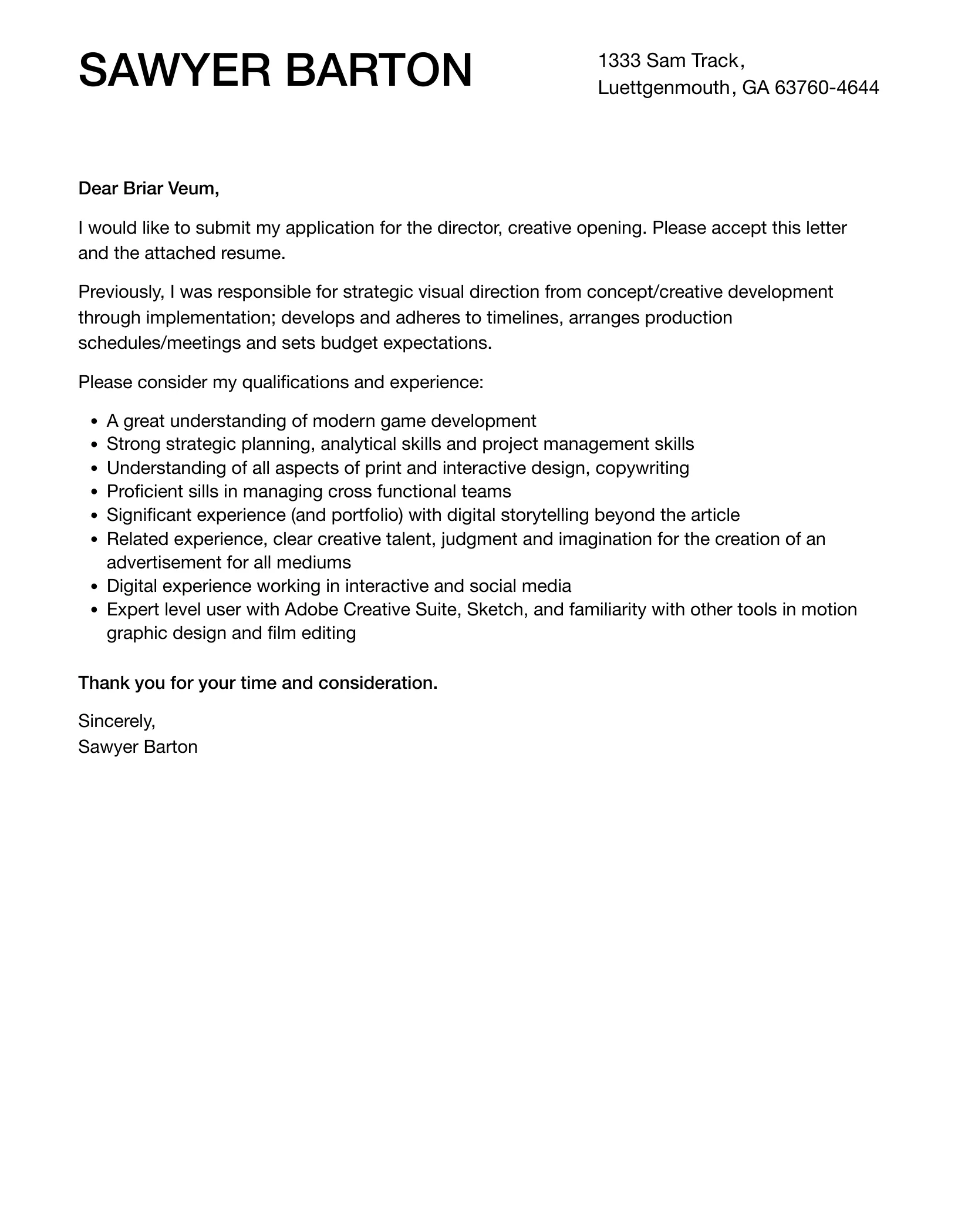
What Is a Creative Director Cover Letter
A Creative Director cover letter is a crucial document that accompanies your resume when applying for creative director positions. It serves as your first introduction to a potential employer, providing an opportunity to showcase your skills, experience, and personality in a way that your resume alone cannot. Unlike a resume, which lists your qualifications, a cover letter allows you to tell your story and explain why you are the ideal candidate for the role. It is a chance to demonstrate your passion for creativity, your leadership abilities, and your understanding of the company’s needs. A well-crafted cover letter can significantly increase your chances of landing an interview.
Why is a Cover Letter Important for a Creative Director
In the competitive field of creative direction, a cover letter is not just important, it’s essential. Firstly, it allows you to personalize your application. Creative roles often value individuality and a cover letter provides a space to express your unique approach and perspective. Secondly, it helps you demonstrate your communication skills. Creative directors must effectively communicate ideas and vision, and your cover letter is a direct example of your writing proficiency. Thirdly, a cover letter allows you to bridge the gap between your resume and the job description. By highlighting specific skills and experiences that align with the role, you show the hiring manager why you are a perfect fit. Finally, a cover letter gives you the opportunity to expand on your achievements, providing context and depth to your accomplishments that a resume may lack.
Key Elements to Include in Your Creative Director Cover Letter

A strong Creative Director cover letter needs several key elements to capture attention and demonstrate your suitability for the role. Starting with the basics, make sure you have your contact information and the date at the top, followed by the hiring manager’s information. The opening paragraph is crucial as it sets the tone. Make sure to highlight your key skills and experience, showcasing relevant projects and achievements that align with the job requirements. Quantify your accomplishments whenever possible, using numbers and data to illustrate your impact. Furthermore, demonstrate your understanding of the role and the company, showing you’ve done your research. Express your enthusiasm and fit, making it clear why you want this specific position. Remember to structure your cover letter effectively, using a compelling introduction, well-developed body paragraphs, and a powerful closing statement.
Your Contact Information and the Date
Begin your cover letter with your full name, address, phone number, and email address at the top. Directly below your contact information, include the date. This ensures the hiring manager can easily reach you and also establishes a clear timeline for your application. Make sure the information is accurate and up-to-date. Using a professional email address is also a must. This section of your cover letter sets the stage for a polished and professional presentation.
The Hiring Manager’s Information
Whenever possible, address your cover letter to a specific person – the hiring manager or the creative director. Research the company website, LinkedIn, or other sources to find this information. Addressing the cover letter to a specific person immediately personalizes your application and shows you’ve taken the time to research the company. If you are unable to find a specific name, you can use a title such as ‘Hiring Manager’ or ‘Creative Director’. However, personalizing your letter adds a significant touch. If you are unsure about the name, avoid using a generic opening, and try to find out who is in charge of hiring.
A Compelling Opening Paragraph
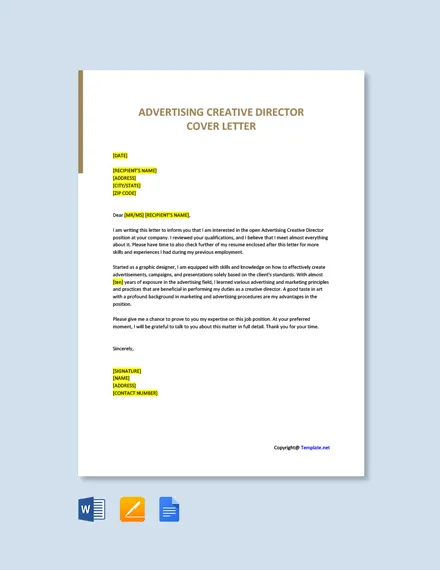
The opening paragraph is your hook. It should immediately grab the reader’s attention and make them want to read further. Start by clearly stating the position you are applying for and where you saw the job posting. Then, briefly mention something that highlights your enthusiasm for the role or the company. You can also mention a key achievement or skill that immediately demonstrates your value. The goal is to create an immediate positive impression and set the tone for the rest of the cover letter. Think of it as the opening of your pitch, the first impression is key, so make it count by being direct and confident.
Highlighting Your Key Skills and Experience
In the body of your cover letter, showcase your key skills and experience that align with the job description. Identify the most important requirements and address them directly. Provide specific examples of your experience, detailing how you have successfully used your skills in past projects. Include both hard skills (such as design software proficiency, project management, etc.) and soft skills (such as leadership, communication, and problem-solving). Frame your skills within the context of past accomplishments to show your ability to use these skills to deliver tangible results. This section should be tailored to each job application, highlighting skills and experiences that are most relevant to the specific role and company.
Showcasing Relevant Projects and Achievements
Use the body of your cover letter to highlight the relevant projects and achievements that demonstrate your capabilities. Describe the projects you’ve led or contributed to, emphasizing your specific role and responsibilities. For each project, discuss the challenges you faced, the strategies you implemented, and the results you achieved. Include specific examples of your creative vision and how you brought those visions to life. If possible, mention any awards or recognition you received for your work. Use language that is engaging and descriptive to paint a picture of your accomplishments and their impact. Consider including a link to your portfolio to provide visual evidence of your work and skills, if possible.
Quantifying Your Accomplishments

Whenever possible, quantify your accomplishments with measurable results. Use numbers and data to illustrate the impact of your work. For example, instead of saying you ‘increased brand awareness,’ say you ‘increased brand awareness by 30% through a successful social media campaign.’ Instead of saying you ‘managed a team,’ say you ‘managed a team of 10 designers, resulting in a 15% reduction in project turnaround time.’ Quantifying your achievements makes them more impactful and credible. It provides concrete evidence of your ability to deliver results. This approach showcases your impact and makes your cover letter more compelling to the hiring manager.
Demonstrating Your Understanding of the Role and Company
Show the hiring manager that you understand the role and the company by demonstrating your knowledge of their brand, mission, and values. Research the company’s website, social media, and any recent press releases. Mention specific projects or campaigns that have impressed you. Explain how your skills and experience align with the company’s goals and how you can contribute to their success. Show that you have a clear understanding of what the company is looking for in a creative director and how your skills and experience fit the bill. This shows you’ve done your homework and that you are truly interested in the position.
Expressing Your Enthusiasm and Fit
Throughout your cover letter, express your enthusiasm for the role and the company. Show your passion for creativity and your interest in making a positive impact. Explain why you want this specific position and what excites you about the opportunity. Tailor your enthusiasm to the specific role. Mention what excites you about the job, the team, or the company culture. This demonstrates that you are not just looking for a job but are genuinely invested in the success of the company and the team. This enthusiasm can be a key differentiator. Passionate individuals tend to go above and beyond, and that is what any employer wants.
Structuring Your Cover Letter for Impact

The structure of your cover letter is just as important as the content. A well-structured letter is easy to read and allows the hiring manager to quickly grasp your qualifications and enthusiasm. Divide your cover letter into distinct sections, using clear headings and subheadings to organize your thoughts. Make sure there’s a logical flow to the sections, moving from an engaging introduction to detailed explanations of your skills, experience, and achievements. A well-structured cover letter enhances its overall impact and ensures your key messages are effectively conveyed. Prioritize creating a narrative that will tell the story of your career journey.
Crafting a Strong Introduction
The introduction is your first chance to make a strong impression. Start with a clear statement of the position you are applying for and how you found the job posting. Then, briefly mention your most impressive qualifications or accomplishments that align with the role. Show your enthusiasm for the position and the company in the opening paragraph. The introduction should be concise, engaging, and set the tone for the rest of the cover letter. The goal is to make the hiring manager want to read on and learn more about your skills and experience. This section should get straight to the point and highlight the main reason why you are interested in the role.
Developing the Body Paragraphs
The body paragraphs are where you provide the meat of your cover letter. Use these paragraphs to elaborate on your skills, experience, and achievements. Provide specific examples to back up your claims. Use the job description as a guide to tailor your content and emphasize skills and experiences that align with the role requirements. Structure your body paragraphs logically, starting with the most relevant information. Each paragraph should focus on a specific skill, experience, or project, providing context and highlighting the impact of your work. The body paragraphs should clearly demonstrate why you’re the ideal candidate for the position.
Writing a Powerful Closing

The closing paragraph should reiterate your interest in the position and express your enthusiasm for the opportunity. Summarize your key qualifications and skills, briefly reminding the hiring manager why you are a strong fit. End with a call to action, stating that you are available for an interview and eager to discuss your qualifications further. Thank the hiring manager for their time and consideration. A strong closing leaves a lasting positive impression and encourages the hiring manager to take the next step in the hiring process. Avoid any generic phrasing in the closing, and make sure it aligns with the tone of your letter.
Formatting Your Cover Letter Professionally
The way your cover letter looks can be just as important as the content. A well-formatted cover letter is easy to read and shows that you pay attention to detail. Use a professional font, such as Arial, Calibri, or Times New Roman, and keep the font size between 11 and 12 points. Use headings and white space to break up the text and make it visually appealing. Proper formatting helps you present yourself professionally and makes the cover letter easier to read. Make sure it is clean, organized, and easy to read, as this is a critical part of presenting yourself as a professional creative director.
Choosing the Right Font and Size
Choose a professional and easy-to-read font for your cover letter. Common choices include Arial, Calibri, and Times New Roman. Avoid using overly decorative or unusual fonts, as they can be distracting. Maintain a consistent font throughout the document. The ideal font size for a cover letter is between 11 and 12 points. This size is large enough to be easily readable without taking up too much space. Make sure that your font choice and size match the style and tone of the company and the role. Use a consistent font and size throughout the document. The formatting helps with readability.
Using Headings and White Space

Use headings and white space to break up the text and make your cover letter more visually appealing. Use clear headings to separate the different sections of your cover letter, such as ‘Skills and Experience’ or ‘Projects and Achievements.’ Use subheadings within these sections to further organize your content. Use white space (the blank areas on the page) to make your cover letter less cluttered and easier to read. Leave adequate margins around the text and between paragraphs. Proper use of headings and white space makes your cover letter more readable and showcases your organizational skills. It also helps the hiring manager to quickly scan your document.
Proofreading and Editing Your Cover Letter
Before submitting your cover letter, meticulously proofread and edit it. Check for any grammatical errors, spelling mistakes, or typos. Use a spell checker, but don’t rely on it completely, as it may not catch all errors. Ask a friend or colleague to review your cover letter as a fresh pair of eyes can often spot mistakes that you might have missed. Thorough proofreading ensures that your cover letter is polished and professional. Take the time to ensure there are no mistakes as any errors in your cover letter can lead to a rejection of your application, as they may imply a lack of attention to detail, which is crucial for a Creative Director.
Avoiding Common Cover Letter Mistakes
Avoiding common cover letter mistakes is critical to making a positive impression. Several factors can undermine your application if not corrected. These mistakes can range from incorrect formatting and typos to generic and vague language, excessive focus on yourself, and a failure to tailor your letter to the specific job. Carefully review these areas to ensure your cover letter makes the right impact and increases your chances of getting an interview.
Incorrect Formatting and Typos
Incorrect formatting and typos can immediately damage your credibility. Ensure your cover letter has a clean and professional appearance with consistent fonts, sizes, and spacing. Typos and grammatical errors show a lack of attention to detail and can create a negative impression of your communication skills. Double-check your letter for errors, and use a spell checker as well as a grammar checker. Having a friend or colleague review your letter is also recommended to catch any mistakes. Present yourself professionally, and make sure your cover letter is free of formatting errors or typos, as this will create a more professional image.
Generic and Vague Language
Avoid using generic and vague language that could apply to any candidate. Highlight specific achievements, skills, and experiences that demonstrate your suitability for the role. Instead of saying you ‘have experience in design,’ say you ’led the design of a successful marketing campaign.’ Instead of using general terms, be specific about your accomplishments and the results you achieved. The more specific you are, the more the hiring manager will be able to understand the value you would bring to the company. Providing specific examples will help distinguish you from other candidates.
Focusing Too Much on Yourself
While it’s important to showcase your skills and experience, avoid making your cover letter all about you. Instead, focus on how your skills and experiences can benefit the company. Emphasize how you can contribute to their goals and solve their problems. Relate your accomplishments to the company’s needs. Always think from the hiring manager’s perspective: What are they looking for? How can you make their job easier or their company more successful? Tailor your language to the job description, focusing on the skills and requirements emphasized by the company.
Failing to Tailor Your Letter
Avoid using a generic cover letter for every job application. Customize your cover letter for each specific role and company. Research the company, understand their mission, and tailor your letter to show you align with their values and needs. Highlight the skills, experience, and achievements that are most relevant to the job description. Mention specific projects or campaigns that align with their business. When the cover letter reflects the specific job and company, you demonstrate your interest and diligence. Make sure your cover letter is not a one-size-fits-all document but rather a targeted and personalized presentation.
Tips for Tailoring Your Cover Letter to Each Job
Tailoring your cover letter to each job is essential to demonstrate your interest and qualifications. This involves researching the company and the role, using keywords from the job description, and highlighting relevant skills and experiences. Make sure to spend some time on research to ensure your cover letter resonates with the organization’s culture and expectations. You can significantly increase your chances of getting noticed by the hiring manager when you demonstrate your tailored application. This extra effort shows a genuine interest and attention to detail, which are important attributes for a Creative Director.
Researching the Company and Role
Before writing your cover letter, thoroughly research the company and the specific role you are applying for. Visit the company website, read their ‘About Us’ page, and browse their social media profiles. Understand their mission, values, and recent projects. Review the job description carefully, noting the key requirements and responsibilities. Demonstrating that you have researched the company shows the hiring manager that you are truly interested in working there. This research will give you valuable insights for tailoring your cover letter to align with the company’s needs and expectations, and will make it more likely that you stand out as a serious candidate.
Using Keywords from the Job Description
Carefully review the job description and identify the keywords and phrases used to describe the required skills and experience. Use these keywords throughout your cover letter, especially when highlighting your qualifications and accomplishments. This will help your cover letter pass through applicant tracking systems (ATS) and catch the attention of the hiring manager. Use these keywords in a natural and organic way, so your writing is clear and easy to understand. Make sure you’re not just stuffing keywords, but using them in a way that accurately reflects your skills and experience. Tailoring your letter using the correct keywords will get it noticed by the algorithm.
Highlighting Relevant Skills and Experience
Focus on highlighting the skills and experiences that are most relevant to the job requirements. In your cover letter, make sure you match the skills and experience that the company is seeking. Provide specific examples that demonstrate your abilities. If the job description emphasizes design software proficiency, showcase your skills by describing a project where you used that software to achieve a successful outcome. Always refer back to the job description and use your cover letter to explain how your skills meet the company’s needs. Focus on showing how your skills can contribute to the company’s success.
Writing a Cover Letter for Different Situations
Your approach to writing a cover letter can vary depending on your career situation. Whether you are applying for your first Creative Director position, transitioning to the role from another career path, or targeting a new industry, the cover letter should be tailored to address the unique circumstances. Tailoring your cover letter to your situation helps highlight the experiences and accomplishments most relevant to the hiring manager. Making these adjustments can significantly increase the likelihood of an interview offer.
Applying for Your First Creative Director Position
If you are applying for your first Creative Director position, focus on transferable skills, leadership potential, and relevant experience. Highlight any leadership roles you have held in the past, such as managing a team or leading a project. Emphasize your creative vision, communication skills, and ability to work collaboratively. If you don’t have direct Creative Director experience, showcase any relevant experiences. This includes project management, design leadership, or creative strategy roles. Focus on projects where you demonstrated creative vision, problem-solving abilities, and leadership skills. Make a strong case for why you would be successful in the role. Be enthusiastic and convey your eagerness to grow as a Creative Director.
Transitioning to a Creative Director Role
If you are transitioning to a Creative Director role, leverage your existing skills and experience from related fields. Highlight your creative and leadership skills, and provide concrete examples of your achievements. Illustrate how your experience in other roles has prepared you for this career change. For example, if you have a background in design or marketing, emphasize your design thinking, creative problem-solving, and ability to understand your target audience. Show that you have a vision for how to lead a creative team and drive successful projects. Use this as a chance to discuss your ability to inspire creativity and guide a team.
Applying for a Creative Director Role in a New Industry
If you are applying for a Creative Director role in a new industry, emphasize your transferable skills and your understanding of the industry’s creative needs. Highlight your core creative skills such as vision, leadership, and communication. Show how you can adapt to new environments and quickly learn the nuances of a new industry. Mention any research you have done to understand the industry’s creative requirements and how your skills can be applied to that field. Show your willingness to learn, adapt, and contribute to the industry’s growth. Demonstrating your passion and adaptability will help make a strong impression.
Creative Director Cover Letter Examples
Reviewing Creative Director cover letter examples can provide valuable insights into the structure, content, and tone of effective cover letters. Look for examples that match your career situation and industry. Study the way the candidates highlight their skills, experience, and achievements. Pay attention to how they demonstrate their understanding of the role and the company. By studying different examples, you can gain a better understanding of how to write a compelling and effective cover letter. Examples give you a solid base to construct your cover letter to showcase your skills and experience, which will eventually lead to an interview.
Creative Director Cover Letter Template
A Creative Director cover letter template can be a helpful starting point. However, it is essential to customize the template to fit your specific skills, experience, and the job requirements. A template will help you organize your thoughts and provide a structure for your cover letter. Start by filling in the template’s sections with your information. Then, tailor the content to align with your unique qualifications and the job description. Customize the template to show how you can bring value to the specific role and the company. A customized template gives you a significant advantage in your job search.