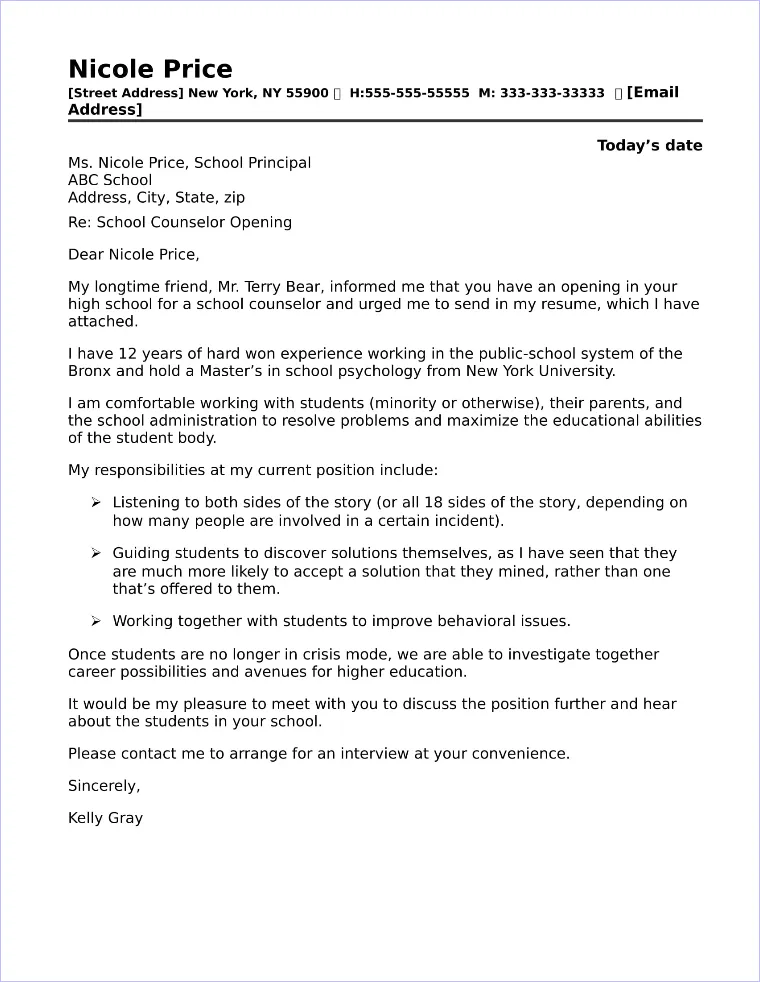
Understanding the Importance of a School Counselor Cover Letter
A school counselor cover letter is more than just a formality; it’s your first opportunity to make a strong impression on a potential employer. It serves as a personalized introduction, allowing you to highlight your unique qualifications, skills, and experiences in a way that a resume alone cannot. A well-crafted cover letter demonstrates your genuine interest in the specific school and position, showcasing your understanding of their needs and your ability to meet them. It’s your chance to set yourself apart from other applicants and persuade the hiring committee that you are the ideal candidate to support students’ academic, career, and social-emotional development. Neglecting this crucial step means missing the opportunity to fully represent yourself and your passion for school counseling.
Researching the School and Position
Before you begin writing, thorough research is essential. Visit the school’s website to learn about its mission, values, and student demographics. Understanding the school’s specific needs and challenges will enable you to tailor your cover letter to address them directly. Review the job description carefully, noting the required qualifications, desired skills, and any special initiatives or programs the school is involved in. This research will provide valuable insights that allow you to align your experiences and skills with the school’s specific requirements, making your application more relevant and appealing. This demonstrates to the hiring committee that you have taken the time to understand their needs and are genuinely interested in joining their community.
Tailoring Your Letter to the Specific Role

Generic cover letters are easily spotted and often discarded. Tailoring your letter to the specific role is crucial for capturing the hiring manager’s attention. Use the information you gathered during your research to address the school’s particular needs and challenges. For instance, if the school emphasizes a focus on mental health, highlight your experience in this area. If they prioritize college readiness, showcase your knowledge of college application processes and career counseling. Clearly demonstrate how your skills and experiences align with the specific requirements outlined in the job description. Personalizing your letter not only shows that you’ve done your homework but also that you possess the qualities and experiences the school is actively seeking in a candidate. This personalized approach significantly increases your chances of standing out.
Highlighting Relevant Skills and Experiences
Your cover letter should be a showcase of your relevant skills and experiences. Don’t just list your qualifications; provide specific examples that demonstrate your abilities. Use the STAR method (Situation, Task, Action, Result) to illustrate your accomplishments and the impact you’ve made in previous roles. Quantify your achievements whenever possible. For example, instead of saying “Improved student outcomes,” you could say, “Implemented a new counseling program that increased student test scores by 15%.” By providing concrete evidence of your skills and experiences, you build credibility and convince the reader of your capabilities. Remember, the goal is to show, not just tell, what you can bring to the position. Tailor your examples to the specific requirements outlined in the job description, ensuring that your cover letter is as relevant and compelling as possible.
Emphasizing Counseling Expertise
As a school counselor, your counseling expertise is paramount. Your cover letter should clearly demonstrate your proficiency in various counseling techniques and approaches. Mention your experience with individual and group counseling, crisis intervention, and conflict resolution. Highlight any specializations, such as expertise in working with students with specific needs (e.g., students with disabilities, those from diverse backgrounds). Mention your ability to build rapport with students, parents, and school staff. Provide examples of how you have effectively supported students’ social-emotional development and academic success. This is the core of your role, and demonstrating your counseling expertise is crucial for showcasing your ability to contribute positively to the school environment. Demonstrate your commitment to creating a supportive and inclusive environment for all students.
Showcasing Experience with Diverse Student Populations

Schools are becoming increasingly diverse, and demonstrating your experience with diverse student populations is essential. Highlight your understanding of cultural sensitivity, inclusivity, and the unique challenges faced by students from various backgrounds. Showcase your experience working with students of different ethnicities, socioeconomic statuses, sexual orientations, and abilities. Describe any training or professional development you’ve completed on topics such as cultural competency, implicit bias, or inclusive practices. Provide examples of how you have successfully fostered a sense of belonging and provided equitable support to all students. Your ability to create an inclusive and supportive environment for a diverse student body is a critical asset. This shows your commitment to equity and social justice within the school setting.
Demonstrating Knowledge of School Counseling Principles
A strong cover letter should demonstrate a clear understanding of the principles of school counseling. Mention your knowledge of ethical guidelines, confidentiality, and best practices in the field. Highlight your commitment to student advocacy, collaboration with parents and teachers, and the development of comprehensive school counseling programs. Show that you are familiar with relevant legislation and policies that impact school counseling practices. If you have experience in program development, assessment, or data analysis, be sure to mention it, as it highlights your ability to evaluate the effectiveness of counseling services. By demonstrating your knowledge of core principles and best practices, you will highlight your ability to provide quality counseling services that support student success.
Structuring Your Cover Letter for Maximum Impact
The structure of your cover letter plays a crucial role in making a positive impression. A well-organized letter is easy to read and allows you to effectively communicate your key qualifications. Begin with a professional heading that includes your contact information and the date. Address the letter to the hiring manager or, if possible, the principal or superintendent. The body of the letter should consist of a clear and concise introduction, several body paragraphs that highlight your skills and experiences, and a strong conclusion that reiterates your interest in the position. Maintain a professional tone throughout, and use clear, concise language. A well-structured cover letter shows you’ve thought about your application and gives the reader an overview of your skills and experience quickly.
Crafting a Strong Opening Paragraph

The opening paragraph is your first chance to capture the reader’s attention. Begin by stating the position you are applying for and where you saw the job posting. Briefly express your enthusiasm for the opportunity and the school. Immediately highlight one or two of your key qualifications or experiences that align with the job requirements. This will grab the reader’s interest right away. Avoid generic opening lines; instead, personalize your introduction by mentioning something specific about the school or the position that excites you. This approach demonstrates genuine interest and sets the tone for a compelling cover letter. Think of it as your elevator pitch – in a few sentences, you should be able to capture the reader’s interest.
Developing Engaging Body Paragraphs
The body paragraphs are where you elaborate on your skills, experiences, and qualifications. Each paragraph should focus on a specific aspect of your qualifications and provide concrete examples to support your claims. Use the STAR method to describe situations, the tasks you performed, the actions you took, and the results you achieved. Quantify your accomplishments whenever possible to demonstrate the impact of your work. For instance, if you implemented a new program, mention the increase in student engagement or academic performance that resulted. Use strong action verbs to describe your responsibilities and accomplishments. Break your information into concise, easy-to-read paragraphs. Avoid jargon and keep your language clear and straightforward. Each paragraph should be relevant and add value to your application.
Writing a Compelling Closing
The closing paragraph should leave a lasting impression. Reiterate your interest in the position and the school. Summarize your key qualifications and reiterate why you are a good fit. Express your enthusiasm for an interview and provide your contact information again for easy reference. Thank the reader for their time and consideration. Maintain a professional tone throughout your closing. Avoid sounding desperate or overly eager. A strong closing paragraph should leave the reader with a positive impression of your capabilities and your enthusiasm for the opportunity. It should also make it easy for them to contact you.
Proofreading and Formatting Your Cover Letter

Proofreading and formatting are essential steps in creating a professional and polished cover letter. Errors in grammar, spelling, and punctuation can undermine your credibility and make you appear careless. Read your letter carefully, checking for any mistakes. Use spell check and grammar check tools, but don’t rely on them entirely. Have a friend or colleague review your letter for a fresh perspective. Ensure your formatting is consistent and easy to read. Use a professional font, such as Times New Roman or Arial, and maintain a standard font size (11 or 12 points). Use clear headings, bullet points, and white space to break up the text and improve readability. A well-formatted and error-free cover letter demonstrates your attention to detail and professionalism, making a positive impression on the hiring committee.
Ensuring Clarity and Conciseness
Clarity and conciseness are key elements of an effective cover letter. Avoid using overly complex language or jargon. Write in clear, straightforward sentences that are easy to understand. Get straight to the point and avoid unnecessary words or phrases. Keep your paragraphs relatively short and focused on a single idea. Use strong action verbs to convey your accomplishments and skills in a compelling manner. Make sure your writing style is professional and reflects your attention to detail. A clear, concise cover letter demonstrates respect for the reader’s time and makes a positive impression.
Reviewing for Grammatical Errors and Typos
Grammatical errors and typos can severely damage your credibility and reduce your chances of getting hired. Always review your cover letter carefully for any mistakes. Check for correct spelling, punctuation, and grammar. Use spell check and grammar check tools to identify errors. However, these tools are not foolproof, so don’t rely on them entirely. Have a friend or colleague proofread your letter for a fresh perspective. Read your cover letter aloud to catch any awkward phrasing or grammatical errors. A flawless cover letter demonstrates your attention to detail, professionalism, and respect for the hiring manager. The small investment of time in proofreading can make a significant difference in the overall impression your application makes.
Formatting for Professionalism

Formatting your cover letter for professionalism is critical to making a positive impression. Use a professional-looking font, such as Times New Roman or Arial, and maintain a standard font size (11 or 12 points). Use a consistent format throughout your letter. Align your text to the left and use single spacing. Include a professional heading with your contact information, the date, and the recipient’s information. Use clear headings to separate different sections of your letter. Proofread your cover letter to ensure consistency in your formatting. A well-formatted cover letter presents a polished and professional image, making a positive impression on the hiring manager and showing you are prepared to create quality documentation.