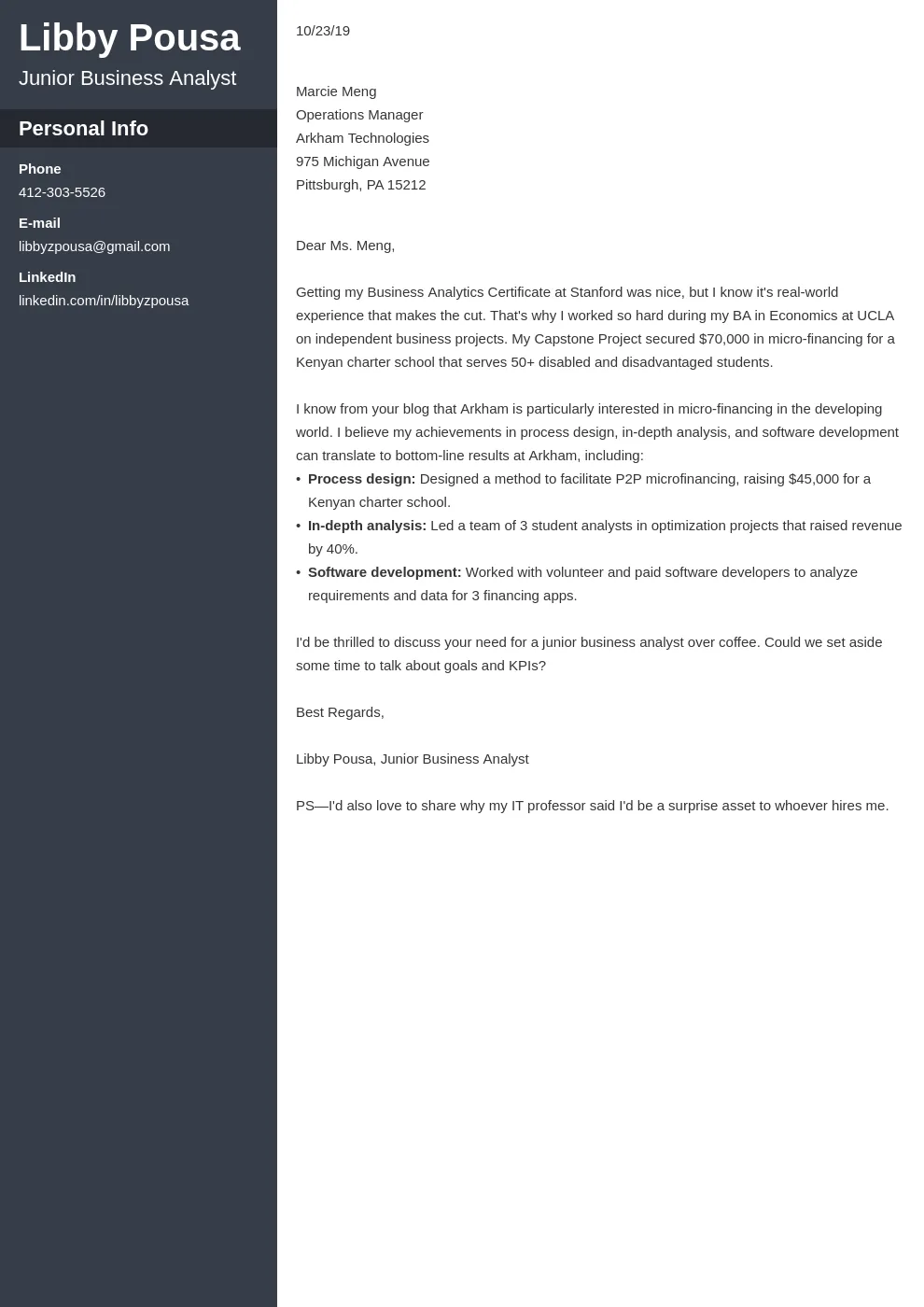
Understanding the Importance of a Business Analyst Cover Letter
In the competitive landscape of job applications, a well-crafted cover letter is often the key to unlocking the door to your dream role as a Business Analyst. Far more than just a formality, this document provides a crucial opportunity to present yourself in a compelling way, going beyond the confines of your resume to showcase your personality, passion, and the unique value you bring to the table. The cover letter serves as your first impression, setting the tone for the rest of the application process. It’s your chance to explain why you’re the perfect fit, demonstrating how your skills and experience align with the specific requirements of the role and the company’s overall objectives. A strong cover letter immediately grabs the hiring manager’s attention, distinguishing you from other applicants and increasing your chances of landing an interview. It’s a strategic tool that elevates your application, making you stand out in a crowded field and showcasing your genuine interest in the opportunity.
Why a Cover Letter Matters
A cover letter serves several critical functions in the job application process. Primarily, it allows you to articulate your career goals and explain why you’re interested in the specific role and company. This demonstrates your proactive approach and genuine interest, something that’s often missing from a standard resume. Furthermore, it provides the space to delve deeper into your skills and experiences, offering context and explaining how your background aligns with the job requirements. You can highlight specific achievements and quantify your contributions, providing concrete evidence of your capabilities. A well-written cover letter shows that you’ve done your research, understand the company’s values, and are enthusiastic about contributing to their success. It also provides a platform for expressing your personality and communication style, giving the hiring manager a sense of who you are beyond your qualifications. In essence, it’s an opportunity to humanize your application and make a lasting impression.
Highlighting Relevant Skills and Experience

Your cover letter is the perfect canvas to showcase the specific skills and experiences most relevant to the Business Analyst role you’re targeting. Start by carefully reviewing the job description and identifying the key requirements. Then, select the skills and experiences from your background that directly align with these requirements. Don’t just list these skills; provide context. Describe situations where you successfully applied these skills, quantifying your accomplishments whenever possible. For example, instead of saying “Improved efficiency,” you could say, “Improved project efficiency by 15% through the implementation of a new data analysis framework.” Use specific examples from your previous roles or projects to illustrate your abilities. This could include experience with requirements gathering, process modeling, data analysis, stakeholder management, or any other relevant skills. By demonstrating your capabilities through concrete examples, you create a compelling narrative that captures the hiring manager’s attention and solidifies your qualifications.
Key Components of a Business Analyst Cover Letter
Header and Contact Information
The header of your cover letter is the first thing the hiring manager will see, so it’s important to get it right. Begin by including your full name, address, phone number, and professional email address. Make sure your contact information is current and easily accessible. Next, include the date and the hiring manager’s name and title, if known. If you can’t find the hiring manager’s name, address the letter to the Hiring Manager or the specific department. This personalized touch shows that you’ve taken the time to research the company and the role. Using a professional and clean layout for your header makes your letter look polished and professional, demonstrating attention to detail. Ensure the information is well-organized and easy to read, helping the hiring manager quickly access your contact details and understand the context of the letter.
Professional Greeting

The greeting sets the tone for your entire cover letter, so it’s important to get it right. Start with a formal and professional greeting, such as “Dear Mr./Ms. [Last Name]”. If you don’t know the hiring manager’s name, use a general greeting like “Dear Hiring Manager” or “Dear [Department Name] Team.” Avoid overly casual greetings like “Hi” or “Hello” as they can seem unprofessional. Using the correct title (Mr., Ms., Dr.) shows respect and attention to detail. Always double-check the spelling of the hiring manager’s name to avoid making a negative first impression. By choosing a respectful and professional greeting, you set a positive tone and show that you value the opportunity and the recipient’s time. This initial impression can significantly influence how the hiring manager perceives the rest of your cover letter.
Opening Paragraph
Your opening paragraph is your chance to immediately capture the hiring manager’s attention. Start by clearly stating the position you’re applying for and where you found the job posting. Then, briefly explain why you’re interested in the role and the company. This is where you can express your enthusiasm and demonstrate that you’ve researched the organization. Consider mentioning a key skill or accomplishment that aligns directly with the job requirements. A strong opening paragraph is concise, engaging, and makes a compelling case for why you are the perfect candidate. It should create a sense of intrigue and encourage the hiring manager to read the rest of your cover letter. Avoid generic openings; instead, tailor your introduction to reflect your unique qualifications and passion for the opportunity. The goal is to make a memorable first impression and distinguish yourself from other applicants.
Body Paragraphs Highlighting Achievements
The body paragraphs are where you provide concrete evidence of your skills and experiences. Each paragraph should focus on a specific achievement or aspect of your background that demonstrates your suitability for the Business Analyst role. Use the STAR method (Situation, Task, Action, Result) to structure your paragraphs. First, describe the situation or context. Next, explain the task you were assigned. Then, detail the actions you took to complete the task. Finally, quantify the results whenever possible. This method provides a clear, concise, and compelling narrative that showcases your problem-solving abilities and achievements. For example, you might describe a project where you gathered requirements, analyzed data, and implemented a solution that improved efficiency or reduced costs. Focus on the aspects of your experience that align with the job description, highlighting skills such as data analysis, process improvement, or stakeholder management. The goal is to provide tangible evidence of your capabilities and how you can contribute to the company’s success.
Quantifying Accomplishments

Quantifying your accomplishments is crucial for demonstrating the impact you’ve made in previous roles. Whenever possible, use numbers and data to support your claims. Instead of saying “Improved efficiency,” state “Improved operational efficiency by 20%.” Instead of saying “Managed multiple projects,” say “Managed 5+ simultaneous projects with budgets ranging from $100K to $500K.” Use metrics to illustrate your results, such as cost savings, increased revenue, reduced errors, or improved customer satisfaction. This approach provides concrete evidence of your abilities and allows the hiring manager to easily understand the value you bring to the table. Numbers make your accomplishments more impactful and memorable. Always ensure the data you present is accurate and relevant to the job requirements. By quantifying your achievements, you create a compelling case for your qualifications and stand out from other applicants.
Using Action Verbs
Using strong action verbs is essential for making your cover letter engaging and impactful. Action verbs help you describe your accomplishments in a dynamic and compelling way. Start each bullet point or sentence with a powerful verb to create a sense of energy and accomplishment. Some effective action verbs for Business Analysts include “Analyzed,” “Developed,” “Implemented,” “Managed,” “Improved,” “Streamlined,” “Collaborated,” “Led,” “Facilitated,” “Documented,” and “Optimized.” Choose verbs that accurately reflect your role and responsibilities. Avoid passive language; instead, focus on what you did and the results you achieved. For example, instead of “Was responsible for data analysis,” write “Analyzed large datasets to identify trends.” Using action verbs makes your cover letter more readable and emphasizes your proactive approach. It also helps the hiring manager quickly understand your skills and accomplishments. Using dynamic language boosts your application’s overall impact and increases your chances of landing an interview.
Demonstrating Industry Knowledge
Demonstrating your knowledge of the business analyst field is crucial for making a positive impression. Mentioning relevant industry trends, methodologies, or tools shows that you’re up-to-date and passionate about your field. Research the company and industry to identify key areas of interest and tailor your letter accordingly. Highlight any certifications or training you’ve completed, such as the Certified Business Analysis Professional (CBAP) certification. Showcase your understanding of business analysis frameworks, such as Agile or Waterfall, and how you have applied these methodologies in previous projects. If you have experience with specific software or tools, such as Jira, Confluence, or data analysis platforms, mention these and briefly describe how you used them to achieve specific results. By demonstrating your industry knowledge, you show that you are not only qualified but also a forward-thinking professional, eager to contribute to the company’s success.
Closing Paragraph

The closing paragraph is your final opportunity to leave a lasting impression. Reiterate your interest in the role and the company, and briefly summarize why you are a good fit. Express your enthusiasm for the opportunity and mention your key skills and experiences that make you the ideal candidate. Maintain a professional tone and make it clear that you are available for an interview. Thank the hiring manager for their time and consideration. Keep the closing concise and to the point, reinforcing your eagerness to move forward in the application process. A strong closing paragraph solidifies your value and demonstrates your commitment to the role, making it more likely that you will receive a call for an interview.
Call to Action
Include a clear call to action in your closing paragraph. This tells the hiring manager what you want them to do next. A common call to action is to request an interview. For example, you could say, “I am eager to discuss my qualifications further and would welcome the opportunity for an interview.” Alternatively, you can express your willingness to provide additional information. Make it easy for the hiring manager to contact you by restating your contact information, including your phone number and email address. Ensure that your call to action is concise, confident, and directly related to the next steps in the hiring process. A well-defined call to action provides a sense of direction and helps ensure that your application is not overlooked. It encourages the hiring manager to take immediate action and move forward with the application process.
Proofreading and Formatting
Proofreading and formatting are critical steps that demonstrate your attention to detail. Before submitting your cover letter, carefully proofread it for any grammatical errors, typos, and spelling mistakes. These errors can make your application look unprofessional and undermine your credibility. Ensure that the font is easy to read and consistent throughout the document. Use a standard font, such as Arial or Times New Roman, and a font size between 10 and 12 points. Check the layout to ensure it is neat and well-organized, with clear headings and sufficient spacing. Use consistent formatting for headings, bullet points, and paragraphs. Have a friend or colleague review your cover letter to catch any errors you may have missed. A polished and well-formatted cover letter reflects professionalism and attention to detail, increasing the likelihood that your application will be taken seriously. Ensure that your cover letter presents a clean and professional image of you.
Tips for a Strong Cover Letter

Tailoring Your Cover Letter
Tailoring your cover letter to each specific job application is one of the most important tips for success. Avoid using a generic cover letter that is sent to multiple companies. Instead, customize your cover letter to match the specific requirements of the job posting and the company’s values. Carefully review the job description and identify the key skills, experiences, and qualifications that the employer is looking for. Then, highlight your own relevant experiences, skills, and achievements. Use the same keywords and phrases from the job description to show that you understand the role and that you’re a good fit. Research the company to understand its mission, values, and culture. Mention specific projects, initiatives, or company achievements that resonate with you. Demonstrate how your skills and experiences align with the company’s objectives. By tailoring your cover letter, you show that you’ve taken the time to understand the specific needs of the employer, making you a more appealing candidate.
Researching the Company
Thoroughly researching the company is essential for demonstrating your interest and understanding of its mission and values. Visit the company’s website to learn about its products or services, target market, and recent news. Explore their “About Us” section to gain insights into their culture, values, and goals. Check their social media profiles, such as LinkedIn, to understand their brand and connect with employees. Review industry publications and news articles to stay updated on their recent activities. Use this research to tailor your cover letter and show that you understand the company’s needs. Mention specific projects, initiatives, or company achievements that interest you. Highlight how your skills and experiences align with their goals. Showing that you’ve done your homework demonstrates your enthusiasm and makes you a more appealing candidate. It demonstrates that you are genuinely interested in the company.
Showcasing Soft Skills

While technical skills are essential for a Business Analyst role, showcasing your soft skills is equally important. Soft skills, such as communication, teamwork, problem-solving, and leadership, demonstrate your ability to work effectively in a team and navigate complex situations. Provide examples of how you’ve successfully utilized these skills in previous roles. For example, describe how you facilitated a meeting, resolved a conflict, or collaborated with stakeholders to achieve a common goal. Mention your ability to communicate complex information clearly and concisely, both verbally and in writing. Highlight your analytical skills, your ability to identify problems, and propose effective solutions. Showcase your leadership skills and your ability to motivate and guide others. Mention your ability to manage your time effectively and meet deadlines. By showcasing your soft skills, you demonstrate that you are a well-rounded professional capable of thriving in a collaborative environment.
Including Keywords
When writing your cover letter, incorporate keywords from the job description. Many companies use Applicant Tracking Systems (ATS) to scan resumes and cover letters for specific keywords. These systems help filter applicants and identify those who best meet the job requirements. Carefully review the job description and identify the keywords related to skills, experiences, and qualifications. Then, integrate these keywords naturally into your cover letter. Don’t overdo it – the goal is to showcase your qualifications in a clear and concise manner. Use these keywords to highlight your experience and the ways in which you meet the employer’s needs. By including the right keywords, you increase the chances of your cover letter being noticed by the ATS and reviewed by a hiring manager. This strategic approach can help you stand out from other candidates.
Common Mistakes to Avoid
Avoid these common mistakes to ensure your cover letter strengthens your application. Do not use a generic cover letter. As mentioned earlier, tailoring your cover letter to each specific job is critical. Avoid using vague language and instead use specific examples and quantify your accomplishments. Do not include irrelevant information; only focus on the skills and experiences that are most relevant to the job. Do not make any grammatical errors, typos, or spelling mistakes, and always proofread your cover letter. Avoid using an unprofessional tone or overly casual language. Avoid being too lengthy; keep your cover letter concise and to the point. Do not simply repeat your resume; provide additional information and context. By avoiding these common mistakes, you can ensure that your cover letter is effective and professional.