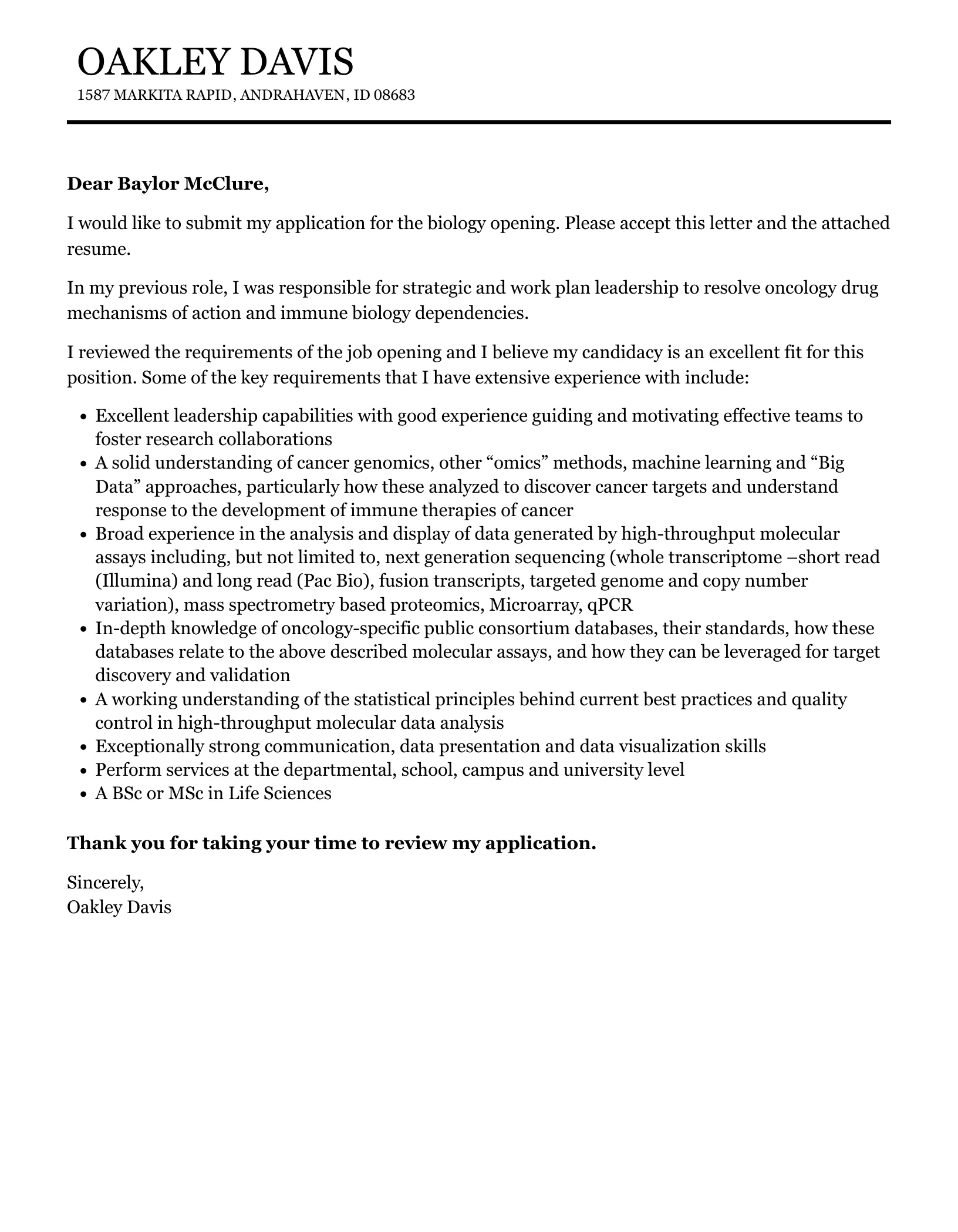
Crafting a Biology Undergrad Cover Letter That Captivates
A compelling biology undergrad cover letter is your first chance to make a strong impression on potential employers. It is your opportunity to showcase your academic accomplishments, relevant skills, and passion for biology, setting you apart from other applicants. A well-crafted cover letter is more than just a formality; it’s a vital tool to highlight your suitability for the position and demonstrate your genuine interest in the opportunity. It needs to be professional and tailored to each application. Think of it as the bridge between your resume and the hiring manager’s initial assessment of you. This guide will equip you with the knowledge and techniques needed to write a cover letter that not only gets noticed but also secures you an interview. Mastering the art of the cover letter is a crucial step in launching a successful career in the field of biology.
Understanding the Purpose of a Biology Undergrad Cover Letter
The primary purpose of your biology undergrad cover letter is to introduce yourself and elaborate on the information presented in your resume. While your resume provides a concise overview of your qualifications, the cover letter allows you to delve deeper, providing context and highlighting the specific aspects of your experience and skills that align with the job requirements. Think of it as your chance to tell a story. It’s also your chance to demonstrate your personality and enthusiasm for the role and the company. Your letter should persuade the reader that you are a strong match for the position and the kind of person they would want to work with. It should showcase your communication skills, attention to detail, and ability to articulate your career goals.
Highlighting Your Academic Achievements

Your academic achievements form the foundation of your qualifications. Focus on noteworthy accomplishments like your GPA, Dean’s List recognition, or any academic awards you’ve received. Do not just list your GPA; if it is impressive, mention it proudly. If you were involved in any honors programs or specialized coursework, be sure to highlight them. Mentioning relevant coursework can also be helpful here, especially if it ties directly into the job requirements. When highlighting achievements, quantify them whenever possible, such as ‘maintained a 3.8 GPA’ or ‘received the Biology Department’s Outstanding Student Award’. Always tailor your achievements to match the specific needs and interests of the employer. This demonstrates that you have taken the time to research the role and understand what they are looking for in a candidate.
Emphasizing Relevant Coursework
Carefully select and emphasize coursework that aligns with the job description. If the position requires knowledge of genetics, highlight relevant courses such as Molecular Biology or Advanced Genetics. If the role focuses on environmental science, mention courses like Ecology or Environmental Toxicology. Briefly describe the key concepts you learned in those courses and how they prepared you for the role. Think of each course as a skill-building block; describe what it taught you. For example, ‘In my Cell Biology course, I gained a comprehensive understanding of cellular processes, including… This knowledge is directly applicable to…’. This shows the employer that you possess the specific knowledge base required to perform the job effectively. Tailoring your letter in this way also proves your dedication and interest in the specific role.
Showcasing Research Experience
If you have research experience, this is a crucial section. Briefly describe your role in any research projects you participated in, whether in a lab, in the field, or through independent studies. Highlight your responsibilities and the skills you developed, such as data collection, analysis, or report writing. This is a key component for many employers. If you’ve presented research at a conference or co-authored a publication, be sure to include those achievements. Quantify your contributions whenever possible. For example, ‘Assisted in the collection and analysis of over 500 samples…’. Consider the specific technologies and techniques you utilized. For instance, ‘Proficient in PCR, gel electrophoresis, and microscopy’. This experience proves to employers you are capable and experienced in a laboratory environment. This experience is extremely valuable and demonstrates your practical skills.
Detailing Laboratory Skills

Laboratory skills are highly valued in many biology positions. Make sure to list the specific laboratory techniques you are proficient in, such as cell culture, microscopy, PCR, or chromatography. This is another place to showcase the technical skills employers are seeking. Specify any equipment you have experience using, such as centrifuges, spectrophotometers, or microscopes. Providing a brief description of how you used these skills in previous research or coursework can further strengthen your application. ‘Used PCR to amplify DNA samples for genetic analysis’. If you’ve followed specific lab safety protocols or have experience with quality control procedures, be sure to mention those skills. Having technical skills is a very high value.
Demonstrating Your Passion for Biology
Your cover letter is your opportunity to communicate your genuine passion for biology. It’s not enough to list your skills and achievements; you need to show that you are enthusiastic about the field and the specific job. You can express your passion by describing what initially sparked your interest in biology and how your experiences have fueled your enthusiasm. Mention specific areas of biology that you are most interested in and why they appeal to you. Connect your passion to the company’s mission or the specific research they are conducting. For example, ‘I am particularly drawn to [Company Name]’s work in…’. This personal connection will make your letter more memorable and demonstrate your dedication to the field. Your passion can make you stand out.
Tailoring Your Cover Letter to the Specific Job
Customize each cover letter for the specific job and company you are applying to. Generic cover letters are easily spotted and often discarded. Carefully review the job description and identify the key skills, experiences, and qualifications the employer is seeking. Then, tailor your cover letter to address those requirements directly. Use keywords from the job description to show that you have the right qualifications. Research the company and mention their specific projects, values, or goals that resonate with you. This level of detail demonstrates your genuine interest and your understanding of the role. Show them you took the time to understand their company and their needs. This is another area where you show you can stand out.
Researching the Company and Position

Before you begin writing your cover letter, thoroughly research the company and the specific position. Visit their website, read their mission statement, and learn about their current projects and research areas. Understand the company’s culture and values. Explore their social media profiles and read articles or news releases about the company. This knowledge will help you tailor your letter and demonstrate your genuine interest in the role. In your cover letter, reference specific projects, initiatives, or aspects of the company that excite you. Mentioning the company’s values and how they align with your own career goals can also create a more personal connection. Research also helps you understand the language the employer is using and make sure you can follow the conversation.
Addressing the Hiring Manager Effectively
Always address your cover letter to a specific person if possible. If you can find the name of the hiring manager or the person responsible for reviewing applications, use it. If you can’t find a specific name, using a title like ‘Dear Hiring Manager’ is acceptable. Avoid generic greetings such as ‘To Whom It May Concern’. In the first paragraph, state the position you are applying for and where you saw the job posting. Briefly mention why you are interested in the role and the company. Be sure to maintain a professional tone throughout the letter and use proper grammar and punctuation. This shows you respect the reader’s time.
Formatting Your Cover Letter for Maximum Impact
The formatting of your cover letter is very important. A well-formatted letter is easy to read and makes a good first impression. Use a professional font, such as Times New Roman, Arial, or Calibri, in a size between 10 and 12 points. Make sure the font is legible. Use single spacing within paragraphs and double spacing between paragraphs. Use a standard business letter format, including your contact information, the date, and the employer’s contact information. Keep your letter concise; aim for one page. Use clear headings and subheadings to organize your thoughts. Proofread the document to make sure there are no typos or grammatical errors. A consistent formatting will help your letter stand out.
Choosing the Right Font and Layout

Your choice of font and layout can significantly impact the readability and professionalism of your cover letter. Choose a font that is easy to read and is not overly stylized. Stick to classic fonts like Times New Roman, Arial, or Calibri. Use a font size that is comfortable to read, typically between 10 and 12 points. Ensure your layout is clean and organized. Use ample white space to prevent the letter from looking cluttered. Divide your letter into clear paragraphs, with a clear structure. Use bullet points sparingly, and only to list information. Avoid using excessive formatting or colors. Make sure the layout of your letter is consistent and professional, which helps the hiring manager’s eyes flow smoothly from paragraph to paragraph.
Keeping Your Cover Letter Concise and Engaging
A concise and engaging cover letter captures the reader’s attention and keeps them interested. Your letter should provide enough information to convey your qualifications without being overly lengthy. Aim for one page, if possible. Start with a strong opening that immediately grabs the reader’s attention. Use active and dynamic language throughout the letter. Avoid overly complex sentences and jargon. Keep your paragraphs brief and focused. Use clear and concise language. Highlight your most relevant skills and experiences. Focus on what makes you unique and what you can contribute to the company. Proofread it carefully for any errors.
Proofreading Your Cover Letter Meticulously
Proofreading your cover letter is a crucial step that should never be skipped. Errors can significantly detract from your credibility and professionalism. Before submitting your cover letter, carefully proofread it for any grammatical errors, typos, or inconsistencies. Ensure that your sentences flow smoothly and your language is clear and concise. Read your cover letter aloud to catch any awkward phrasing or errors that you might miss when reading silently. Use a grammar and spell checker, but don’t rely on it entirely. Ask a friend, career advisor, or professor to review your cover letter. Their fresh perspective can catch errors that you might overlook. A polished, error-free cover letter demonstrates attention to detail and professionalism.
Avoiding Common Cover Letter Mistakes

There are several common mistakes that can undermine your cover letter. Avoid generic templates; tailor your letter to each specific job. Don’t simply repeat your resume; use the cover letter to expand on your skills and experiences. Avoid using overly formal or casual language. Do not include information that is irrelevant to the job or the company. Do not focus on what you want; focus on how you can help the employer. Avoid negative statements. Do not mention salary expectations in your cover letter, unless specifically requested. Always proofread your cover letter to make sure that there are no errors. Ensure that your cover letter is error-free and tailored to the specific job.
Mentioning Skills, Don’t List Them
Rather than simply listing your skills, demonstrate them through specific examples. Don’t just say that you have strong communication skills. Instead, describe a situation where you effectively communicated complex information to a diverse audience. Instead of stating that you are detail-oriented, provide an example of how you ensured accuracy in a lab report or research project. By providing these examples, you are showing instead of telling. This approach makes your skills more credible and memorable. It also allows you to showcase your personality and demonstrate how you apply your skills in a real-world context.
Quantify Your Achievements
Whenever possible, quantify your achievements to demonstrate your impact and value. Instead of saying that you improved efficiency in the lab, state by what percentage. ‘Increased efficiency by 15%’. If you managed a team or project, mention the size of the team or the budget you managed. ‘Managed a team of 5’. If you were involved in research, mention the number of samples you analyzed or the number of presentations you gave. Quantifiable achievements provide concrete evidence of your skills and abilities and make your cover letter more persuasive. This data allows the reader to see the value you will bring to their company.
Focusing on your future with the Company

Instead of focusing solely on your past achievements, demonstrate your forward-thinking approach by briefly discussing your career goals and how the position aligns with them. Mention how the role can help you build your skills and expertise. Explain how you see yourself contributing to the company’s success in the future. ‘I am eager to contribute to [Company Name]’s ongoing research into…’. This demonstrates that you are not just looking for a job but are invested in the company’s long-term goals. This also helps the reader view you as a candidate who will stay for the long term. This makes you a more attractive candidate.
The Importance of a Strong Closing
Your closing is your final chance to make an impression. End with a strong, confident statement that summarizes your interest in the position and your value as a candidate. Restate your enthusiasm for the opportunity. Thank the hiring manager for their time and consideration. Be clear about your next steps. Indicate that you are available for an interview. Provide your contact information again, including your phone number and email address. Ensure that your closing is professional and leaves the reader with a positive impression.
Expressing Enthusiasm and Next Steps
Conclude your cover letter with a strong expression of your enthusiasm for the opportunity and your desire to move forward in the application process. Reiterate your interest in the position and the company. State that you are available for an interview at their earliest convenience. Thank the hiring manager for their time and consideration. In your closing paragraph, include a clear call to action. For example, ‘I am eager to discuss my qualifications further in an interview’. Make sure you mention your contact information again. Ensure that your closing statement reinforces your positive impression, leaving the reader with a sense of your confidence and your genuine interest in the role.