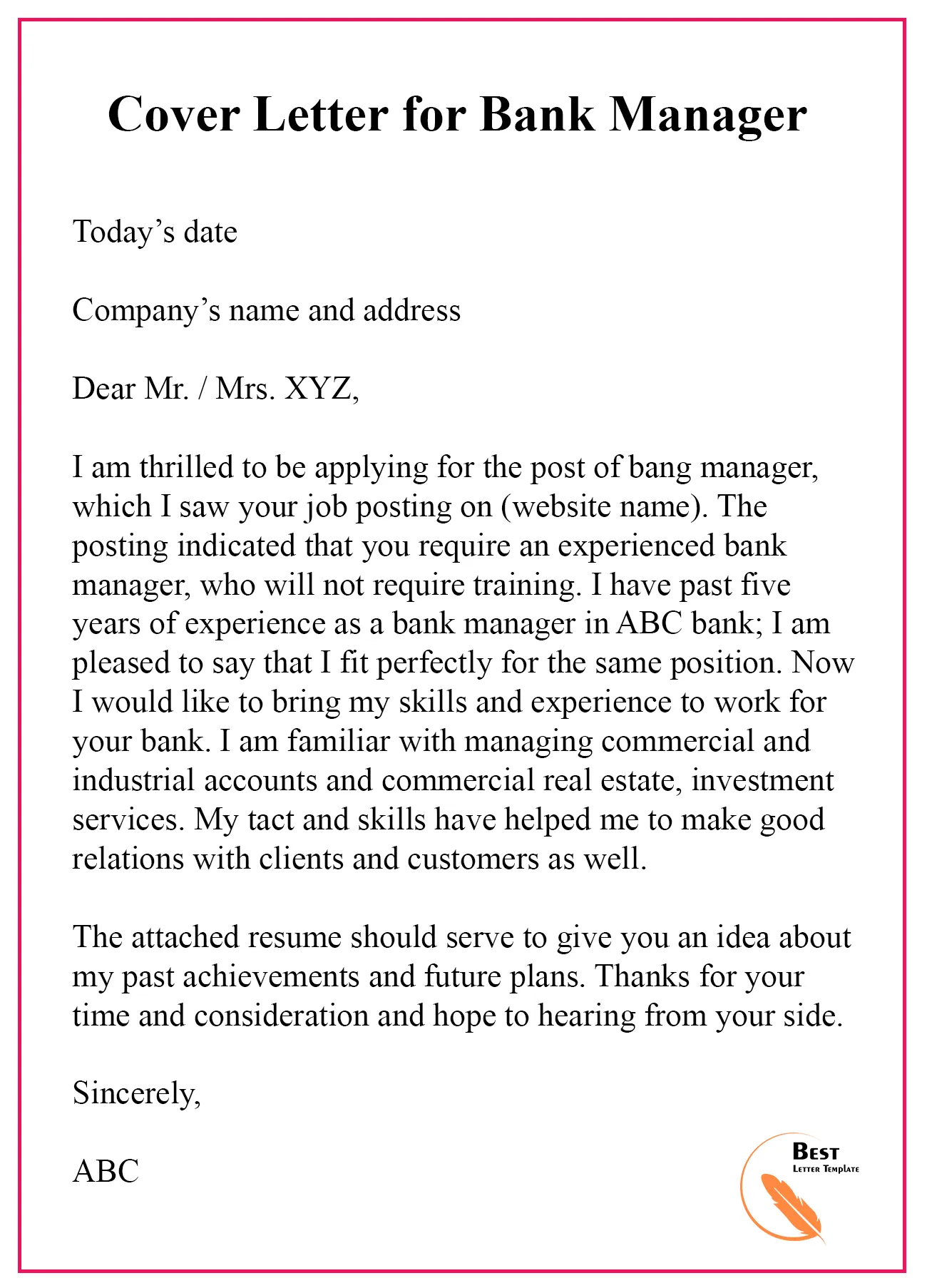
Key Elements of a Bank Job Cover Letter
A well-crafted cover letter is crucial for landing a bank job. It serves as your first impression, giving you the opportunity to showcase your skills, experience, and enthusiasm. A successful cover letter should not just reiterate your resume but also provide context, personality, and demonstrate your understanding of the banking industry. This guide will break down the key elements you need to master to create a compelling cover letter that increases your chances of getting hired. Understanding each element, from the header to the closing, is vital in presenting yourself as a strong candidate. By paying close attention to detail and tailoring your letter to each specific job, you can significantly boost your prospects in the competitive world of banking.
Header Essentials
The header of your bank job cover letter is the first thing a recruiter sees. It should immediately convey professionalism and attention to detail. Your header needs to include your full name, address, phone number, and email address. Ensure your email address is professional and appropriate. Avoid using nicknames or informal addresses. Use a clean, easy-to-read font, and align your information neatly. Consider using a simple, professional template to format your header. This section is a critical introduction to your contact details, which ensures recruiters can easily reach you. Make sure the formatting is consistent with the rest of the document, so you can highlight your contact information efficiently.
Your Contact Information

Clearly listing your contact information ensures that potential employers can easily reach you. Start with your full name at the top, followed by your current address. Next, include your phone number, making sure it is a number where you can be easily reached and that you have a professional voicemail message set up. Finally, provide your email address, ensuring it is a professional-sounding one (e.g., john.doe@email.com rather than something like funnyguy123@email.com). Double-check all your contact details for accuracy. A typo in your email address could mean missing out on a job opportunity. Consider adding a link to your LinkedIn profile if you have one, to provide additional context about your professional background.
Date and Recipient Information
After your personal contact information, include the current date. Then, you need to address the letter to the appropriate person. Research the hiring manager’s name and title if possible, as it shows you’ve taken the initiative to personalize your application. If you can’t find a specific name, use a professional greeting, such as ‘Dear Hiring Manager’. Include the bank’s name, the department you are applying to, and the bank’s address. This ensures the cover letter is directed correctly and shows that you’ve done your homework. Accuracy in this section demonstrates professionalism and attention to detail, which are highly valued in the banking industry.
Greeting and Introduction
The greeting and introduction set the tone for your entire cover letter. Start with a formal greeting, such as ‘Dear Mr./Ms. [Last Name]’ if you know the hiring manager’s name. Avoid generic greetings like ‘To Whom It May Concern’. The first paragraph should immediately grab the reader’s attention. State the position you are applying for and where you found the job posting. Briefly mention why you are interested in the role and the bank. This section needs to show enthusiasm and make the reader want to continue reading. Ensure that the tone is professional, enthusiastic, and reflects your understanding of the bank’s values and the role’s requirements. This initial connection is vital in setting a positive impression.
Crafting a Compelling Opening

Your opening paragraph should be concise and to the point. Clearly state the position you’re applying for and how you learned about the opportunity. If someone referred you, mention their name. Highlight one or two key skills or experiences that directly align with the job requirements. Show enthusiasm and briefly explain why you are interested in the position and the bank. Avoid generic statements, and make sure your introduction is tailored to the specific job. For instance, if the role emphasizes customer service, mention your strong customer service skills. A well-crafted opening grabs the reader’s attention and encourages them to read the rest of your cover letter, making it a vital aspect of your application.
Highlighting Your Qualifications
This is where you demonstrate why you are the best candidate for the job. Focus on the skills and experience that directly match the job description. Provide specific examples to support your claims. Use the STAR method (Situation, Task, Action, Result) to structure your examples, highlighting how your actions led to positive outcomes. Emphasize relevant experience, such as customer service, financial analysis, or sales. Mention any certifications or training that are relevant to the banking industry. Your goal is to prove your qualifications by providing concrete examples of your skills and how you’ve used them to achieve results. Be precise and highlight your accomplishments to stand out.
Showcasing Relevant Skills
Identify the key skills the bank is looking for in the job description. These might include customer service, analytical abilities, communication skills, or proficiency in specific software. Provide examples that show how you have successfully utilized these skills in previous roles. For instance, if the job requires customer service skills, describe a situation where you resolved a customer issue effectively, resulting in positive feedback or increased customer satisfaction. If the role emphasizes analytical skills, mention your experience in analyzing financial data or preparing reports. Be specific about the tasks you undertook and the outcomes you achieved, providing concrete evidence of your capabilities. This helps the recruiter understand your practical abilities.
Quantifying Achievements

Quantify your achievements to make your claims more impactful. Use numbers and data to demonstrate the results you have achieved in previous roles. For example, instead of saying ‘improved customer satisfaction,’ say ‘increased customer satisfaction scores by 15%’. Instead of stating that you ‘managed a team’, state the ’number of team members’ and the ‘percentage of team growth’. Quantifying your accomplishments provides concrete evidence of your abilities and makes your cover letter more persuasive. Include relevant metrics and data to highlight your performance and value to the company. Make sure the numbers accurately reflect your contributions and support your claims with specific, factual details to make a strong case.
Demonstrating Knowledge of the Bank
Show that you have done your homework and have researched the bank. Mention specific products, services, or initiatives that align with your interests and career goals. This demonstrates your genuine interest in the bank and your understanding of its mission and values. Refer to recent news, company reports, or community involvement to show your awareness of the bank’s current activities. Tailor your cover letter to the specific bank and the role you are applying for. This demonstrates that you are not simply sending out a generic application but are genuinely interested in working for their organization. It shows you are an informed applicant and are likely to be a good fit for the company culture.
Tailoring Your Cover Letter
Customizing your cover letter for each job application is essential. A generic cover letter is unlikely to impress hiring managers. Tailor your letter to the specific job requirements outlined in the job description. Highlight the skills and experiences that align with the role’s needs. Research the bank and its values to show your understanding of the organization. This shows that you’ve taken the time and effort to prepare a personalized application. Customization differentiates you from other candidates who submit generic applications. It demonstrates a genuine interest in the role and the bank, increasing your chances of getting noticed. Proofread the letter carefully to ensure it is free of errors and specifically addresses the job requirements.
Researching the Bank and Role

Before writing your cover letter, research the bank thoroughly. Visit the bank’s website, read recent news articles, and look at their social media presence. Understand their mission, values, and recent achievements. Study the job description carefully. Identify the key skills, qualifications, and experiences the bank is seeking. Tailor your cover letter to highlight how your skills and experiences align with the role’s requirements. This research will help you write a more informed and compelling cover letter. It will demonstrate your genuine interest in the role and your knowledge of the bank, making you stand out from other applicants.
Adapting to Specific Job Requirements
Analyze the job description and highlight the skills and experiences that are most relevant to the role. Use the same keywords and phrases used in the job description to demonstrate your understanding of the role’s requirements. Provide specific examples of how you have used these skills in previous roles. If the job emphasizes customer service, provide examples of how you have handled customer issues and achieved positive outcomes. If the job requires experience in financial analysis, describe your experience in analyzing financial data and preparing reports. Tailoring your cover letter demonstrates that you understand the job and are a good fit. This makes it more likely that your application will be selected for further consideration.
Closing Your Cover Letter
The closing of your cover letter should be professional and leave a positive impression. Reiterate your interest in the position and the bank. Express your gratitude for the reader’s time and consideration. Include a call to action, such as requesting an interview or stating that you are available for a discussion. Ensure the closing is formal and polite. A strong closing will reinforce your enthusiasm and encourage the hiring manager to take the next step. This section is vital because it sums up your interest and prompts the recruiter to move forward with your application. A professional closing will provide a good finish to your application.
Expressing Gratitude and Call to Action

Thank the hiring manager for their time and consideration. Express your appreciation for the opportunity to be considered for the role. Include a clear call to action. State your availability for an interview or a discussion. For instance, you could write, ‘I am available for an interview at your earliest convenience and can be reached at [phone number] or [email address].’ A clear call to action makes it easy for the hiring manager to take the next step. This section reinforces your enthusiasm and ensures that you stay at the forefront of the recruiter’s mind. Close your cover letter with a professional closing such as ‘Sincerely’ or ‘Respectfully’.
Formatting and Proofreading
The formatting and proofreading of your cover letter are crucial for creating a professional and polished appearance. Use a clean, easy-to-read font, such as Arial or Times New Roman, with a font size between 11 and 12 points. Maintain consistent formatting throughout the document, including margins, line spacing, and paragraph alignment. Proofread your cover letter carefully for any grammatical errors, spelling mistakes, and typos. Ask someone else to review your cover letter as a second pair of eyes can often catch mistakes that you might miss. A well-formatted and error-free cover letter conveys professionalism and attention to detail, which are highly valued in the banking industry.
Ensuring a Professional Appearance
Choose a professional font, such as Times New Roman, Arial, or Calibri. Use a font size between 11 and 12 points for readability. Set consistent margins (typically 1 inch on all sides) to ensure the document looks clean and organized. Use single or 1.15 line spacing to make the text easier to read. Ensure that the formatting is consistent throughout your document. Avoid using excessive bolding, italics, or underlining. Keep the tone of the cover letter professional and formal. A well-formatted cover letter presents you as detail-oriented and professional, which significantly improves your chances of making a positive impression on the hiring manager.
Proofreading for Errors

Proofreading is a critical step in ensuring your cover letter is free from errors. Carefully review your cover letter for any spelling mistakes, grammatical errors, and typos. Use a spell checker and grammar checker as a first step, but don’t rely on them entirely. Read your cover letter aloud to catch any awkward phrasing or missing words. Ask someone else to review your cover letter as a second pair of eyes can often identify errors that you might miss. Pay close attention to the details, such as names, dates, and company names, to ensure they are accurate. An error-free cover letter reflects your professionalism and attention to detail, making a positive impression on the hiring manager.
Example Bank Job Cover Letter Sections
To effectively illustrate the points mentioned in this guide, let’s examine example sections of a bank job cover letter. These examples provide templates and give an idea of how to create compelling content for your application. The structure and language should match the recommendations, and they will help in creating each section to your needs. These sections include the header, greeting, skills and qualifications, and closing, to help you understand how to write your own. Using these examples as a guide, you can adapt your cover letter to create a convincing and professional application.
Header Example
Your header should include your full name, address, phone number, and email address. The information should be clear and easy to read. For example:
John Doe 123 Main Street, Anytown, CA 12345 (555) 123-4567 john.doe@email.com
Greeting Example
If you know the hiring manager’s name, use a formal greeting. If you don’t know their name, use a general greeting. For example:
Dear Mr. Smith, or Dear Hiring Manager,
Skills and Qualification Example
Focus on skills and experience that align with the job. Provide specific examples and quantify achievements. For example:
‘In my previous role at XYZ Bank, I consistently exceeded sales targets by 15% due to my strong customer service and sales skills. I was also responsible for managing a team of five tellers and ensured that all customer inquiries were resolved within 24 hours.’
Closing Example
End with a call to action and express gratitude. For example:
‘Thank you for your time and consideration. I am eager to learn more about this opportunity and discuss how my skills and experience can benefit ABC Bank. I am available for an interview at your earliest convenience. You can reach me at (555) 123-4567 or john.doe@email.com.
Sincerely, John Doe’