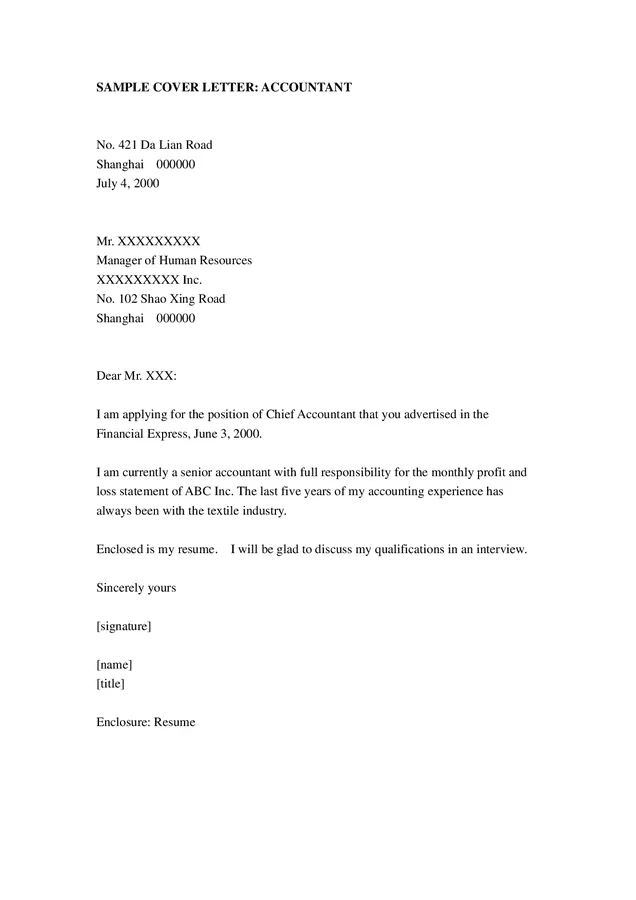
Why a Strong Accounting Cover Letter Matters
In the competitive world of accounting, a well-crafted cover letter is your initial opportunity to make a lasting impression on potential employers. It serves as your professional introduction, providing a glimpse into your skills, experience, and personality. A strong cover letter can significantly increase your chances of landing an interview, while a weak one may lead to your application being overlooked. It allows you to go beyond the information presented in your resume, offering context, showcasing your communication skills, and demonstrating your genuine interest in the position and the company. A compelling cover letter is not just a formality it’s a strategic tool that can set you apart from other candidates. Consider it your chance to highlight your unique value proposition and convince the hiring manager that you are the ideal fit for the role.
Highlighting Your Accounting Skills
Your cover letter should act as a showcase of your accounting skills. This is where you highlight both your technical and soft skills, tailored to the specific job requirements. Begin by identifying the key skills the employer is seeking in the job description. Then, provide concrete examples from your previous experiences that demonstrate your proficiency in those areas. Use action verbs to describe your accomplishments and quantify your achievements whenever possible. For example, instead of simply stating ‘managed accounts payable,’ you could write ‘Streamlined accounts payable processes, reducing processing time by 15% and improving vendor relationships.’ By clearly articulating your skills and providing evidence of your successes, you make a strong case for your ability to excel in the role.
Technical Skills for Cover Letters

Technical skills are the foundation of any successful accounting career, and they should be prominently displayed in your cover letter. These skills demonstrate your ability to perform the core functions of the job. Ensure you mention relevant software proficiency, such as QuickBooks, SAP, or Oracle. Showcase your understanding of accounting principles and regulations, including GAAP and IFRS. Moreover, highlight any experience with financial modeling, data analysis, and reporting. Tailor the technical skills mentioned to match those listed in the job description, emphasizing your competence in areas the employer values most. A strong emphasis on technical skills will prove that you have the practical expertise needed to succeed in the role.
Financial Reporting
Financial reporting is a cornerstone of accounting, so demonstrating your skills in this area is crucial. Mention your experience with preparing financial statements, such as balance sheets, income statements, and cash flow statements. Highlight your ability to ensure accuracy and compliance with relevant accounting standards. If you have experience with consolidations, variance analysis, or other specialized reporting tasks, be sure to include them. Explain any experience in preparing reports for management, investors, or regulatory bodies, and provide examples of how you have improved reporting processes or increased the quality of financial information. Your focus should be on your ability to create clear, accurate, and insightful financial reports.
Budgeting and Forecasting
Experience in budgeting and forecasting is highly valuable in accounting roles. Highlight your ability to develop and manage budgets, analyze variances, and make informed financial predictions. Detail your experience with forecasting revenue, expenses, and cash flow. If you have been involved in creating or maintaining financial models, be sure to describe your role and the outcomes achieved. Mention any experience with scenario planning or sensitivity analysis. Providing examples of how your budgeting and forecasting skills have helped to improve financial performance or reduce costs can be highly effective. Emphasize your ability to provide reliable financial projections and make data-driven recommendations.
Data Analysis

In today’s data-driven world, data analysis skills are increasingly important in accounting. Mention your experience with data mining, data visualization, and the use of analytical tools. If you have used tools like Excel, Tableau, or Power BI to analyze financial data, be sure to specify. Describe any experience with identifying trends, anomalies, or insights from financial data. Showcase your ability to translate complex data into actionable recommendations. Emphasize your skill in using data to improve financial decision-making, enhance efficiency, or reduce risks. Your ability to analyze and interpret financial data can set you apart.
Soft Skills to Showcase
While technical skills are crucial, soft skills are equally important for success in accounting. Soft skills demonstrate your interpersonal and communication abilities, as well as your work ethic and approach to problem-solving. These skills are critical for building relationships, collaborating with colleagues, and effectively communicating financial information. Highlight skills such as communication, teamwork, problem-solving, and attention to detail. Provide examples of how you have used these skills in previous roles. Soft skills complement your technical expertise and show that you are a well-rounded professional.
Communication and Teamwork
Effective communication and teamwork are essential in accounting. Highlight your ability to communicate complex financial information clearly and concisely, both verbally and in writing. Describe any experience presenting financial data to non-financial stakeholders. If you have worked in a team environment, emphasize your ability to collaborate effectively with colleagues, share information, and contribute to a positive team dynamic. Mention your ability to actively listen, provide constructive feedback, and resolve conflicts. Providing specific examples of successful team projects will demonstrate your ability to work well with others and foster a collaborative environment.
Problem-solving Abilities

Accounting roles often require strong problem-solving skills. Highlight your ability to analyze financial data, identify discrepancies, and propose solutions. Describe any experience with investigating financial issues, resolving errors, or improving processes. Mention your analytical and critical thinking skills. If you have resolved complex accounting problems or implemented new solutions to improve efficiency or accuracy, be sure to provide details. Showcase your ability to approach challenges strategically and your commitment to finding effective solutions. Highlighting your problem-solving abilities demonstrates your ability to handle challenges and contribute to the overall success of the organization.
Writing a Compelling Cover Letter
A compelling cover letter is well-structured, concise, and tailored to the specific job and company. It should capture the reader’s attention, highlight your relevant skills and experiences, and demonstrate your enthusiasm for the position. It should showcase your unique value proposition and explain why you are the best candidate for the job. Ensure your cover letter is free of errors and easy to read. Proofread carefully to avoid any typos or grammatical errors. A well-written cover letter reflects your professionalism and attention to detail, making a positive impression on the hiring manager. Invest time in crafting your letter, ensuring it stands out from the competition and increases your chances of an interview.
Structuring Your Cover Letter
The structure of your cover letter should follow a standard format, consisting of an introduction, body paragraphs, and a conclusion. The introduction grabs the reader’s attention and states your interest in the position. The body paragraphs highlight your relevant skills, experiences, and achievements. The conclusion reiterates your interest and includes a call to action. Each section should be concise and focused, conveying the most important information effectively. Using clear headings and paragraphs makes your cover letter easy to read and scan. Sticking to a well-organized structure ensures that your key qualifications are highlighted and the hiring manager can quickly grasp why you are a good fit.
Opening Paragraph Strategy

The opening paragraph of your cover letter is crucial because it’s the first impression. Start with a strong statement that grabs the reader’s attention. Mention the specific position you are applying for and where you saw the job posting. Briefly state why you are excited about the opportunity and what makes you a strong candidate. Avoid generic openings. Instead, tailor your introduction to the company and position, showing that you understand their needs and goals. Consider mentioning a key skill or accomplishment that immediately demonstrates your value. A compelling opening paragraph sets the tone for the rest of your cover letter and encourages the reader to continue. An engaging introduction greatly increases the likelihood that your cover letter will be read thoroughly.
Body Paragraph Essentials
The body paragraphs are the heart of your cover letter, where you showcase your skills, experience, and achievements. Use these paragraphs to provide detailed examples of how your qualifications align with the job requirements. Back up your claims with specific accomplishments and quantify your achievements whenever possible. Use the STAR method (Situation, Task, Action, Result) to describe your experiences. For each point, explain the situation, the task you were assigned, the actions you took, and the results you achieved. Focus on the most relevant skills and experiences, and tailor your examples to the specific job description. By providing compelling details and using the STAR method, you make your case convincingly.
Closing Your Cover Letter Effectively
The closing paragraph should reiterate your interest in the position and summarize why you are a good fit. Thank the hiring manager for their time and consideration. Express your enthusiasm for the opportunity and your desire to learn more about the role. Include a clear call to action, such as stating that you are available for an interview and eager to discuss your qualifications further. Make sure your contact information is readily available. Avoid generic closing statements. Instead, end with a strong, confident statement that reinforces your value and encourages the reader to contact you. A well-crafted closing leaves a lasting positive impression, increasing your chances of being contacted for an interview.
Tailoring Your Cover Letter for Each Job

Customizing your cover letter for each job is crucial to increase your chances of success. Generic cover letters are easily recognizable and often get discarded. Spend time tailoring your letter to match the specific requirements of each position and company. Review the job description carefully and identify the key skills and qualifications the employer is seeking. Modify your cover letter to emphasize the relevant skills and experiences. Use the same keywords and phrases as the job description to highlight your qualifications. Personalize your letter by referencing the company’s mission, values, or recent achievements. Showing that you understand the company’s needs and goals demonstrates your genuine interest and makes your application stand out.
Researching the Company and Job
Before writing your cover letter, research the company and the specific job you are applying for. Visit the company’s website to learn about their mission, values, and recent activities. Review the job description carefully to understand the required skills, responsibilities, and qualifications. Identify any specific projects or initiatives the company is working on. If possible, research the hiring manager or team you would be working with. This information will help you tailor your cover letter to the company’s needs and show that you have a genuine interest in the opportunity. Demonstrating your knowledge of the company and job demonstrates your attention to detail and initiative.
Customizing Your Content
After researching the company and job, customize your content to match the specific requirements. Use the keywords and phrases from the job description throughout your cover letter. Provide specific examples of how your skills and experiences align with the job responsibilities. Highlight any accomplishments that demonstrate your ability to meet the company’s needs. Personalize your letter by mentioning specific projects or initiatives you are interested in. Show that you understand the company’s goals and that you are excited about the opportunity to contribute. Tailoring your content demonstrates that you have a genuine interest in the role and that you are the right fit for the company.
Accounting Cover Letter Examples to Get Inspired

Reviewing accounting cover letter examples can provide inspiration and guidance. Search online for sample cover letters that are relevant to your experience and the specific job you are applying for. Pay attention to how the cover letters are structured, what skills and experiences are highlighted, and how the writers demonstrate their value. Analyze how the examples are tailored to the specific job and company. Use these examples as a starting point, but make sure to customize your cover letter to reflect your own unique qualifications and experiences. By studying successful examples, you can learn how to effectively present yourself and increase your chances of getting noticed.
Example Cover Letter 1
Here’s a sample cover letter demonstrating the structure and key elements discussed. (Note this is an example only and needs to be tailored to your own experience and the job). [Your Name] [Your Address] [Your Phone Number] [Your Email] [Date] [Hiring Manager Name] [Hiring Manager Title] [Company Name] [Company Address] Dear [Hiring Manager Name], I am writing to express my enthusiastic interest in the Accountant position at [Company Name], as advertised on [Platform]. With my [Number] years of experience in accounting and a proven track record of [Key Achievement], I am confident I possess the skills and dedication to excel in this role and contribute to your team. In my previous role at [Previous Company], I was responsible for [Specific Task 1] and [Specific Task 2], resulting in [Quantifiable Result 1] and [Quantifiable Result 2]. I am proficient in [Accounting Software] and possess a strong understanding of [Relevant Accounting Principles]. I am particularly drawn to [Company Name] because of [Company Value or Initiative]. I am eager to learn more about this opportunity and discuss how my skills and experience align with your needs. Thank you for your time and consideration. I look forward to hearing from you soon. Sincerely, [Your Name]
Example Cover Letter 2
Another sample for your reference (remember to personalize). [Your Name] [Your Address] [Your Phone Number] [Your Email] [Date] [Hiring Manager Name] [Hiring Manager Title] [Company Name] [Company Address] Dear [Hiring Manager Name], I am writing to express my interest in the Accounting Assistant position at [Company Name], as advertised on [Platform]. As a highly organized and detail-oriented professional with [Number] years of experience in accounting, I am excited about the opportunity to contribute to your team. In my previous role at [Previous Company], I excelled at [Task 1] and [Task 2], ensuring accuracy and efficiency. I am proficient in [Accounting Software] and possess a strong understanding of GAAP. I am particularly drawn to [Company Name] because of [Company Value or Initiative]. I am eager to contribute my skills to your team and learn more about the role. Thank you for your time and consideration. Sincerely, [Your Name]
Common Cover Letter Mistakes to Avoid

Avoiding common cover letter mistakes can significantly improve your chances of success. These errors can lead to your application being rejected. By knowing these pitfalls, you can ensure your cover letter is polished and professional. Some key mistakes include typos and grammatical errors, using generic cover letters, not tailoring your letter to the specific job, and failing to highlight relevant skills and experiences. Taking the time to avoid these errors can make your cover letter stand out and give you a competitive edge. Proofreading and careful attention to detail are crucial steps in creating a compelling cover letter.
Typos and Grammatical Errors
Typos and grammatical errors can damage your credibility and make a negative impression on the hiring manager. Even minor errors can suggest a lack of attention to detail or a lack of professionalism. Always proofread your cover letter carefully before submitting it. Use spell check and grammar check tools, but also read it aloud to catch any errors that automated tools might miss. Consider having a friend or colleague review your cover letter for a fresh perspective. Proofreading is a critical step in ensuring that your cover letter presents you in the best possible light.
Generic Cover Letters
Using a generic cover letter is a significant mistake. A generic cover letter is not tailored to the specific job or company, and it often lacks the personal touch needed to capture the reader’s attention. Hiring managers can quickly identify generic letters, and they often discard them without a second glance. Always customize your cover letter to the specific job requirements. Research the company and the role, and highlight the relevant skills and experiences that match the job description. Personalize your letter by referencing the company’s mission, values, or recent achievements. A customized cover letter demonstrates your genuine interest and makes you a much more attractive candidate.
Frequently Asked Questions
Here are some frequently asked questions about accounting cover letters: Q What should I include in my cover letter? A: Highlight your relevant skills, experience, and achievements, tailor your letter to the job description, and show your enthusiasm for the opportunity. Q How long should my cover letter be? A: Keep it concise, ideally one page. Q Should I mention my salary expectations? A: Unless the job posting asks for it, it’s generally best to avoid mentioning salary expectations in your cover letter. Q What if I don’t have much experience? A: Focus on your education, internships, relevant coursework, and any transferable skills. Emphasize your willingness to learn and your enthusiasm for the role.